The Pinnacle Works That Define an Art Form — From Squash Blossoms to Concha Belts
By The Humiovi Editorial Desk — Sedona, Arizona · est. 1972
·
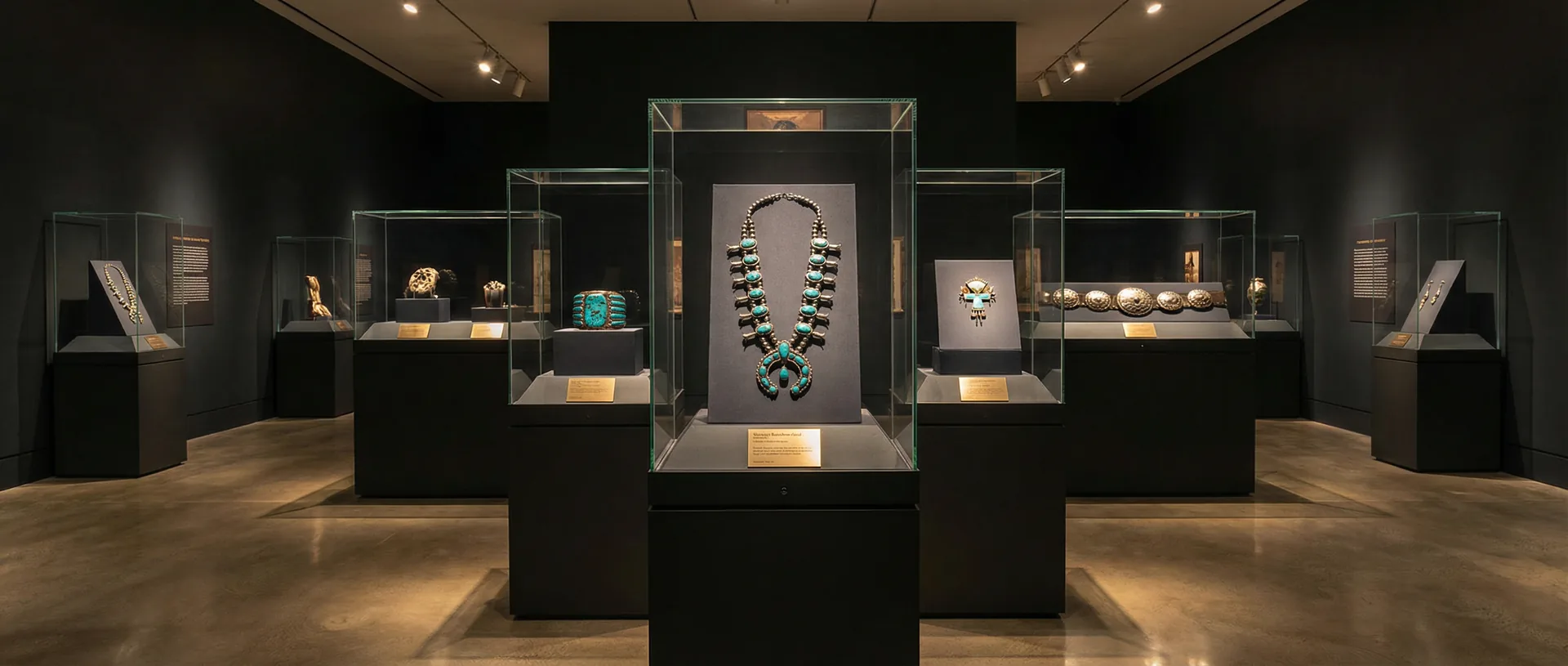
A piece becomes museum-worthy through technical mastery evident at every scale, exceptional material quality, coherent design integrity, and — for historical works — original unrestored condition. Provenance elevates it further, a documented history linking the piece to a significant artist, collector, exhibition, or cultural moment that pure aesthetics cannot provide.
In the world of Native American jewelry, the term museum quality is applied with both precision and reverence. Not every fine piece merits the designation — it is reserved for works that transcend skilled craftsmanship to achieve something genuinely extraordinary in their execution, materials, cultural significance, or historical importance.
Museum-quality pieces share several characteristics that separate them from merely excellent work. First, technical mastery must be evident at every scale — from the overall composition down to the smallest detail visible under magnification. The solder work is invisible. The stone settings are precise. The surface finishing reveals no shortcuts. These pieces represent the absolute pinnacle of their maker's skill.
Second, material quality must be exceptional. Museum-grade pieces feature the finest available turquoise, coral, or other stones — typically natural, untreated material from historically significant mines. The silver work uses heavy-gauge material, and the overall piece has a substantial presence that commands attention.
Third, design integrity sets museum pieces apart. Whether traditional or contemporary, the design must demonstrate coherent artistic vision. Every element relates to every other element in a composition that feels both inevitable and surprising. The best pieces seem to have always existed — as though the artist discovered rather than created them.
Fourth, condition matters enormously for historical pieces. A 19th-century concha belt in original, unrestored condition — with intact patina, original leather, and all components present — is exponentially more valuable than a comparable piece that has been over-polished, re-leathered, or had components replaced.
Finally, provenance elevates a museum-quality piece from remarkable to irreplaceable. A documented history linking the piece to a significant artist, collector, exhibition, or cultural moment adds layers of meaning that pure aesthetics cannot provide.
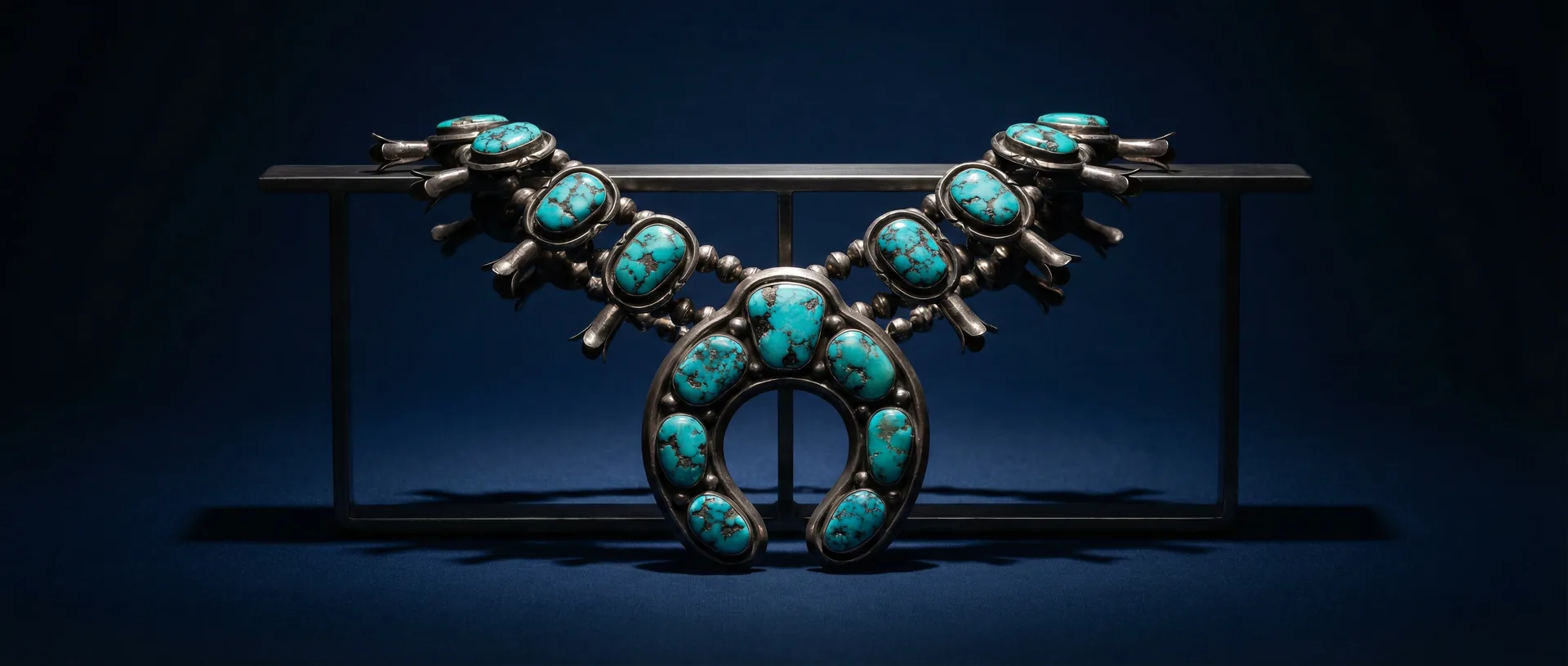
A squash blossom necklace reaches museum quality through the totality of execution: precisely formed identical blossom beads, a perfectly proportioned naja, flawlessly graduated bench beads, and substantial heavy-gauge silver that still drapes gracefully. The finest historical examples use coin silver and natural turquoise from now-closed mines, commanding extraordinary auction prices.
At the summit of the squash blossom necklace tradition stand pieces that exemplify everything the form can achieve. A museum-quality squash blossom necklace is not merely large or heavily stoned — it is a feat of engineering, artistry, and material selection that represents hundreds of hours of expert labor.
The finest historical examples date from the late 19th and early 20th centuries, when Navajo silversmiths were working with coin silver of exceptional purity and natural turquoise that is now unavailable at any price. A pre-1920 squash blossom featuring turquoise from mines that are now closed — Cerrillos, Blue Gem, early Morenci — carries both artistic and geological significance.
What distinguishes a museum-quality example from a merely fine one is the totality of execution. Each of the ten to twelve blossom beads is individually formed with absolute precision — identical in size, symmetry, and finish, yet showing the subtle irregularities that confirm hand fabrication. The naja pendant anchors the composition with perfect proportions, its crescent form balanced and graceful, its stone settings (if present) featuring perfectly matched cabochons. The bench beads between blossoms are flawlessly round and graduated in size from clasp to center.
The overall weight of a museum-quality squash blossom is typically substantial — eight to fourteen ounces — reflecting the heavy-gauge silver and generous stone sizes. Yet the piece must drape gracefully when worn, distributing its weight comfortably across the wearer's shoulders. This balance of mass and wearability is one of the most difficult achievements in the form.
At auction, documented pre-1940 squash blossom necklaces from identified artists have achieved prices from $25,000 to well over $100,000. The record for a squash blossom at auction exceeded $200,000 for a documented ceremonial piece with exceptional provenance.
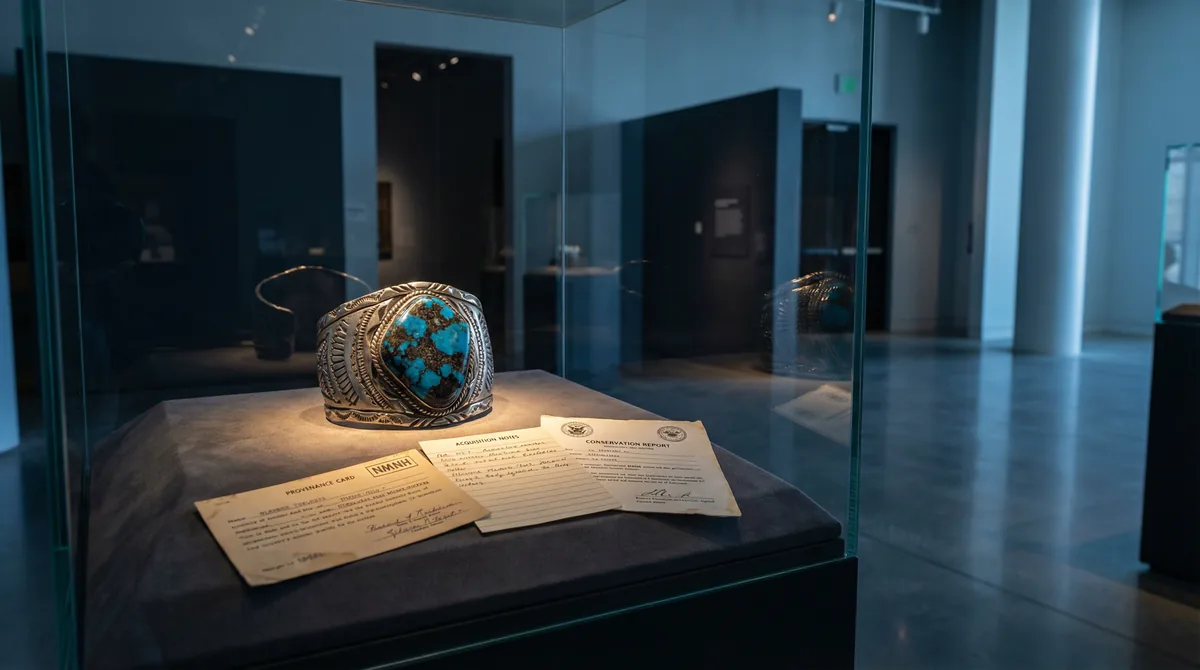
A Bisbee turquoise cuff becomes a masterpiece when exceptional Bisbee stone — prized for intense blue color and chocolate-brown matrix from a mine closed since 1975 — is paired with masterful silverwork that serves rather than competes with the stone. Heavy-gauge bands, impeccable bezels, and finite supply drive premium values.
Bisbee turquoise — characterized by its intense blue color and distinctive chocolate-brown matrix from the Lavender Pit copper mine in Bisbee, Arizona — is among the most prized of all American turquoise varieties. When exceptional Bisbee stones are paired with equally exceptional silverwork in a cuff bracelet, the result can be a museum-quality masterpiece.
The Bisbee mine ceased turquoise production in 1975, making all Bisbee material a finite resource. The highest grades — gem-quality natural Bisbee with strong blue color and well-defined spiderweb matrix — are exceptionally rare. A single museum-quality Bisbee cabochon suitable for a cuff centerpiece might represent a once-in-a-decade find for a collector.
Museum-quality Bisbee cuffs showcase the stone as the primary event. The silver setting, while technically masterful, serves the stone rather than competing with it. A heavy-gauge silver band — typically 20-gauge or heavier — provides the structural foundation. The bezel work must be impeccable, following every contour of the cabochon while maintaining consistent height and clean finishing. Surrounding stampwork or applied decoration, if present, complements the stone's character without overwhelming it.
The greatest Bisbee cuffs achieve a quality that transcends categorization — they are simultaneously jewelry, sculpture, and geological specimen. The stone's natural matrix patterns create a miniature landscape within the silver frame, and the artisan's skill in selecting and setting the stone ensures that this natural artwork is displayed to its absolute best advantage.
Market values for exceptional Bisbee cuffs reflect their rarity. Pieces featuring gem-grade Bisbee stones over 50 carats in weight, set by recognized artists, can command $10,000-$40,000 or more. No new Bisbee stone has been mined since 1975, so the supply is finite.
“A museum-quality piece transcends its materials — it is not merely silver and stone but a distillation of cultural memory, artistic genius, and geological time.”
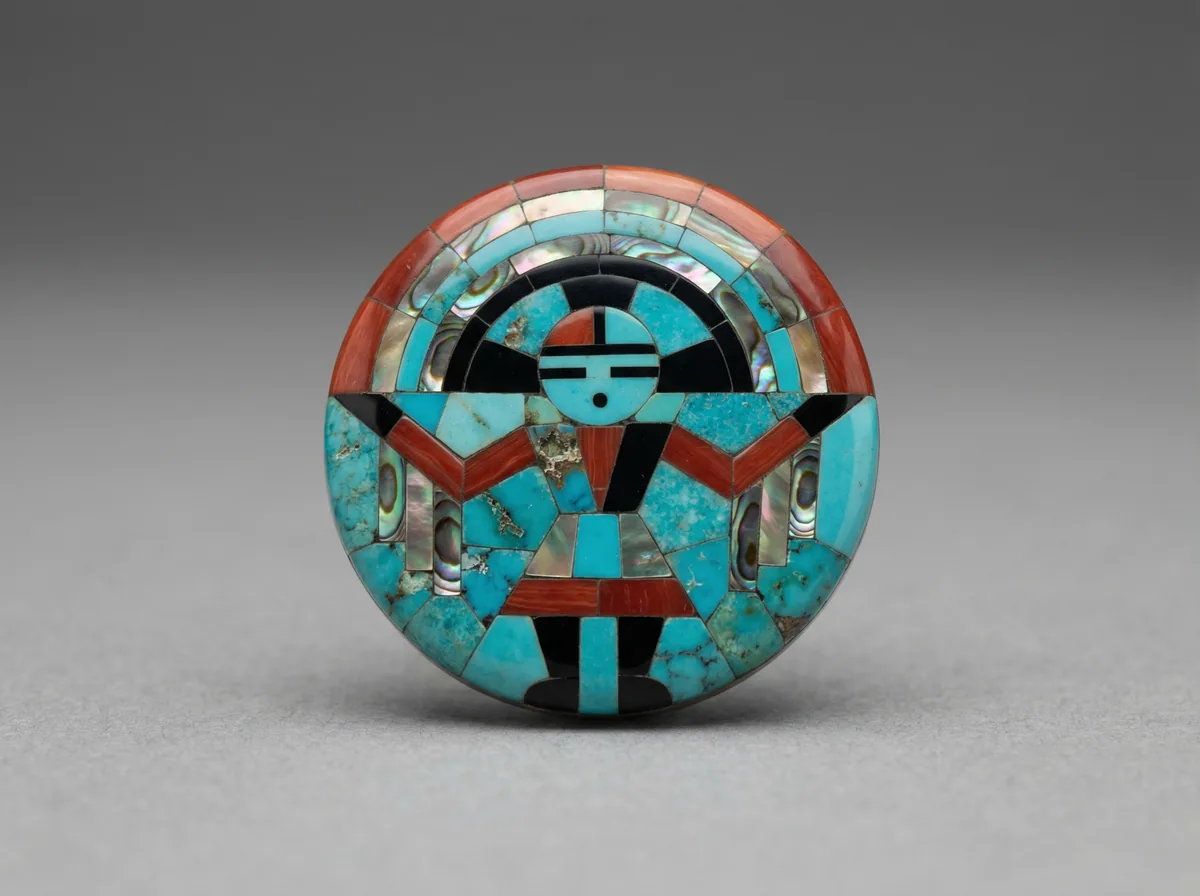
Zuni Rainbow God mosaic inlay is exceptional for its lapidary mastery: hundreds of individually cut stones — turquoise, coral, jet, and shell — fitted to fractions of a millimeter into a single figure. Related petit point and needlepoint set tiny stones in miniature bezels, demanding extraordinary patience and hand-eye coordination.
If Navajo jewelry represents the apex of silversmithing, Zuni jewelry represents the pinnacle of lapidary artistry. The Zuni tradition of intricate stone cutting and inlay work has produced some of the most technically demanding and visually stunning pieces in all of Native American jewelry.
The Rainbow God (or Knife Wing Dancer) figure is one of the most iconic Zuni jewelry subjects — a ceremonial figure depicted in elaborate multi-stone mosaic inlay. Museum-quality examples of this form feature hundreds of individually cut and fitted stone pieces — turquoise, coral, jet, and shell — arranged in precise geometric patterns that create the figure's regalia. Each stone is cut to fit its specific position in the design, with tolerances measured in fractions of a millimeter.
The technical difficulty of this work is staggering. A single Rainbow God pin or pendant may contain 200-400 individual stone pieces, each cut, fitted, and set by hand. The stones must be of consistent thickness so the surface lies perfectly flat. The channels between stones must be uniform in width. The overall design must maintain its compositional integrity at every scale — from the full figure visible at arm's length to the individual stone joints visible under magnification.
Zuni channel inlay — where stone pieces are set into silver channels — and mosaic inlay — where stones are fitted directly against each other without silver borders — represent two distinct technical approaches, each with its own challenges. The finest examples of both techniques achieve a surface so smooth and seamless that the boundary between silver and stone, or between adjacent stones, is barely perceptible to the touch.
Petit point and needlepoint are related Zuni specialties where tiny turquoise or coral stones are individually set in miniature bezels. Museum-quality petit point pieces may contain 100-200 tiny stones, each no larger than a grain of rice, arranged in precise geometric patterns. The patience and hand-eye coordination required for this work are extraordinary.
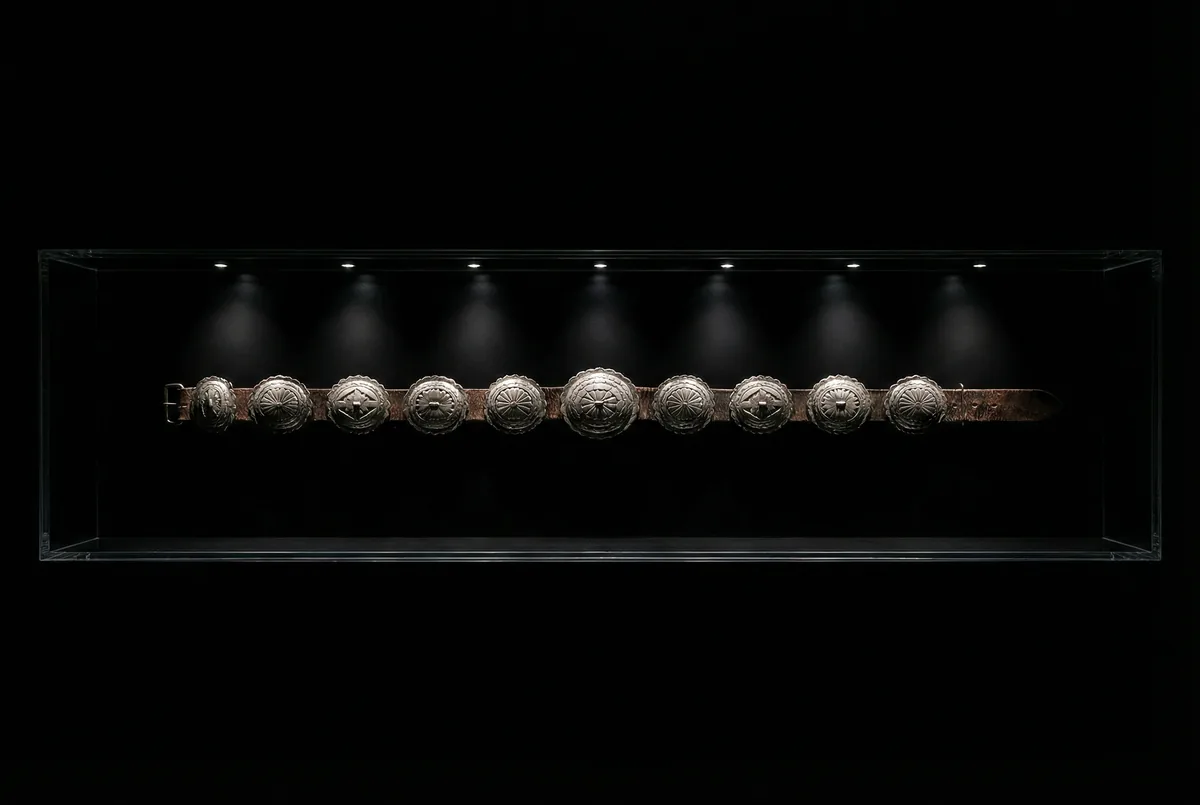
A museum-quality concha belt is defined by uniformity across many components: eight to twelve matched conchas plus a buckle, often 20-30 ounces of silver, with stamping consistent in depth, spacing, and alignment. Phase designations, butterfly spacers, and documented historical provenance distinguish the finest examples of this enduring form.
The concha belt — a series of silver discs (conchas) mounted on a leather strap — is one of the oldest and most prestigious forms in Native American jewelry. A museum-quality concha belt is a substantial undertaking, both in the amount of silver required and the uniformity of execution across multiple individual components.
The form originated in the 1860s-1870s, adapted from Plains Indian hair plate ornaments and Spanish-Mexican belt designs. Early Navajo concha belts feature round or oval conchas with simple stamped decoration, often made from coin silver. The conchas are typically connected by a leather strap that runs through slots cut in each disc, allowing the belt to flex and conform to the wearer's body.
Museum-quality concha belts distinguish themselves through several criteria. Size and weight are factors — a substantial belt may contain eight to twelve conchas plus a buckle, totaling 20-30 ounces of silver or more. But more important than sheer mass is the consistency and quality of execution across all components. Each concha must match its neighbors in diameter, gauge, decorative stamping, and finish. The stamped patterns — whether geometric, floral, or abstract — must maintain consistent depth, spacing, and alignment from the first concha to the last.
First Phase conchas (pre-1880) are round or oval without a central stone setting, featuring incised or stamped decoration. Second Phase conchas (1880s-early 1900s) introduced scalloped edges and more elaborate stamping. Third Phase and later conchas may incorporate turquoise or coral settings, silver wire borders, and increasingly sophisticated decorative techniques.
The butterflies — smaller, butterfly-shaped silver spacer elements placed between conchas — are a distinguishing feature of many belts. On museum-quality pieces, these elements are as carefully executed as the conchas themselves, with stamping and finishing that maintains the aesthetic standard of the larger components.
Historical concha belts with documented provenance — particularly those traced to specific Navajo leaders, ceremonies, or historic trading post transactions — represent the pinnacle of the form. At major auction houses, documented 19th-century Navajo concha belts have sold for $30,000-$75,000, with exceptional examples exceeding $100,000.
The concha belt remains a vital contemporary form. Today's silversmiths continue to create museum-worthy examples, sometimes incorporating modern design sensibilities while maintaining the technical standards that define the form. Contemporary masterwork concha belts by recognized artists can command $8,000-$20,000 or more, reflecting both the enormous labor investment and the prestige of the form.
Provenance commands premium pricing because documented history reduces risk and increases certainty for a buyer. Powerful factors include direct artist acquisition, exhibition and publication history, collection pedigree, trading post documentation, and museum deaccession — each verifying a piece's story in a field where authenticity affects value.
In the museum-quality tier of Native American jewelry, provenance is one of the factors collectors and appraisers weigh most heavily.
The most powerful provenance factors include: direct acquisition from the artist (with dated receipt and, ideally, a photograph of the artist with the piece); exhibition history (inclusion in museum exhibitions, with catalog references); publication history (photographs in books, articles, or catalogs); collection pedigree (previous ownership by recognized collectors, institutions, or cultural figures); and historical significance (connection to important events, ceremonies, or cultural moments).
Trading post provenance is particularly valued for historical pieces. Documentation linking a piece to a specific trading post — Hubbell's, C.G. Wallace, the Fred Harvey Company — provides both authentication and historical context. Trading post tags, ledger entries, and inventory records are primary provenance documents that significantly enhance value.
Museum deaccession provenance — pieces formerly in museum collections — carries institutional authority. When a museum deaccessions a piece (removes it from the permanent collection, usually to fund new acquisitions), the piece carries the museum's authentication and provenance research. Pieces with museum deaccession history are among the most securely attributed objects in the market.
For contemporary work, studio visit documentation, commission correspondence, exhibition history, and artist portfolio inclusion all contribute to provenance. Artists who maintain records of their significant commissions create provenance that adds to a piece's documented history over time.
The provenance premium is not merely sentimental — it reflects the reduced risk and enhanced certainty that documented history provides. In a field where attribution and authenticity questions can dramatically affect value, strong provenance offers a kind of insurance. The documented piece is not just an art object; it is an art object whose story can be verified and shared.
Collectors building museum-quality holdings should document everything from the moment of acquisition. Photograph the piece upon receiving it, retain all dealer correspondence and certificates, and create a provenance file that grows with the piece over time. The provenance you create today becomes the historical record that future generations will rely upon.