Mediterranean Coral, Spiny Oyster, and Mother of Pearl in Native American Jewelry
By The Humiovi Editorial Desk — Sedona, Arizona · est. 1972
·
Mediterranean coral (Corallium rubrum), harvested at depths of 30 to 300 meters around Sardinia, Corsica, and the Adriatic, reached Native American jewelry through Spanish colonial trade networks in the sixteenth and seventeenth centuries. The Navajo, who call it tse'ii, associated its deep red with the south and life force, complementing turquoise's sky-blue.
The genus Corallium — specifically Corallium rubrum, the precious red coral of the Mediterranean — has been harvested for ornamentation since antiquity. Roman, Greek, and North African civilizations prized the material for amulets and jewelry long before it reached the American Southwest. The coral grows as a branching colony on rocky substrates at depths typically between 30 and 300 meters, with the densest populations found in the waters surrounding Sardinia, Corsica, the coast of Tunisia, and the Adriatic Sea near Croatia and Montenegro.
Coral's journey to Native American jewelry began with Spanish colonial trade networks in the sixteenth and seventeenth centuries. Spanish traders, who had long-established Mediterranean coral commerce, introduced the material to indigenous communities in present-day New Mexico and Arizona. The Navajo word for coral, tse'ii, reflects its early adoption into the indigenous material vocabulary. Coral's deep red color held immediate cultural resonance — in Navajo cosmology, red is associated with the south and with life force, making coral a natural complement to turquoise's association with the sky and protection.
By the nineteenth century, coral had become one of the foundational materials of Southwestern jewelry alongside turquoise, shell, and silver. Navajo artisans incorporated Mediterranean coral into squash blossom necklaces, cluster bracelets, and ceremonial pieces. Zuni lapidaries developed intricate inlay and channel work designs that juxtaposed coral's warm red against turquoise's cool blue — a color combination that has become one of the most recognizable visual signatures in Native American art.
The grading of Mediterranean coral follows established gemological criteria. Color is paramount: the most valued shade is a deep, saturated red known as 'oxblood' or 'sardegna' (after Sardinia), followed by medium red, salmon pink (known as 'angel skin' for the palest varieties), and white. Surface quality matters — the best coral is free of pitting, worm holes, and calcite inclusions. Density affects both appearance and durability, with denser material taking a higher polish and exhibiting richer color. Carat weight follows gemstone conventions, with larger cabochons commanding exponentially higher per-carat prices due to the difficulty of obtaining large, unblemished sections from coral branches that rarely exceed two centimeters in diameter.
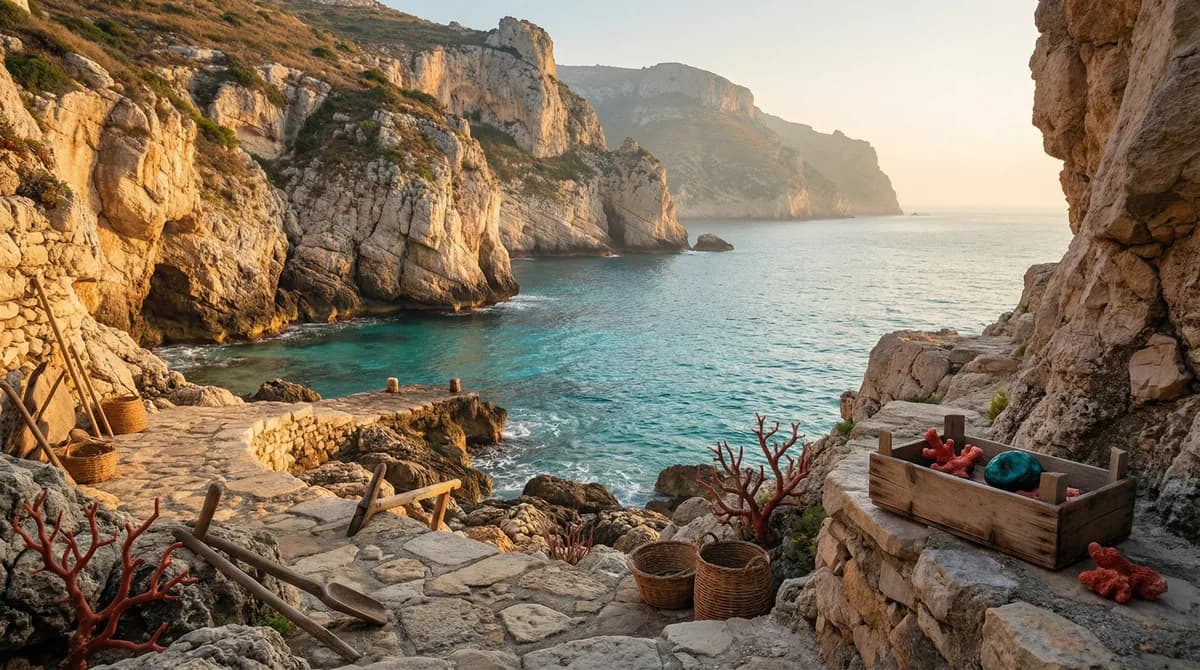
The coral trade now operates under significant conservation constraints: Corallium rubrum populations have declined from overharvesting and warming seas, and although not yet CITES Appendix II-listed, source nations like Italy, France, Spain, and Croatia impose quotas and closures. Annual Mediterranean harvest has fallen to an estimated 30-50 metric tons, pushing oxblood-grade prices to $50-200 per gram.
The contemporary coral market operates under significant regulatory constraints driven by conservation concerns. Corallium rubrum populations have declined substantially throughout the Mediterranean due to overharvesting, rising water temperatures, and ocean acidification. The species has been the subject of repeated proposals for listing under CITES (the Convention on International Trade in Endangered Species), and while it has not yet received Appendix II listing, several Mediterranean nations have implemented domestic harvest restrictions that significantly limit commercial availability.
Italy, France, Spain, and Croatia — the primary source nations — have imposed depth minimums, seasonal closures, licensing requirements, and catch quotas that have reduced the annual Mediterranean coral harvest from historical levels of several hundred metric tons to current levels estimated at 30-50 metric tons annually. The Sardinian harvest, historically the most commercially significant, is now regulated under a permit system that limits individual diver quotas and mandates minimum branch size for harvest.
These restrictions have direct implications for the jewelry market. Wholesale prices for gem-quality Mediterranean coral have increased steadily, with oxblood-grade material now commanding $50-200 per gram depending on size and quality. The supply constraint has also driven increased use of coral from other sources — particularly Corallium japonicum from Japanese and Taiwanese waters, which produces material in a deeper, darker red that the trade calls 'Moro' coral, and Corallium secundum from Hawaiian waters, which yields a distinctive deep pink variety.
For Native American jewelers and collectors, the coral supply situation necessitates careful attention to provenance and legality. Vintage coral — material harvested and traded before current restrictions — remains legal to buy and sell within the United States, and much of the coral in contemporary Native American jewelry derives from pre-restriction inventory. New coral entering the market must comply with applicable CITES regulations and national export laws. Buyers should request documentation of legal sourcing for significant coral purchases and be aware that imported coral may require permits depending on the species and country of origin.
The ethical dimensions of coral use extend beyond legality. Some contemporary Native American jewelers have reduced their coral usage in response to conservation concerns, while others argue that the cultural significance of coral in indigenous traditions justifies continued use within legal frameworks. This tension between cultural heritage and environmental stewardship reflects broader conversations within indigenous communities about the relationship between traditional practices and contemporary ecological realities.
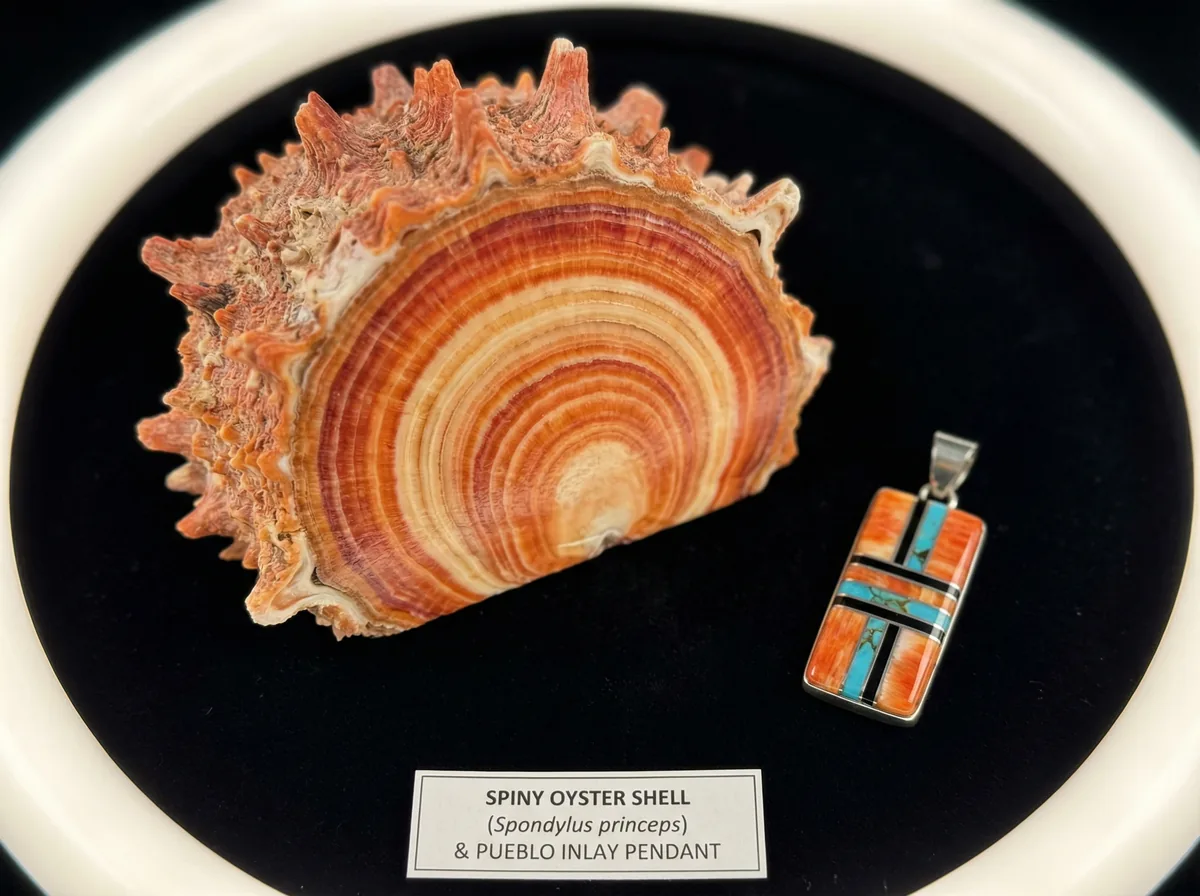
Spiny oyster shell (Spondylus princeps), a bivalve from the Pacific coast and Sea of Cortez found at depths of 15 to 50 meters, has been a prestigious Southwestern trade material for over a thousand years — traded inland since at least 900 CE and found at Chaco Canyon and Mesa Verde. Its colors range from deep red-orange to purple.
Spondylus princeps — the thorny or spiny oyster — has been one of the most culturally significant trade materials in the Americas for over a thousand years. The bivalve mollusk inhabits rocky substrates along the Pacific coast from Baja California through the Sea of Cortez (Gulf of California) and southward to Peru, attaching itself to rocks and coral at depths of 15 to 50 meters. Its shell, which ranges in color from deep red-orange through golden orange, purple, and occasionally pure red, has been traded along indigenous trade networks connecting the Pacific coast to the interior Southwest since at least 900 CE.
Archaeological evidence from sites including Chaco Canyon, Pueblo Bonito, and Mesa Verde demonstrates that spiny oyster shell was among the most prestigious trade goods in pre-contact Southwestern societies. Shell objects traveled hundreds of miles from their coastal origin to inland ceremonial centers, and the presence of spiny oyster artifacts at a site is typically interpreted as evidence of elite status and long-distance trade connections. The material's association with water, fertility, and the ocean gave it spiritual significance for desert-dwelling peoples whose relationship with water was central to survival and cosmology.
In contemporary Native American jewelry, spiny oyster shell is used extensively by Navajo, Zuni, and Santo Domingo (Kewa) Pueblo artisans. The shell's natural color range — from fiery orange to deep purple — provides warm tones that complement turquoise and coral in multi-stone designs. Zuni inlay artists use spiny oyster to create color contrasts in mosaic and channel work, while Navajo silversmiths set large spiny oyster cabochons in silver bezels for pendants, rings, and bracelets.
Color grading of spiny oyster follows market conventions that prize saturated, uniform colors. The most valued color is a deep red-orange that the trade sometimes calls 'red spiny,' followed by bright orange, golden orange, and purple. Purple spiny oyster, while less common in the historical record, has gained significant market traction in recent decades as both jewelers and collectors have developed appreciation for its unique hue. The finest spiny oyster shell takes a glass-like polish and displays a subtle chatoyancy — a shimmering effect caused by the shell's layered microstructure — that distinguishes it from dyed or synthetic imitations.
Authentication of spiny oyster shell involves examining the material's layered structure under magnification. Genuine shell shows visible growth layers and a fibrous microstructure, while dyed bone or synthetic substitutes display homogeneous internal structure. The material's specific gravity (approximately 2.6-2.8) and cool thermal conductivity further distinguish it from plastic imitations.
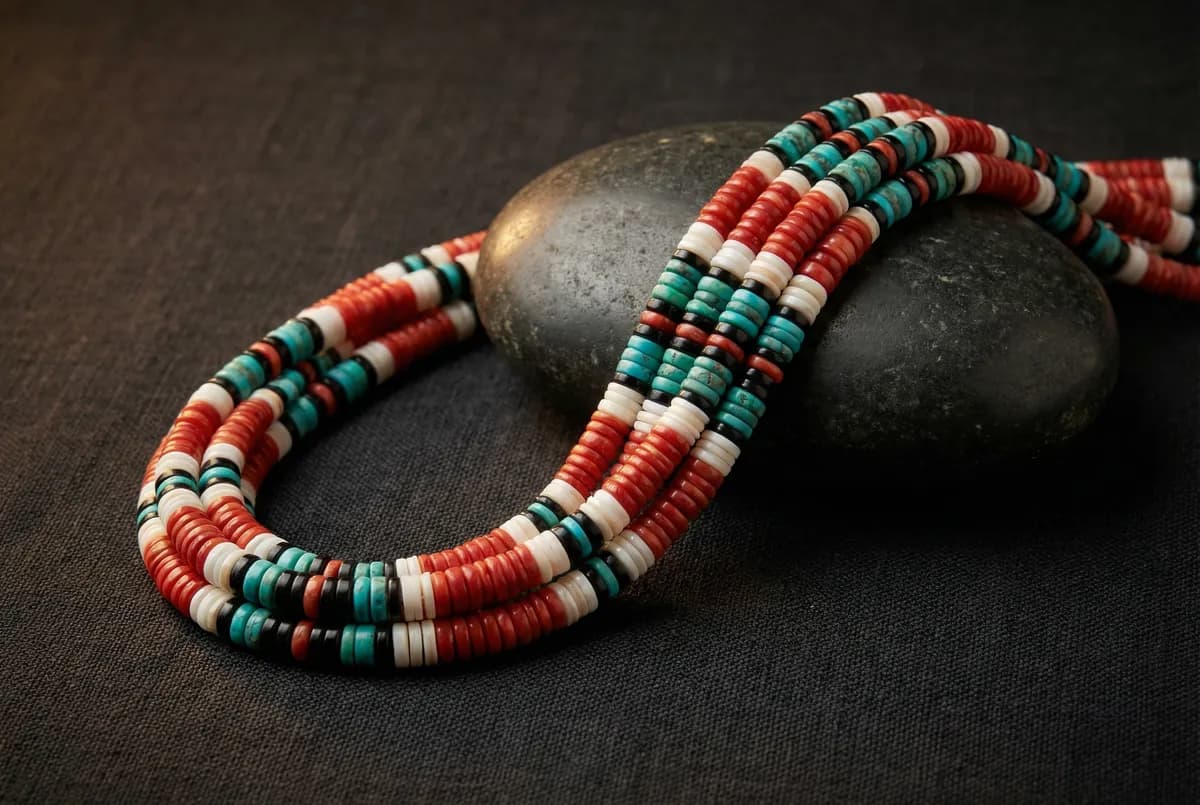
“Every piece of coral and shell set in silver carries the memory of the ocean — a liquid ancestry that connects desert jewelers to waters they may never see but whose gifts they transform into lasting art.”
Beyond coral and spiny oyster, Native American jewelry draws on several marine shells: iridescent mother of pearl from pearl oysters and mussels, dramatically colorful abalone (Haliotis), olive shell (Olivella biplicata) used for beads, and dark pen shell as a contrast element. All are organic calcium carbonate, sensitive to acids, heat, and prolonged dryness.
Beyond coral and spiny oyster, several additional marine shell materials figure prominently in Native American jewelry traditions. Mother of pearl — the iridescent nacre lining of various mollusk species, particularly the pearl oyster (Pinctada) and freshwater mussels — has been used in indigenous ornamentation across North America for millennia. The material's characteristic iridescence, caused by thin-film interference in the layered aragonite crystal structure, produces a shimmering play of color that shifts with viewing angle.
Abalone shell (Haliotis species), harvested along the Pacific coast from Alaska to Baja California, provides some of the most dramatically iridescent nacre used in jewelry. The green, blue, and purple play of color in polished abalone has made it a favored material for inlay work, particularly among Pacific Northwest and California indigenous artists, though it appears in Southwestern jewelry as well. Red abalone (Haliotis rufescens) produces the largest shells and the most consistent nacre quality for lapidary use.
Olive shell (Olivella biplicata), a small marine snail found along the Pacific coast, has served as a bead material for thousands of years. Archaeological sites throughout the Southwest yield olivella shell beads in enormous quantities, testifying to the scale of pre-contact trade networks that moved these tiny shells hundreds of miles inland. Contemporary Santo Domingo (Kewa) Pueblo artists continue this ancient tradition, incorporating olivella shell beads into heishi necklaces and mosaic work.
Pen shell (Pinna nobilis and related species) provides a dark brown to black material that Native American lapidaries use as a contrast element in multi-material inlay designs. Its deep, warm color serves a similar visual function to jet (fossilized wood) in color-blocked compositions, providing the dark anchor against which turquoise, coral, and shell create their chromatic effects.
Care requirements for shell materials differ from those for mineral gemstones. All shell is organic in composition — calcium carbonate in crystalline form — and is sensitive to acids, heat, and prolonged dryness. Coral and shell jewelry should be stored away from direct sunlight, cleaned only with a soft damp cloth (never ultrasonic cleaners or chemical solutions), and worn regularly, as the natural oils from skin contact help maintain the material's luster and prevent drying. Exposure to perfume, hairspray, and household cleaners should be avoided, as the acids and solvents in these products can damage the calcium carbonate surface.
Ocean materials carry deep cultural meaning, representing a cosmological link between the arid Southwest and the generative power of the sea. In Navajo tradition, four sacred materials — turquoise, white shell, abalone, and jet — correspond to the cardinal directions, with white shell marking the east and abalone the west. Kewa Pueblo has worked shell heishi for over a thousand years.
The ocean-sourced materials used in Native American jewelry carry cultural significance that extends far beyond their aesthetic properties. For desert-dwelling peoples of the American Southwest, marine materials represented a tangible connection to distant waters — a cosmological link between the arid homeland and the generative power of the sea. This association with water and fertility gave coral, shell, and pearl a spiritual dimension that persists in contemporary practice.
In Navajo ceremonial tradition, the four sacred materials — turquoise, white shell, abalone, and jet — correspond to the four cardinal directions and the four sacred mountains that define Dine Bikeyah (Navajoland). White shell represents the east and the dawn, while abalone represents the west and the evening. These directional associations inform the placement and combination of materials in traditional jewelry, creating pieces that function as miniature cosmological maps worn on the body.
Zuni Pueblo traditions assign particular significance to specific shells. The Zuni concept of 'daylight' — the iridescent shimmer of mother of pearl and abalone — links these materials to the rain-bringing powers of the six directions. Zuni fetish carvings, many of which are fashioned from shell materials, embody animal spirits whose powers are activated through the material's inherent spiritual properties.
Santo Domingo (Kewa) Pueblo has maintained the most continuous shell-working tradition of any Southwestern community. Kewa artisans have produced heishi — hand-ground shell disc beads — for over a thousand years, and the village remains the primary source of traditional heishi necklaces in the contemporary market. The process of grinding, drilling, and polishing shell beads is labor-intensive and time-honored, with the finest strands requiring weeks of work to produce. A museum-quality Kewa heishi necklace, with perfectly uniform beads ground to sub-millimeter tolerances, represents a form of material mastery that has few parallels in world jewelry traditions.
Contemporary Native American jewelers continue to innovate with ocean-sourced materials while honoring traditional practices. Mixed-media compositions that combine coral, spiny oyster, mother of pearl, and turquoise in a single piece create chromatic complexity that celebrates the full range of materials available to the Southwestern jewelry tradition. These works demonstrate that the dialogue between desert and ocean — between turquoise sky and coral sea — remains one of the most fertile creative territories in Native American art.
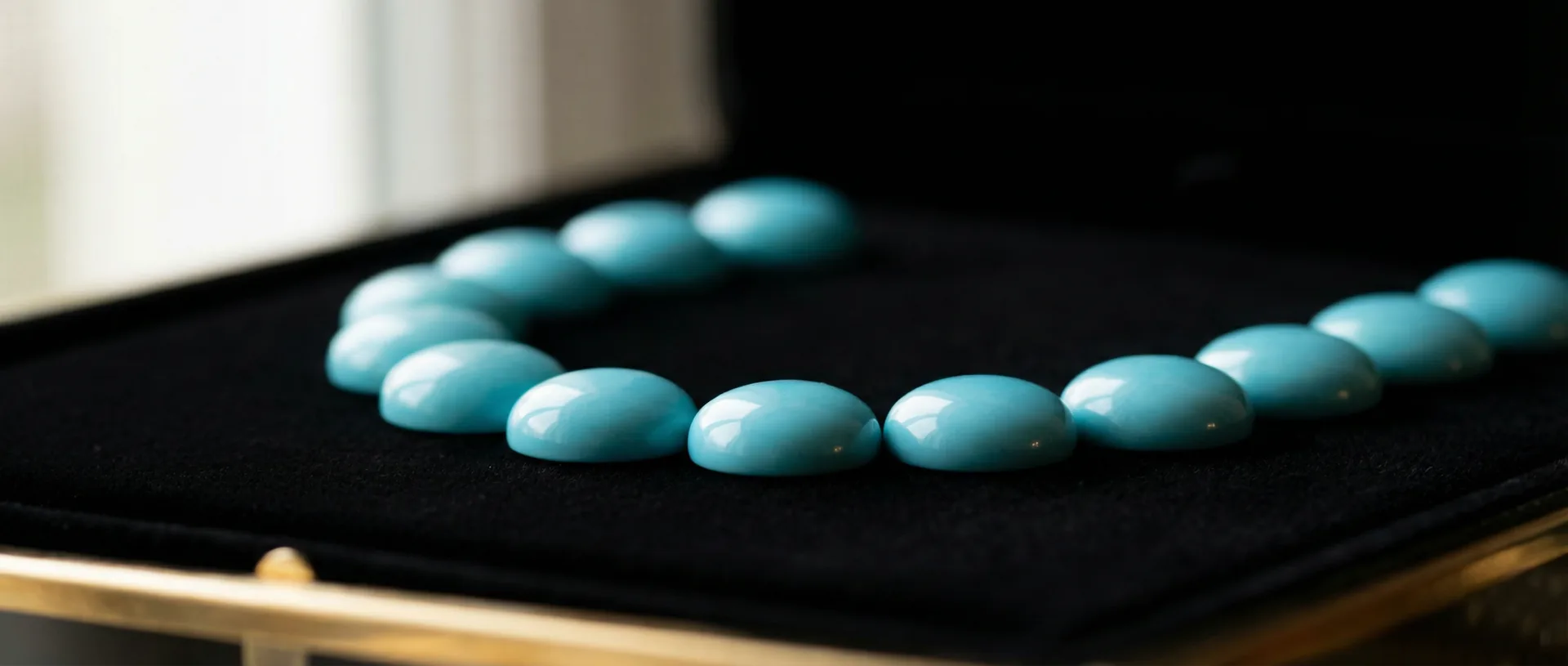
Globe, Arizona's Finite Treasure and the Stone That Redefined American Turquoise
From its discovery in the copper-rich hills near Globe, Arizona in the 1920s to the mine's permanent closure in 2012, Sleeping Beauty turquoise has undergone a transformation from abundant commercial stone to one of the most coveted minerals in the gemological world, with no new material produced since the final extraction.
Read Article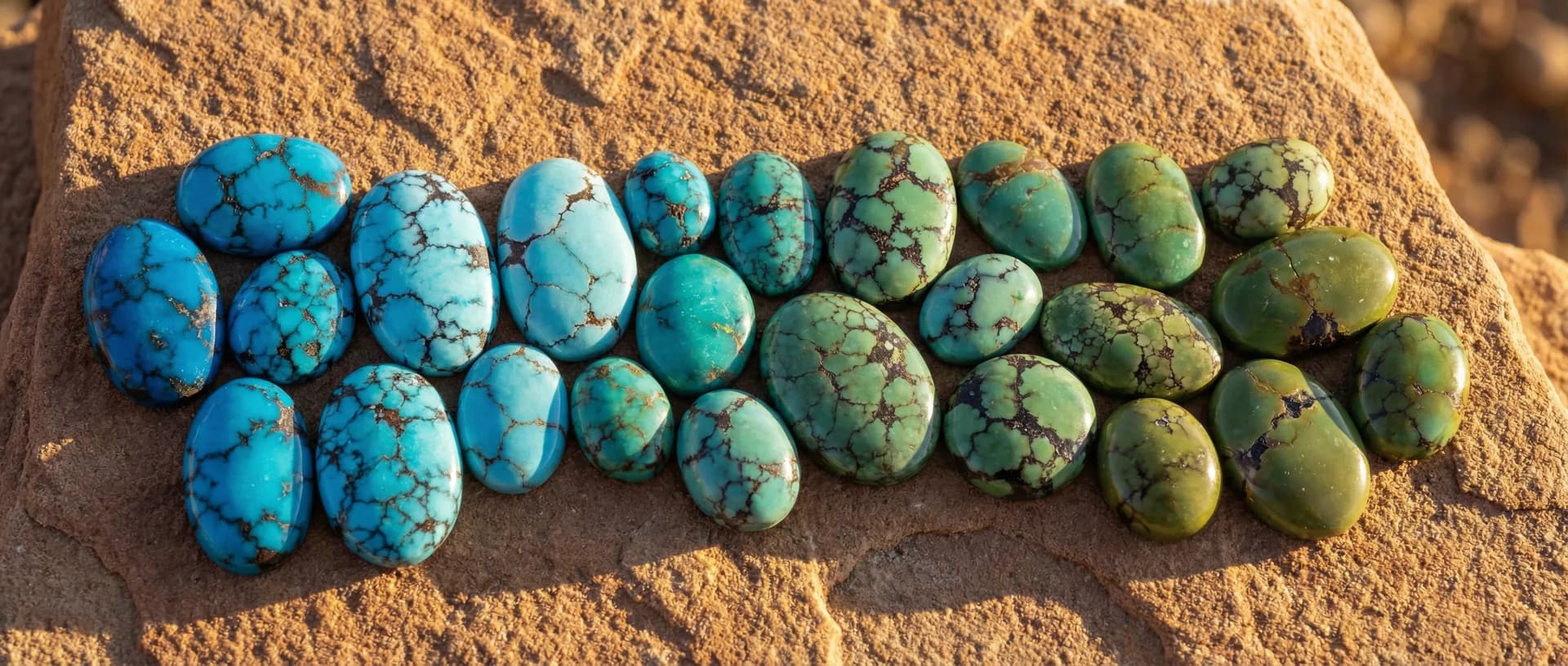
America's Oldest Continuously Mined Turquoise Deposit
The Kingman mine in Mohave County, Arizona has operated continuously since the late nineteenth century, producing turquoise in a remarkable color range from sky blue to deep blue-green, with its spider-web matrix specimens ranking among the most valued turquoise in the world.
Read Article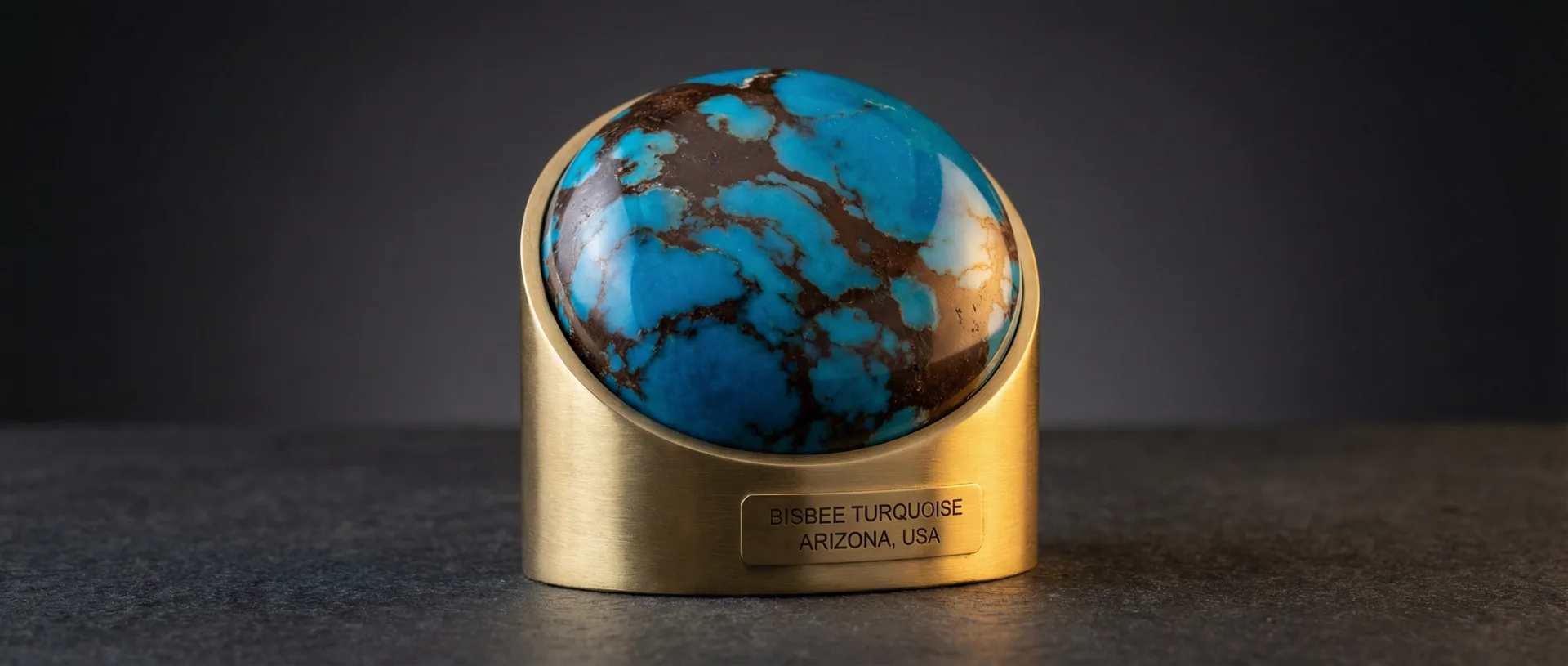
The Lavender Pit's Vanished Treasure
Since the Lavender Pit copper mine in Bisbee, Arizona ceased operations in 1975, not a single new carat of Bisbee turquoise has entered the market. Distinguished by its signature chocolate brown matrix against vivid blue, Bisbee commands prices of $50 to over $200 per carat and stands as one of the most collectible American turquoise varieties ever produced.
Read Article