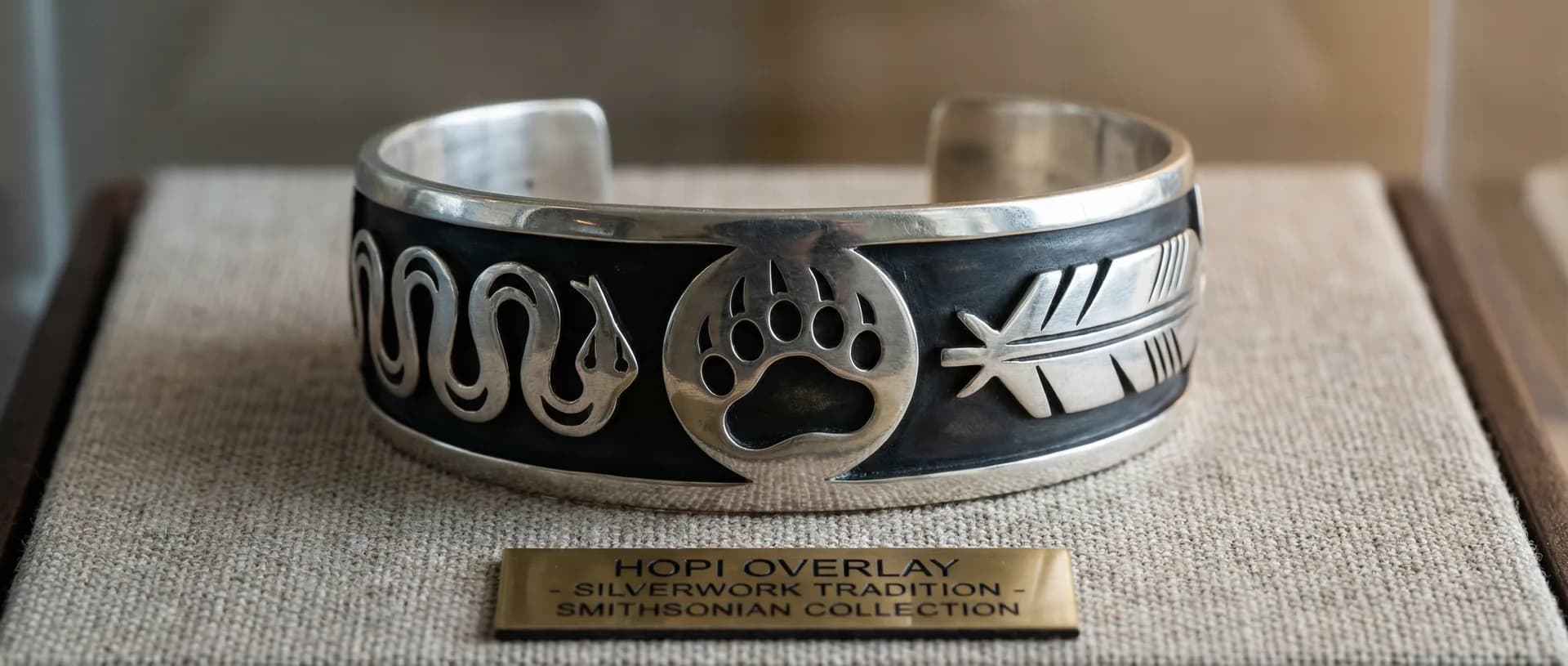
Two Silver Sheets, One Artistic Vision: The Signature Technique of the Hopi Mesas
By The Humiovi Editorial Desk — Sedona, Arizona · est. 1972
·
Hopi overlay was consciously developed in the late 1940s through the Hopi Silvercraft Cooperative Guild, founded with support from the Museum of Northern Arizona and its director Harold Colton. The Guild aimed to create a distinctly Hopi jewelry identity drawing on pottery motifs, textile patterns, and clan symbols.
The Hopi overlay technique occupies a unique position in the history of Native American jewelry: it was consciously developed as a culturally specific art form, designed to distinguish Hopi jewelry from the Navajo and Zuni traditions that dominated the Southwestern jewelry market by the mid-twentieth century. While Hopi artisans had practiced silversmithing since learning the craft from Zuni and Navajo teachers in the late nineteenth century, early Hopi silver was largely indistinguishable from Navajo work in technique and design. The creation of a recognizably Hopi jewelry aesthetic was the result of deliberate cultural initiative.
The pivotal institution was the Hopi Silvercraft Cooperative Guild, established in the late 1940s with support from the Museum of Northern Arizona in Flagstaff and its director, Harold Colton. The Guild's founding mission was explicitly cultural: to develop a jewelry technique that drew upon distinctly Hopi design sources — pottery motifs, textile patterns, clan symbols, and ceremonial imagery — rather than the pan-Southwestern vocabulary that characterized existing Native American jewelry. The overlay technique was selected as the Guild's signature method because it accommodated the bold, graphic design elements of Hopi visual art more effectively than conventional stamp work or stone setting.
Virgil Hubert, a non-Hopi silversmith and teacher at the Museum of Northern Arizona, is credited with introducing the overlay technique to Hopi artisans in the Guild's formative years. Several Hopi veterans returning from World War II military service participated in early Guild training programs. The combination of traditional Hopi design knowledge with newly acquired technical skills produced a body of work that was immediately recognizable as Hopi and that established the aesthetic parameters within which Hopi overlay continues to operate.
The Guild's success in establishing overlay as a distinctly Hopi technique represents one of the most effective examples of cultural branding in American art history. Within a decade of the Guild's founding, 'Hopi overlay' had become a recognized category in the Native American jewelry market, with collectors and dealers distinguishing it clearly from Navajo and Zuni work. This categorical identity persists today, supporting a market segment that values the technique's cultural specificity and the design sophistication it enables.
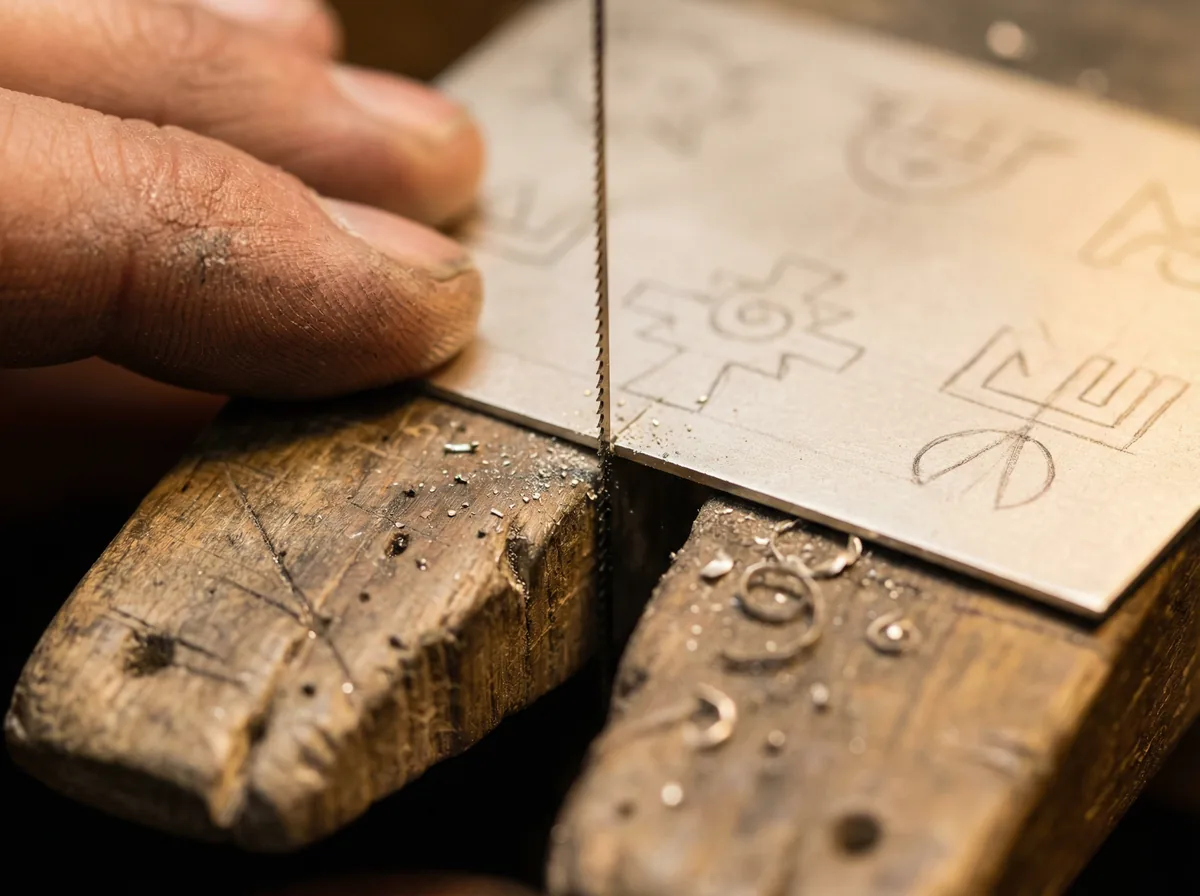
Hopi overlay is made from two identically sized sterling silver sheets. The design is sawed out of the top sheet, while the lower sheet is textured and oxidized dark with liver of sulfur. The two are soldered together, so bright cut designs float against a dark, textured background.
The Hopi overlay technique is deceptively simple in concept and extraordinarily demanding in execution. The process begins with two identically sized sheets of sterling silver, typically 18 to 22 gauge (approximately 0.8 to 1.0 millimeters thick). The design is drawn or transferred onto the top sheet, and the silversmith uses a jeweler's saw to cut out the design elements, removing the silver from the areas that will reveal the lower sheet. This saw work requires steady hands and precise blade control — the saw blade follows curves, angles, and intricate shapes that may include tiny interior details requiring the blade to be threaded through drilled pilot holes.
Once the top sheet has been cut and the design elements are defined as positive shapes surrounded by open negative space, the lower sheet is prepared. The surface of the lower sheet is textured — typically with a crosshatch pattern created by running the sheet through a rolling mill with a textured plate, or by applying hand-stamped texture with fine-line tools. This texturing serves both aesthetic and functional purposes: it creates visual contrast between the smooth top sheet and the textured background, and it provides a roughened surface that improves solder adhesion during assembly.
The lower sheet is then oxidized using liver of sulfur (potassium polysulfide) or a similar chemical agent. The oxidation darkens the silver to a deep charcoal gray or black, creating the dark background against which the bright top-sheet design will read. The depth of oxidation is controlled carefully — too light, and the contrast is insufficient; too dark, and the background appears flat and lifeless rather than richly dark.
The two sheets are then soldered together with the cut top sheet positioned precisely over the textured, oxidized lower sheet. The soldering must be complete — achieving bond across the entire contact surface without gaps that could allow the top sheet to separate over time — while avoiding excessive heat that could warp the sheets or destroy the oxidation. After soldering, the piece is shaped to its final form (bent into a bracelet curve, domed for a pendant, etc.), and the exposed top-sheet surfaces are polished to a bright finish while the recessed oxidized areas are protected from the polishing compounds.
The finished piece presents a striking visual: bright silver design elements — clan symbols, animals, geometric patterns — floating against a dark, textured background. The dimensional quality of the overlay — the top sheet sits slightly above the lower sheet, creating actual physical depth — produces shadows and highlights that change with viewing angle and lighting conditions, giving the piece a dynamic visual quality absent from flat stamp work or engraved designs.
“Hopi overlay achieves something rare in the decorative arts: a technique so perfectly matched to its cultural content that the method and the meaning become inseparable — the bright silver symbols emerging from darkness are themselves an emergence narrative rendered in metal.”
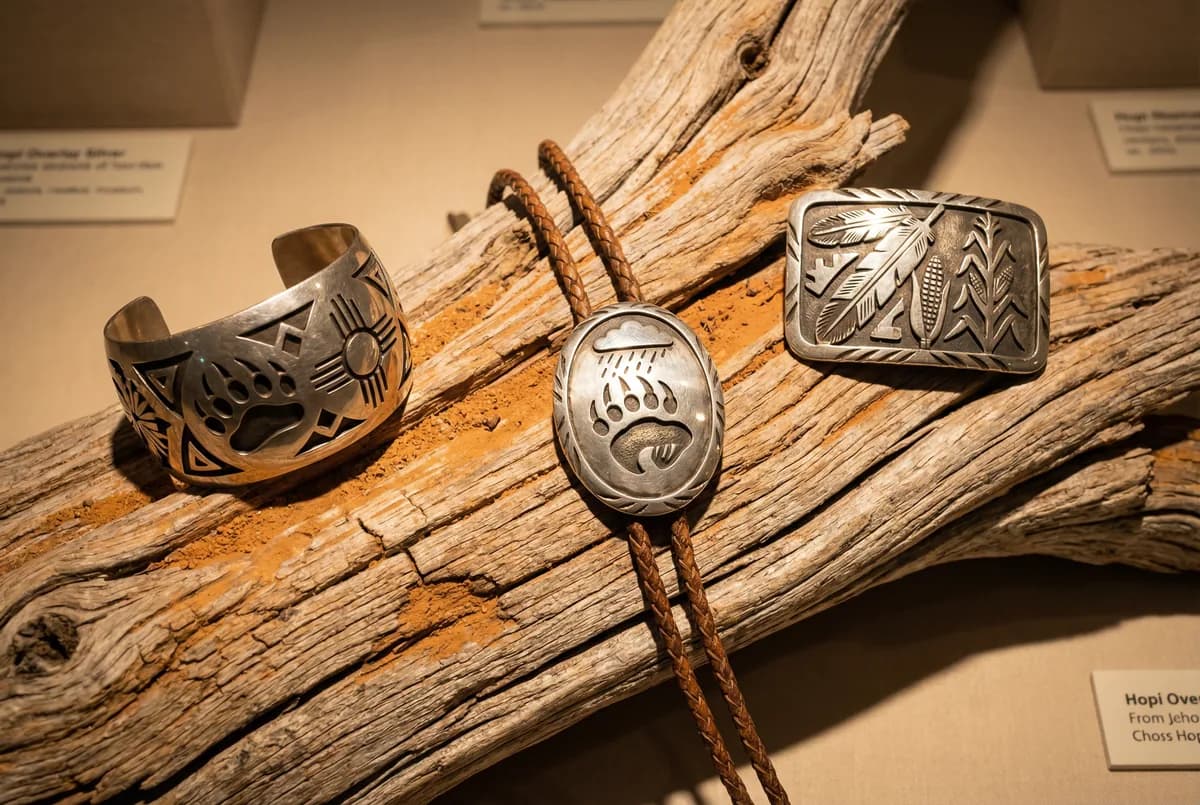
Hopi overlay design draws from Hopi visual culture, encoding clan identities and cosmological concepts in silver. Clan symbols such as the bear paw are most prominent, alongside rain clouds, the migration spiral, and animal imagery like eagles and butterflies, with kachina imagery used selectively and sensitively.
The design vocabulary of Hopi overlay draws directly from the rich visual culture of the Hopi people, encoding cultural narratives, clan identities, and cosmological concepts in silver. Unlike the geometric abstractions that characterize much Navajo stamp work, Hopi overlay designs tend toward representational and symbolic imagery — recognizable forms that carry specific cultural meanings understood within the Hopi community.
Clan symbols constitute the most prominent category of Hopi overlay design. Hopi society is organized into clans — matrilineal kinship groups, each identified with a specific animal, plant, or natural phenomenon — and the symbols associated with these clans provide a vocabulary of imagery that is deeply personal to Hopi artisans and their families. The bear paw, representing the Bear Clan (one of the most prominent Hopi clans), is among the most frequently encountered overlay designs. Other common clan symbols include the eagle, the badger, the spider, the corn plant, and the sun.
Water and rain imagery pervades Hopi overlay design, reflecting the paramount importance of precipitation in Hopi agricultural life. Rain clouds — typically depicted as terraced or stepped forms — appear on overlay pieces with frequency and variety, sometimes as isolated motifs and sometimes as elements within larger compositional narratives that depict the journey of water from cloud to earth to corn plant. The migration spiral, representing the Hopi emergence and migration narrative, is another deeply significant design element that connects individual pieces to the foundational story of Hopi identity.
Animal imagery — including eagles, butterflies, lizards, and snakes — draws from the natural world that surrounds the Hopi mesas and carries symbolic significance that extends beyond simple representation. The eagle, associated with the sky and with communication between human and spiritual realms, appears in both realistic and stylized forms. The butterfly, connected to the Butterfly Dance ceremony, is rendered in designs that range from naturalistic to highly abstract.
Kachina imagery — representations of the spirit beings central to Hopi ceremonial life — appears selectively in overlay design. The use of kachina imagery in commercial jewelry is culturally sensitive within the Hopi community, and many contemporary artisans choose not to depict specific kachinas on pieces intended for sale, reserving these images for personal, family, or ceremonial use. Other artisans include kachina imagery with the understanding that the commercial piece represents the form rather than the spirit, a distinction that parallels similar debates in other traditions about the appropriate use of sacred imagery in secular contexts.
The compositional treatment of these design elements reflects stylistic preferences that vary between individual artisans and, to some degree, between the mesa communities. Designs may be symmetrical or asymmetrical, densely packed or spaciously arranged, and rendered in varying degrees of stylization from near-photographic realism to bold geometric abstraction.
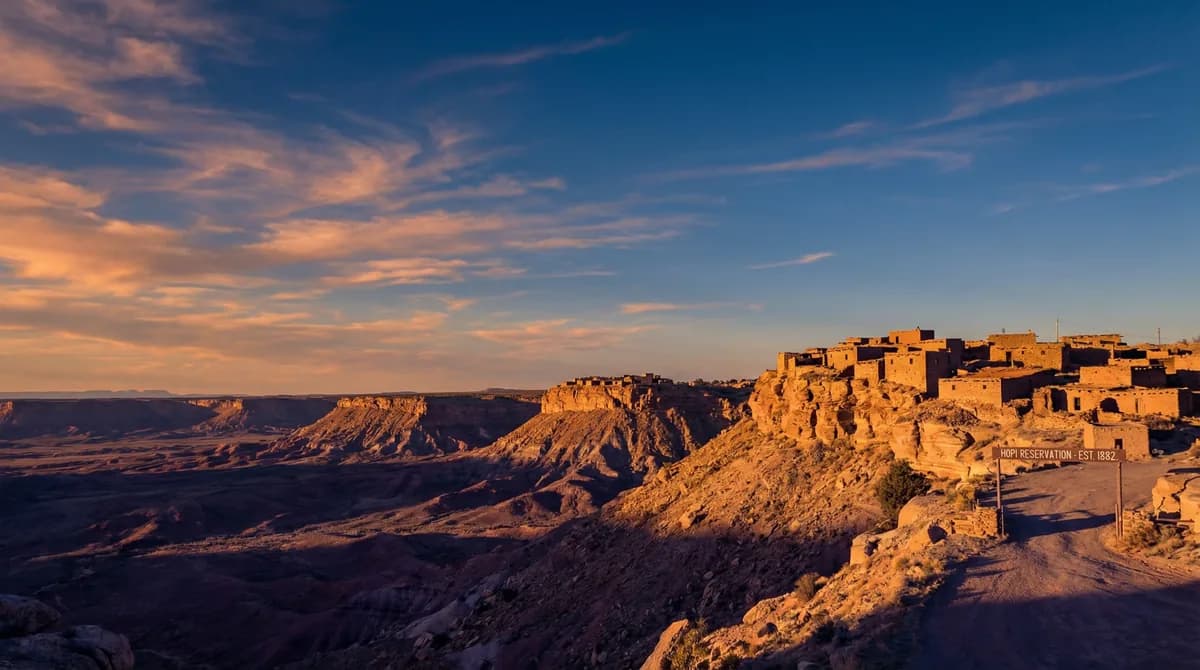
The Hopi Reservation's three mesas each host distinct overlay styles. Second Mesa, home of the Guild, produces 'classic' bold designs with substantial negative space, while Third Mesa is more experimental and individualistic. First Mesa, centered on pottery, incorporates pottery-inspired designs into its overlay work.
The Hopi Reservation in northeastern Arizona encompasses three mesas — First Mesa, Second Mesa, and Third Mesa — each of which hosts distinct village communities with their own cultural emphases and artistic traditions. While Hopi overlay is practiced across all three mesas, stylistic distinctions between Second Mesa and Third Mesa workshops have become recognized by collectors and scholars as meaningful indicators of aesthetic approach.
Second Mesa, home to the villages of Shungopavi, Sipaulovi, and Mishongnovi, has been the primary center of Hopi overlay production since the technique's inception. The Hopi Silvercraft Cooperative Guild was based at Second Mesa, and the earliest overlay artists received their training there. Second Mesa overlay tends toward what collectors describe as 'classic' Hopi style — clean, bold designs with substantial negative space, careful attention to the balance between cut-out areas and solid silver, and a preference for traditional clan and ceremonial imagery. The technical standard at Second Mesa is high, with particular attention to saw-work precision and oxidation quality.
Third Mesa, home to the village of Old Oraibi (one of the oldest continuously inhabited settlements in North America) and the more recent village of Hotevilla, has developed an overlay style that some observers characterize as more experimental and individualistic. Third Mesa artisans have been more willing to incorporate non-traditional design elements, expand the scale and complexity of overlay compositions, and explore variations on the basic overlay technique, including multiple-layer overlay (three or more sheets stacked) and combinations of overlay with other techniques such as stamp work or stone setting.
First Mesa, primarily associated with Hopi-Tewa pottery traditions (the villages of Walpi, Sichomovi, and the Tewa village of Hano), has produced notable overlay artists but is less strongly identified with the technique than Second and Third Mesa. First Mesa's artistic identity centers more on pottery, and the jewelers from First Mesa often incorporate pottery-inspired designs into their overlay work, creating a distinctive cross-media aesthetic.
For collectors, understanding mesa-based stylistic distinctions adds a layer of appreciation to Hopi overlay acquisition. A piece from Second Mesa and a piece from Third Mesa, both technically excellent, may present quite different aesthetic experiences — the former more classically restrained, the latter more compositionally adventurous. Neither approach is superior; they represent complementary expressions of a technique that the Hopi community has made entirely its own.
Charles Loloma, perhaps the most internationally famous Hopi artist, merits specific mention despite — or because of — his departure from overlay conventions. Working primarily from the 1960s through the 1980s, Loloma created jewelry that synthesized Hopi design sensibilities with modernist art concepts, incorporating gold, diamonds, and unusual stone combinations into works that expanded the perceived boundaries of Native American jewelry. While Loloma's work is not overlay in the strict technical sense, his artistic vision — rooted in Hopi identity but unbounded by conventional category — influenced generations of Hopi artists and demonstrated that the tradition could encompass radical innovation without losing its cultural foundation.
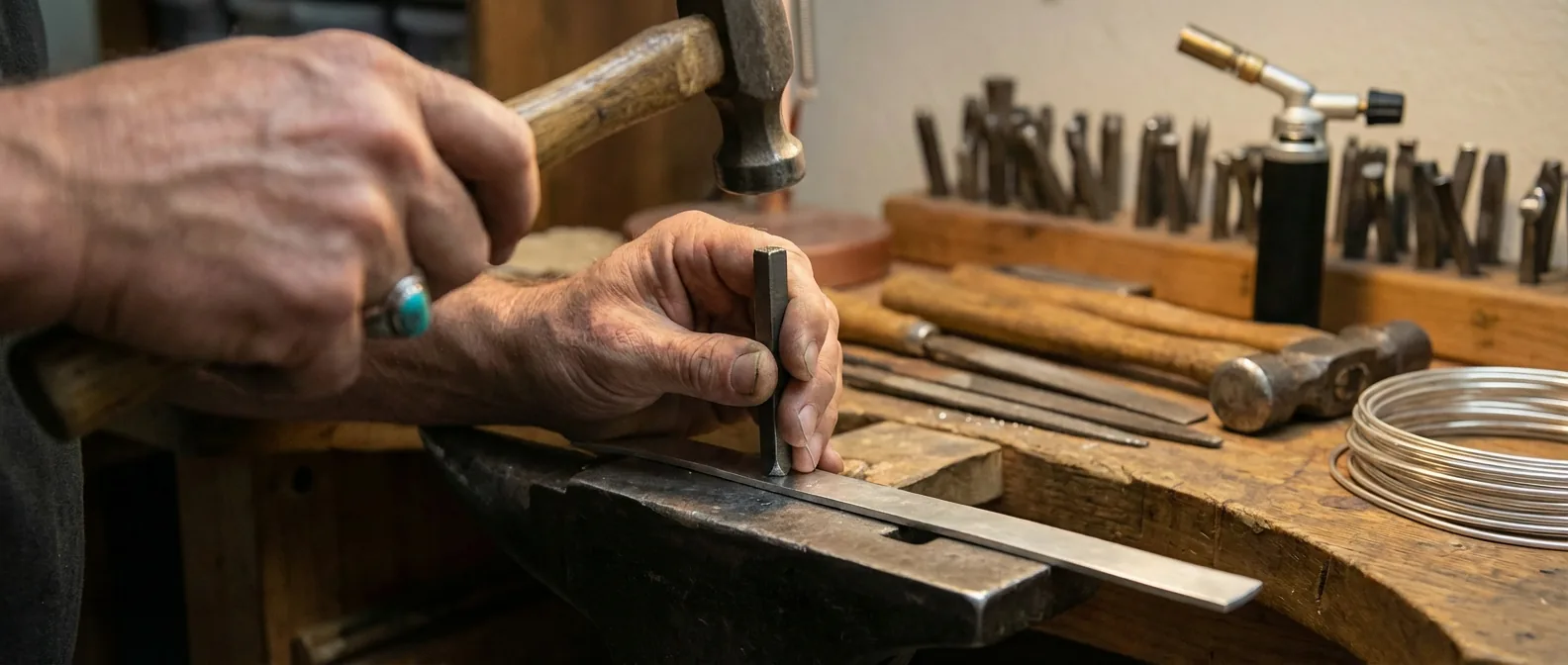
From Atsidi Sani and the Spanish Plateros to the Silversmiths of the Twenty-First Century
Navajo silversmithing traces its origins to the 1860s and 1870s, when Atsidi Sani and other early practitioners adapted metalworking techniques learned from Spanish and Mexican plateros into a distinctly Dine artistic tradition. Through stamp work, repousse, sand casting, and tufa casting, Navajo silversmiths created an iconic design vocabulary — the squash blossom necklace, the concho belt, the ketoh — that remains the foundation of Southwestern jewelry artistry.
Read Article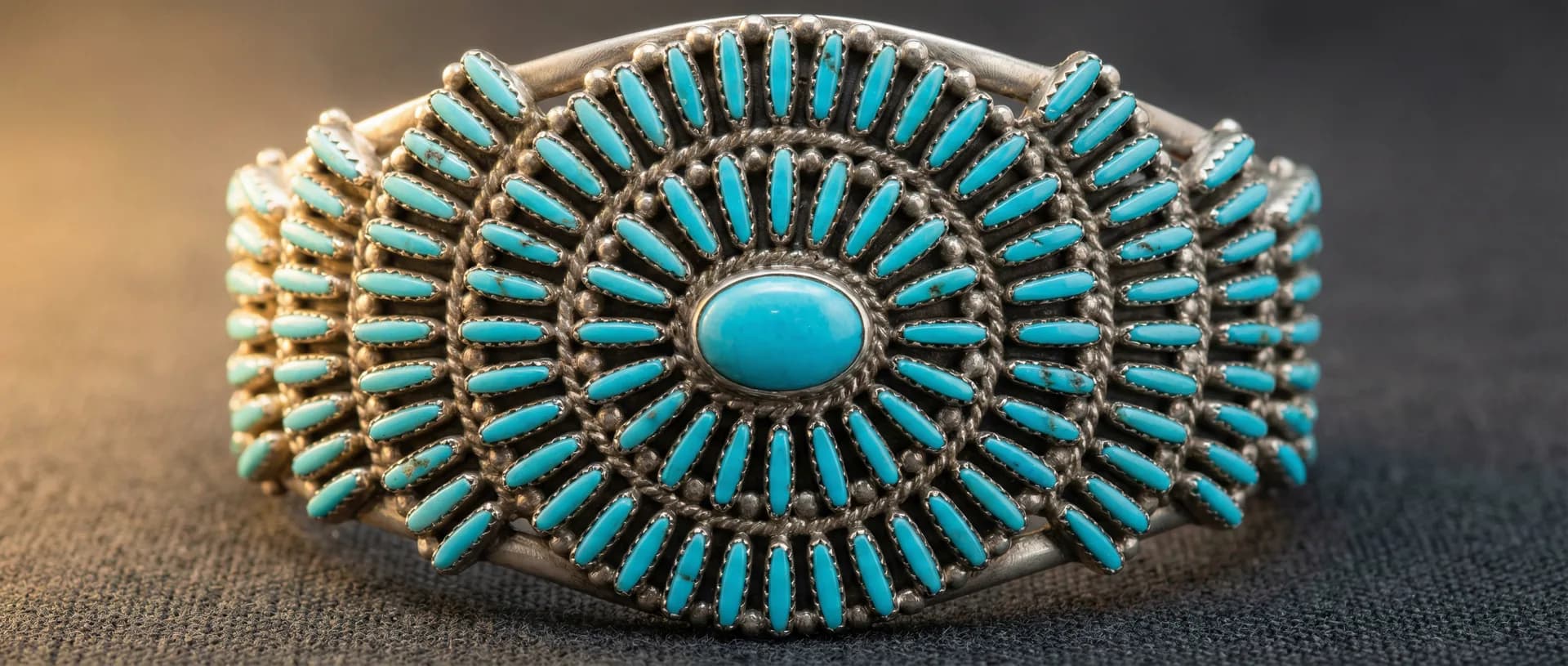
The Precision Art of Long, Thin Stones and Clustered Brilliance from Zuni Pueblo
Zuni Pueblo, New Mexico has produced some of the most technically demanding stonework in the history of world jewelry. Needlepoint — the art of cutting and setting long, thin, pointed turquoise stones — and its companion technique petit point require lapidary precision measured in fractions of a millimeter, passed through families like the Dishta, Quam, and Leekya across multiple generations.
Read Article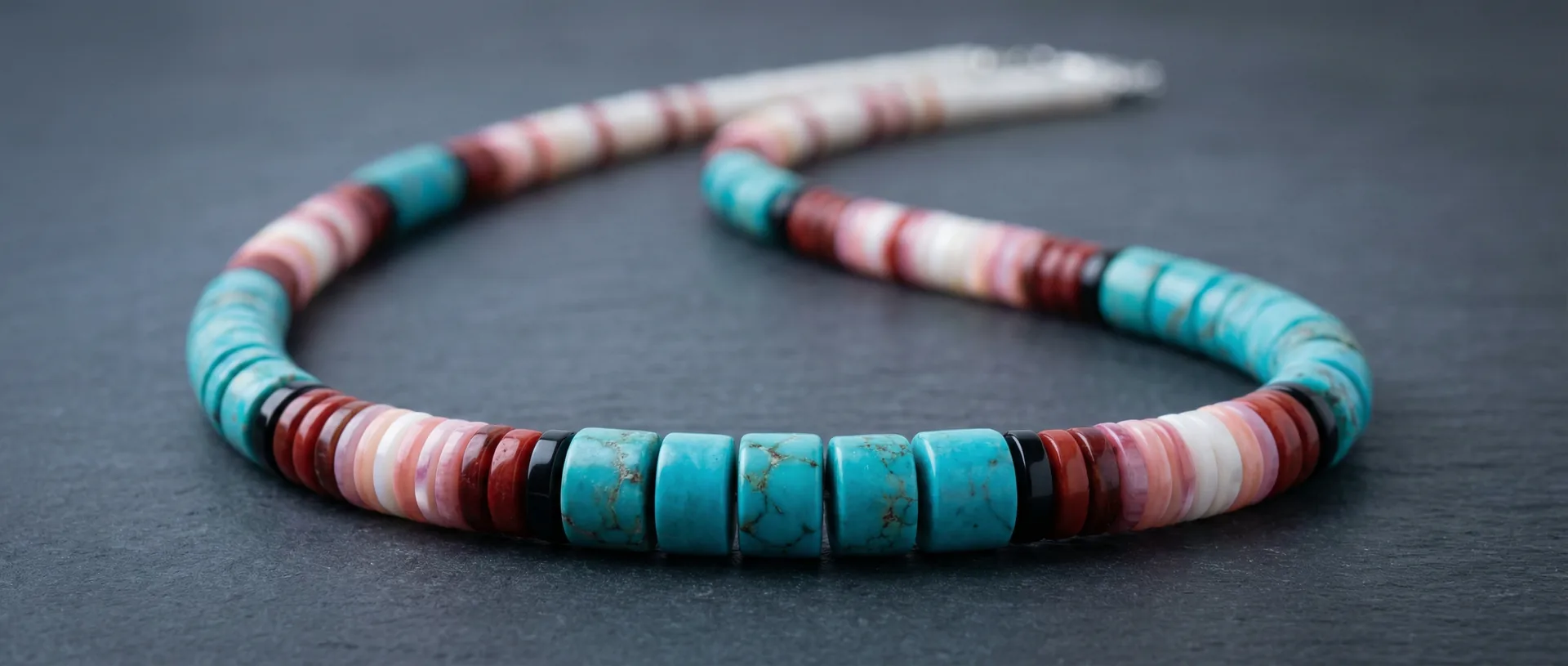
A Thousand Years of Shell Beads from Kewa Pueblo
Heishi — hand-ground shell disc beads — represents one of the oldest continuously practiced jewelry-making traditions in North America. Kewa Pueblo (historically known as Santo Domingo Pueblo), situated along the Rio Grande between Albuquerque and Santa Fe, has been the preeminent center of heishi production for over a thousand years. The process of cutting, drilling, stringing, and grinding shell into perfectly uniform beads remains largely unchanged from its ancient form.
Read Article