From Atsidi Sani and the Spanish Plateros to the Silversmiths of the Twenty-First Century
By The Humiovi Editorial Desk — Sedona, Arizona · est. 1972
·
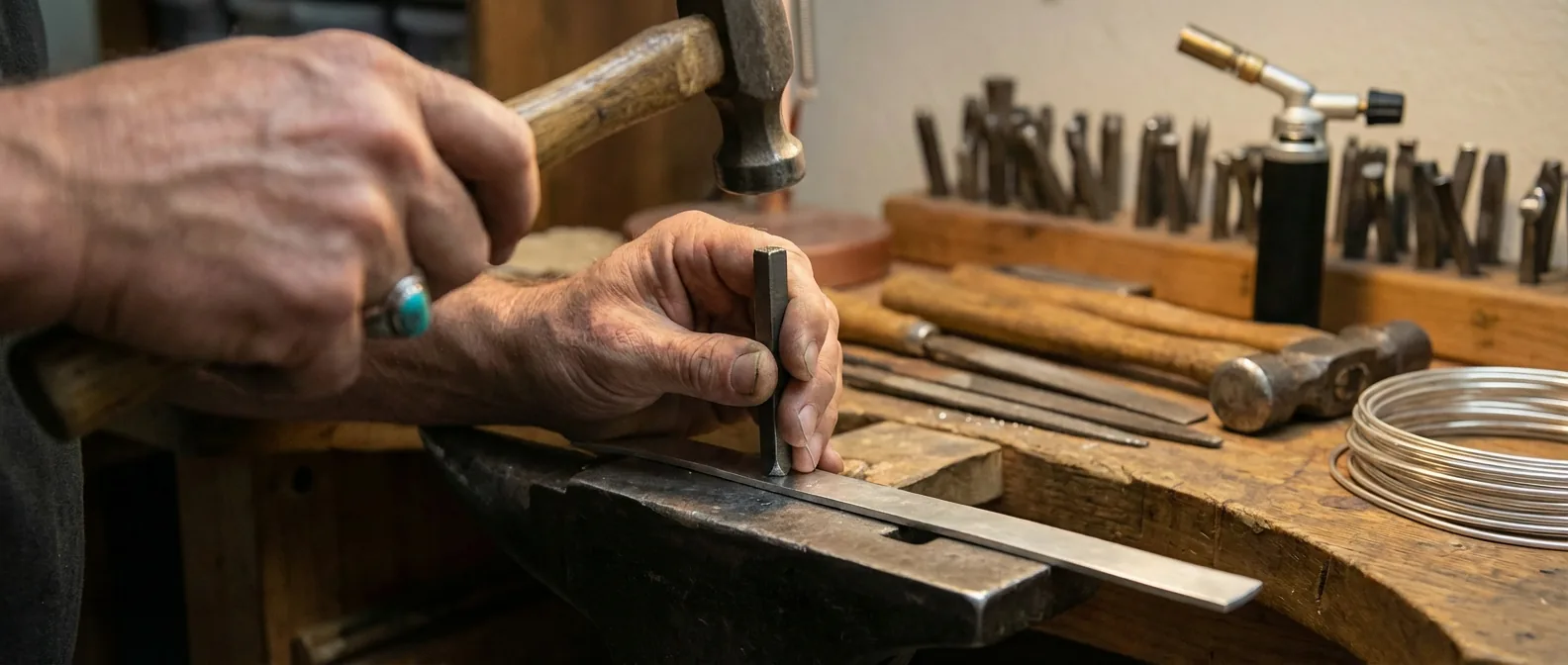
Navajo silversmithing began in the early 1860s when Atsidi Sani (Old Smith) learned metalworking from a Mexican platero named Nakai Tsosi. Working first in iron and copper, then silver, he adapted Spanish-Mexican forms to Navajo aesthetics and taught the craft across Navajoland by the 1880s.
The emergence of Navajo silversmithing represents one of the most consequential cultural adoptions in American artistic history. The tradition's origin is attributed to Atsidi Sani (Old Smith), a Navajo man who learned blacksmithing and basic metalworking from a Mexican platero (silversmith) named Nakai Tsosi (Thin Mexican) in the early 1860s. Atsidi Sani initially worked in iron and copper before transitioning to silver, and by the late 1860s he was producing silver ornaments that adapted Spanish-Mexican forms to Navajo aesthetic sensibilities.
The timing of this adoption was not coincidental. The Navajo people had recently endured the Long Walk of 1864 — the forced march of approximately 8,000 Navajo to Bosque Redondo (Fort Sumner) in eastern New Mexico, where they were interned until 1868. During and following this period of displacement, exposure to Mexican and Anglo-American material culture intensified. The metalworking skills that Atsidi Sani acquired and transmitted to other Navajo artisans provided both an economic livelihood and a medium for cultural expression during a period of profound disruption and renewal.
The Spanish platero tradition that informed early Navajo silversmithing was itself a synthesis of Moorish, Spanish, and Mexican influences. Techniques including filigree, repousse (relief work created by hammering from the reverse side), and decorative stamping all trace their lineage through Spanish colonial workshops to medieval Iberian and North African metalworking traditions. The Navajo adaptation of these techniques was neither imitative nor derivative — within a single generation, Navajo silversmiths had transformed borrowed methods into a visual language that was recognizably and distinctly their own.
Atsidi Sani taught his skills to a network of family members and apprentices, and by the 1880s, silversmithing had spread widely across Navajoland. The earliest pieces — buckles, buttons, bridle ornaments, and simple bracelets — were fashioned from American silver dollars and Mexican pesos, which were melted, cast in stone molds, and hammered into shape. These first-generation pieces, identifiable by their heavy gauge, simple forms, and hand-cut stamp patterns, are among the most prized objects in the field of Native American art, with authenticated examples commanding prices at auction that rival Old Master silver from European traditions.
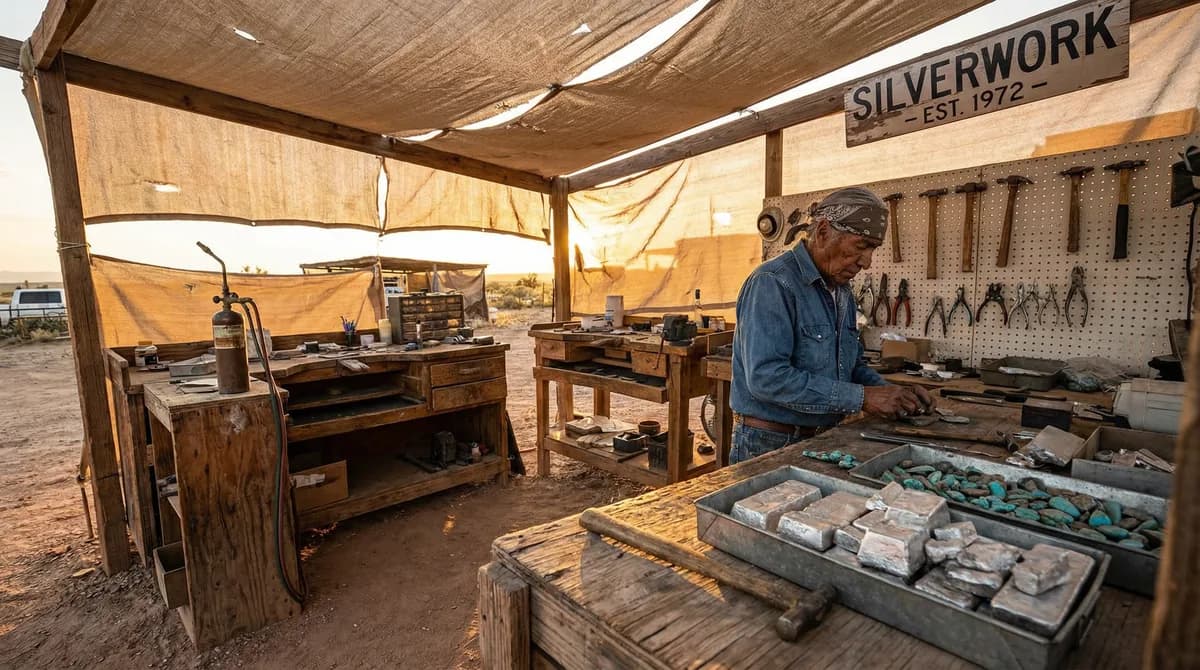
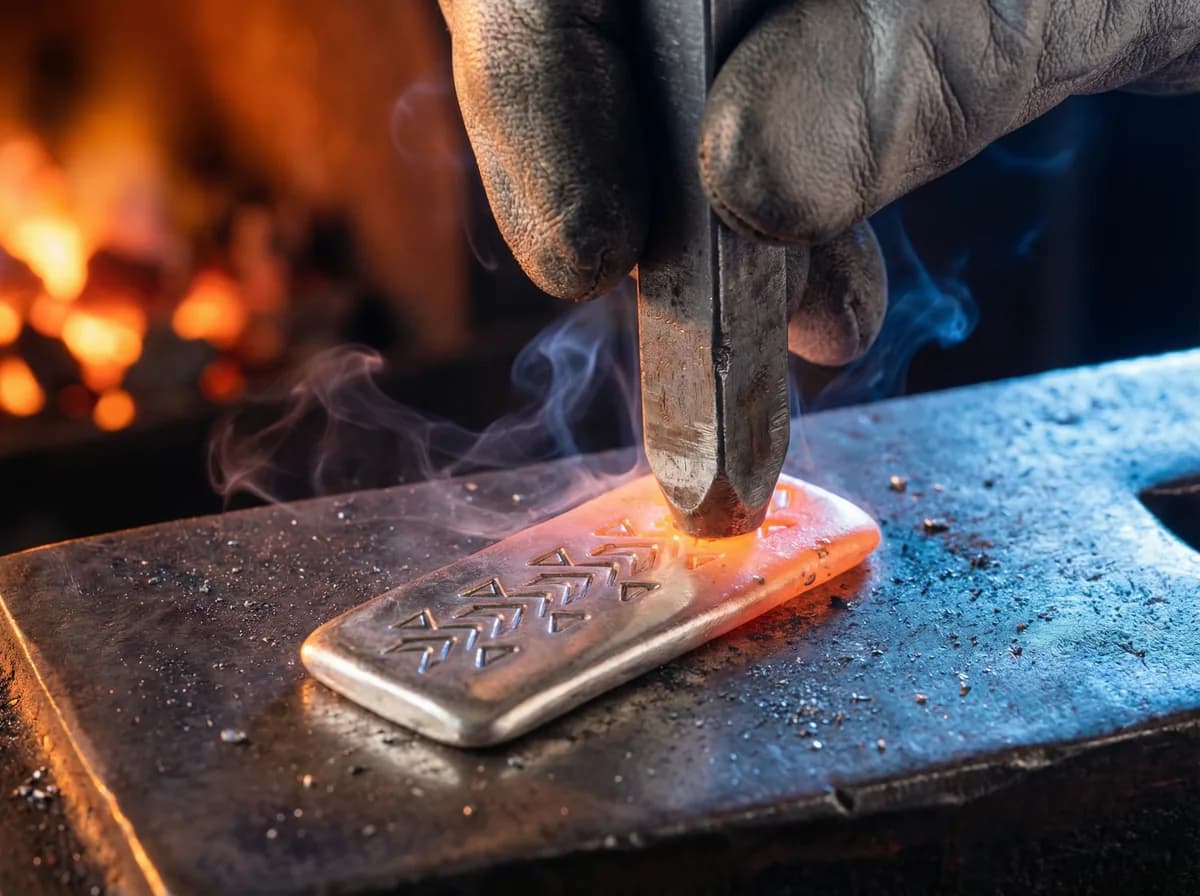
Navajo silversmithing employs four primary techniques: stamp work, which hammers steel stamps into silver to create repeating patterns; repousse, which raises designs by hammering from the reverse; sand casting, using carved sandstone molds; and tufa casting, which uses fine-grained volcanic tufa for intricate detail.
Navajo silversmithing employs four primary techniques that, individually and in combination, produce the full range of forms associated with the tradition. Each technique requires years of practice to master and imposes its own aesthetic characteristics on the finished work.
Stamp work is the most widely practiced technique and the one most immediately associated with Navajo silver. The silversmith creates or acquires steel stamps — small tools with designs filed or ground into their working ends — and hammers them into the silver surface to create repeating patterns. Traditional stamp designs include geometric motifs drawn from Navajo weaving and pottery: arrows, crosses, crescents, triangles, and interlocking stepped patterns. A skilled stamper achieves perfectly uniform depth and spacing across entire surfaces, creating rhythmic patterns that transform flat silver into richly textured fields. The best stamp work demonstrates the paradox at the heart of the technique — each impression is struck individually by hand, yet the result reads as mechanically precise.
Repousse (from the French repousser, 'to push back') involves placing a silver sheet face-down on a yielding surface — traditionally a leather pad filled with pitch — and hammering from the reverse side to create raised designs on the front. The technique produces sculptural, three-dimensional effects that stamp work alone cannot achieve. Navajo repousse typically features bold, flowing forms — leaves, feathers, scrollwork — that complement the geometric precision of stamp work. Many of the finest Navajo pieces combine both techniques, using repousse for primary design elements and stamp work for background texture and border decoration.
Sand casting uses a two-part mold carved from compacted volcanic tufa or fine-grained sandstone. The silversmith carves the desired design into the stone, creating a negative impression of the finished piece. Molten silver is then poured into the mold and allowed to cool. The resulting casting reproduces the carved design in three-dimensional silver, with a characteristic texture — slightly rough and granular — that distinguishes cast work from fabricated (sheet and wire) pieces. Sand-cast pieces include rings, bracelets, belt buckles, and bolo ties, with designs ranging from traditional to highly sculptural.
Tufa casting is a specialized variant of sand casting that uses volcanic tufa stone — a soft, porous rock formed from compressed volcanic ash — as the mold material. Tufa's extremely fine grain allows the silversmith to carve intricate detail that coarser sandstone cannot reproduce, and the stone's porosity creates a distinctive surface texture on the finished silver that many collectors find more appealing than the smoother surface of sand-cast pieces. Tufa casting has experienced a significant revival in contemporary Navajo jewelry, with artists like McKee Platero, Perry Shorty, and Aaron Anderson creating tufa-cast work.
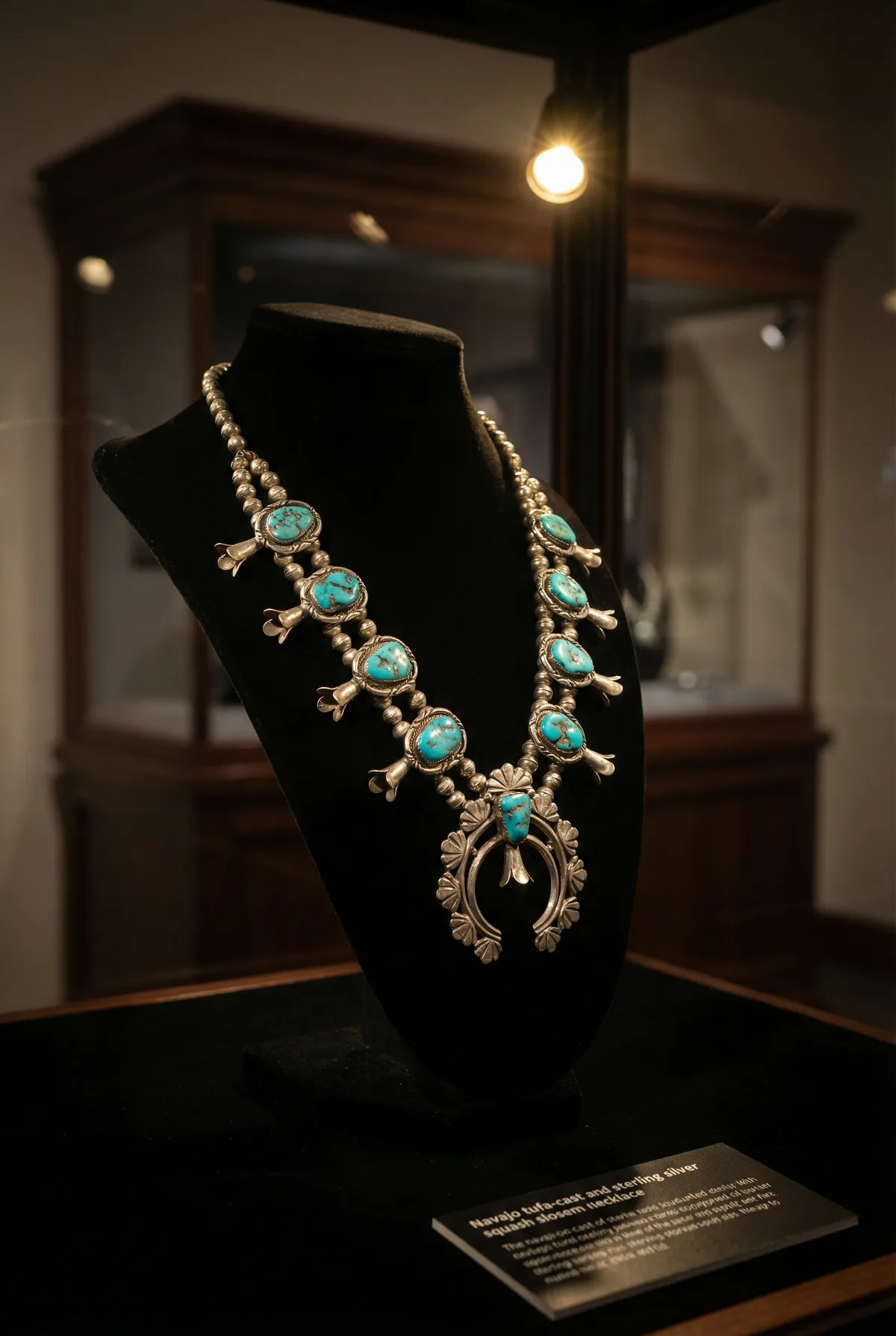
Navajo silversmithing produced several iconic forms: the squash blossom necklace, whose beads derive from Spanish pomegranate ornaments and terminate in a crescent naja; the concho belt of decorated silver discs on leather; and the ketoh, a bow guard transformed into ornament.
Navajo silversmithing produced several jewelry forms that have transcended their cultural origins to become internationally recognized symbols of Southwestern artistry. Understanding the history and construction of these forms provides insight into both the technical mastery and cultural creativity of the Navajo silversmithing tradition.
The squash blossom necklace, despite its name, does not depict squash blossoms. The blossom-shaped silver beads that give the form its common name are derived from the pomegranate blossom ornaments that decorated Spanish colonial trouser and jacket seams. Navajo silversmiths adapted these ornamental forms into necklace beads, typically arranging six to twelve blossoms along a strand of round silver beads, terminating in a naja — a crescent-shaped pendant whose form traces to Moorish horse tack ornaments that arrived in the Southwest through Spanish equestrian culture. The synthesis of these diverse cultural elements into a single, coherent jewelry form represents a feat of creative integration that art historians regard as one of the defining achievements of nineteenth-century American decorative art.
The concho belt consists of oval or round silver discs (conchos) mounted on a leather belt, each disc decorated with stamp work, repousse, or a combination of both. The word 'concho' derives from the Spanish concha (shell), referencing the oval shape of the earliest examples. First-period concho belts, dating to the 1870s and 1880s, featured simple round or oval conchos with minimal decoration and leather thong attachments. The form evolved over subsequent decades to include scalloped edges, elaborate stamp work, turquoise settings, and butterfly-shaped spacer plates between the main conchos. A museum-quality concho belt may contain eight to twelve conchos, each individually crafted and decorated, representing hundreds of hours of skilled labor.
The ketoh (bow guard) originated as a functional leather wrist guard worn by Navajo archers to protect the forearm from bowstring snap. Navajo silversmiths transformed this utilitarian object into an opportunity for artistic expression by mounting elaborately decorated silver plates on the leather base. Ketoh designs range from geometric stamp work to figurative motifs including arrows, thunderbirds, and ceremonial symbols. Although the ketoh lost its functional purpose as archery gave way to firearms, the form persisted as a prestigious ornament worn for ceremonial and social occasions. Vintage ketohs with documented provenance are among the most eagerly sought objects in the Native American art market.
The bolo tie, while often associated with Western rather than specifically Native American culture, has deep roots in Navajo silversmithing. The form — a decorative clasp mounted on a braided cord, worn around the neck — was adopted by Navajo silversmiths in the mid-twentieth century and has become a staple of the tradition. Navajo bolo ties range from simple stamped silver ovals to elaborate sculptural compositions incorporating turquoise, coral, and complex metalwork. Arizona designated the bolo tie as the official state neckwear in 1971, a recognition that underscores the form's integration into broader Southwestern identity.
“From Atsidi Sani's first hammered bracelet to the micro-inlay masterworks of the twenty-first century, Navajo silversmithing has never stopped evolving — yet every contemporary piece still echoes the fundamental act of transforming raw metal into cultural meaning.”
The trading post system operating across Navajoland from the 1870s through the mid-twentieth century shaped Navajo silversmithing as both supplier and retailer. Traders expanded the market but also dictated designs, while the pawn system produced uncommercialized 'Old Pawn' pieces prized for their uncompromising quality.
The trading post system that operated across Navajoland from the 1870s through the mid-twentieth century played a decisive role in the development and dissemination of Navajo silversmithing. Trading posts — commercial establishments operated by Anglo-American and occasionally Hispanic merchants at locations throughout the reservation — served as economic intermediaries between Navajo communities and the broader market economy. For silversmiths, trading posts functioned as both suppliers (providing sheet silver, solder, tools, and turquoise) and retailers (purchasing finished jewelry for resale to collectors and tourists).
Trading post operators influenced Navajo silversmithing in ways both constructive and problematic. On the positive side, traders expanded the market for Navajo silver far beyond its original local and ceremonial context, creating economic opportunities that supported silversmithing as a viable livelihood. Some traders, such as Lorenzo Hubbell at Ganado and C.N. Cotton at Gallup, developed genuine appreciation for the art form and encouraged technical excellence and innovation among the silversmiths they worked with.
However, the trading post system also imposed market pressures that shaped — and sometimes constrained — artistic production. Traders frequently dictated design preferences based on their understanding of tourist and collector tastes, encouraging lighter-weight pieces, standardized sizing, and designs that conformed to Anglo expectations of 'Indian jewelry.' The introduction of commercially manufactured silver sheet and wire (replacing the earlier practice of melting coins) and mass-produced steel stamps altered the material basis of the craft. Some historians argue that these commercial pressures produced a 'tourist style' that prioritized quantity and market appeal over the heavy, individualistic quality of earlier Navajo silver.
Regional variations in Navajo silversmithing developed partly in response to the aesthetic preferences of different trading post communities. Silversmiths working in the area around Gallup, New Mexico — a major commercial center — tended toward lighter, more commercially oriented work. Those in more remote areas of the reservation, where traditional values maintained stronger influence, often produced heavier, more austere pieces that reflected older aesthetic standards. The differences between 'Gallup' style and 'Old Pawn' style, while sometimes overstated, reflect genuine regional variations in the balance between traditional practice and market adaptation.
The 'pawn' system deserves particular attention. Navajo families regularly pledged jewelry at trading posts as collateral for credit, creating the category known as 'Old Pawn' — jewelry made for personal use or ceremony, pawned for economic necessity, and sometimes never redeemed. Old Pawn pieces are prized by collectors because they were made without commercial considerations, reflecting the artisan's personal vision rather than market requirements. The heaviest gauge, the most deeply stamped patterns, and the finest stone selections are often found in Old Pawn pieces, which represent Navajo silversmithing at its most uncompromising.
Twenty-first-century Navajo silversmithing thrives as a living tradition, with artists like Perry Shorty preserving first-period techniques and Jesse Monongya and Lee Yazzie expanding into micro-inlay and gold. Knowledge passes through family apprenticeship and institutions such as the Institute of American Indian Arts.
Twenty-first-century Navajo silversmithing exists in a state of remarkable creative vitality, with contemporary artists pushing the boundaries of technique while maintaining deep connections to the tradition's foundational methods. The art form has evolved from a folk craft practiced by a relatively small number of artisans into a globally recognized fine art tradition with institutional support, critical discourse, and a market that distinguishes clearly between commercial production and individual artistic achievement.
Contemporary artists work across the full spectrum of traditional and innovative approaches. Artists like Perry Shorty maintain rigorous fidelity to first-period techniques, creating heavy-gauge pieces using hand-drawn silver wire, hand-cut stamps, and traditional tufa casting methods that would be recognizable to Atsidi Sani himself. Their work functions as both artistic production and cultural preservation, demonstrating that the earliest techniques retain their expressive power when executed at the highest level of skill.
At the other end of the spectrum, artists like Jesse Monongya and Lee Yazzie have expanded the technical vocabulary of Navajo jewelry to include micro-inlay techniques and gold fabrication.
The transmission of silversmithing knowledge continues through both family apprenticeship and institutional programs. The Institute of American Indian Arts (IAIA) in Santa Fe, the Navajo Nation's own vocational training programs, and various community-based workshops ensure that technical skills and cultural knowledge are passed to new generations. However, artists and cultural leaders express concern about the declining number of young people entering the tradition, as economic pressures and alternative career opportunities compete for the attention of potential apprentices.
The market for contemporary Navajo silverwork reflects the tradition's maturity. Gallery representation, artist websites, and major Native American art markets (including the Santa Fe Indian Market, the Heard Museum Indian Fair, and the Gallup Inter-Tribal Ceremonial) provide established channels for collectors to acquire significant works directly from artists. Prices for top-tier contemporary Navajo silver range from $1,000-5,000 for fine cuff bracelets to $10,000-50,000 or more for major works. The existence of a sophisticated secondary market, with auction records and price indices, further confirms the tradition's status as a serious collecting field with established valuation conventions.
For the visitor to Sedona and the broader Southwest, encountering Navajo silverwork is an opportunity to engage with one of America's most significant living art traditions. Every piece of Navajo silver, from a simple stamped ring to an elaborate squash blossom necklace, carries within it the lineage of Atsidi Sani's anvil — over 150 years of accumulated skill, cultural meaning, and artistic ambition compressed into shaped and decorated metal.
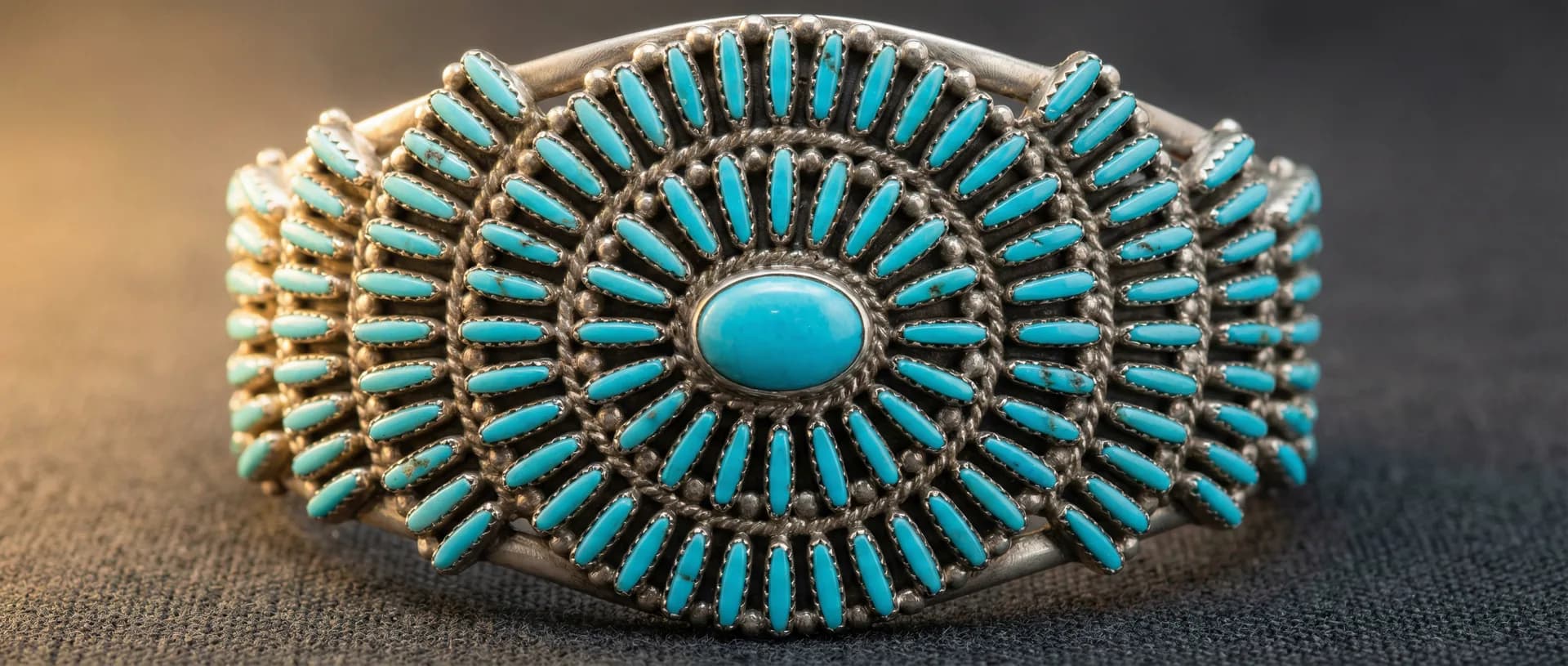
The Precision Art of Long, Thin Stones and Clustered Brilliance from Zuni Pueblo
Zuni Pueblo, New Mexico has produced some of the most technically demanding stonework in the history of world jewelry. Needlepoint — the art of cutting and setting long, thin, pointed turquoise stones — and its companion technique petit point require lapidary precision measured in fractions of a millimeter, passed through families like the Dishta, Quam, and Leekya across multiple generations.
Read Article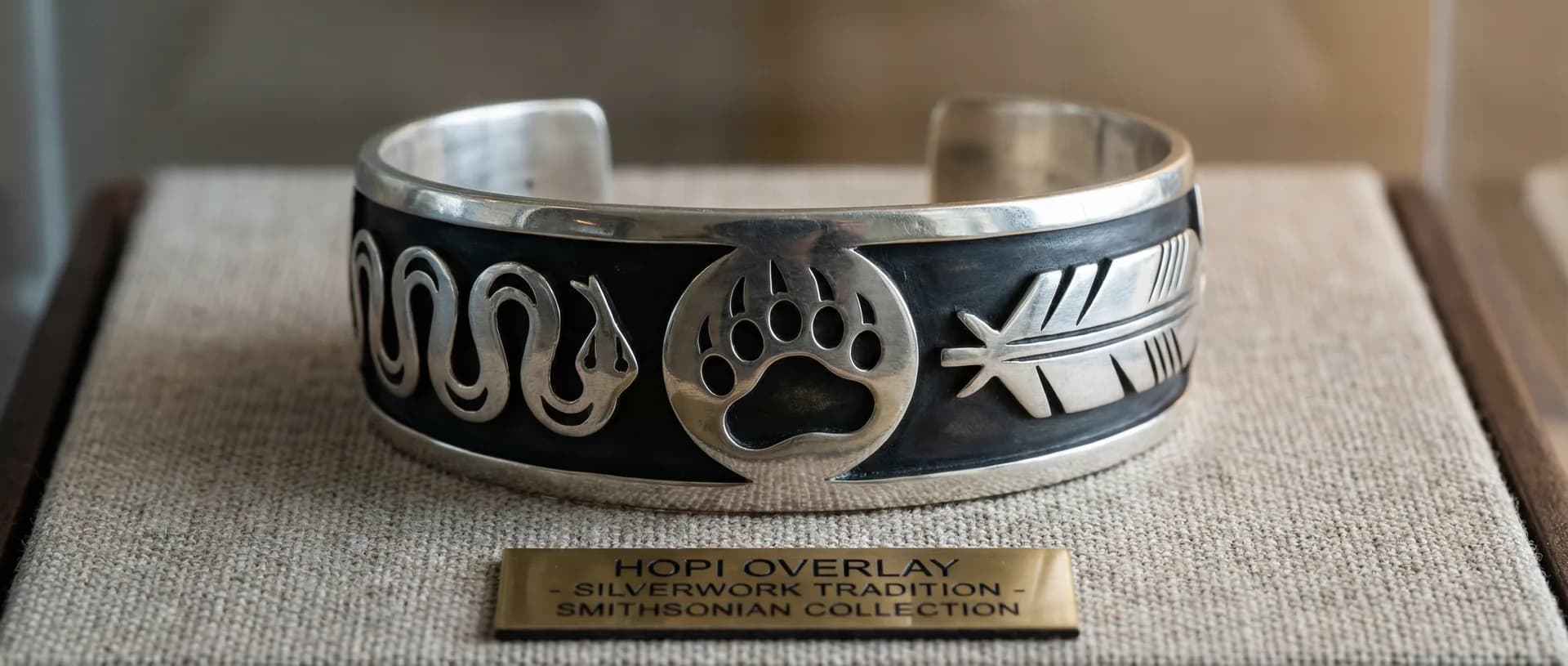
Two Silver Sheets, One Artistic Vision: The Signature Technique of the Hopi Mesas
Hopi overlay — the technique of cutting designs from one silver sheet and soldering it atop a second, oxidized sheet — emerged in the 1940s through the Hopi Silvercraft Cooperative Guild as a deliberate effort to create a Hopi-specific jewelry identity distinct from Navajo silversmithing. Clan symbols including bear paw, rain cloud, and migration spiral encode cultural narratives in silver, with stylistic distinctions between Second Mesa and Third Mesa workshops reflecting the artistic diversity within Hopi culture.
Read Article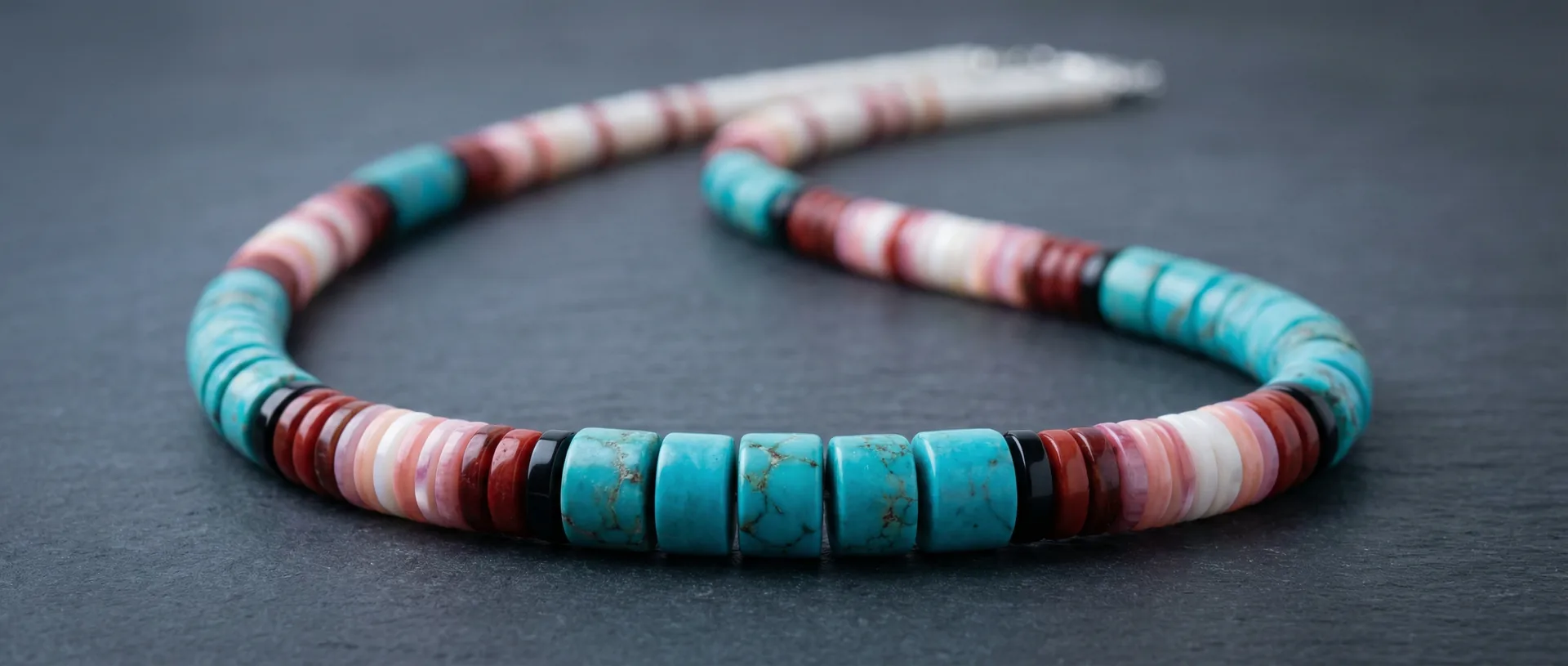
A Thousand Years of Shell Beads from Kewa Pueblo
Heishi — hand-ground shell disc beads — represents one of the oldest continuously practiced jewelry-making traditions in North America. Kewa Pueblo (historically known as Santo Domingo Pueblo), situated along the Rio Grande between Albuquerque and Santa Fe, has been the preeminent center of heishi production for over a thousand years. The process of cutting, drilling, stringing, and grinding shell into perfectly uniform beads remains largely unchanged from its ancient form.
Read Article