The silver overlay masters of the Arizona mesas — luminous two-tone silver carrying clan symbols, kachina forms, and the imagery of Hopi life.
Hopi Mesas · northeastern ArizonaThe Hopi are a Puebloan people whose villages crown the high mesas of northeastern Arizona. Old Oraibi, settled around 1100 CE, is among the oldest continuously inhabited communities in the United States, and the Hopi have preserved their language, ceremony, agriculture, and worldview with remarkable continuity across the centuries.
Hopi silversmithing began at the close of the nineteenth century, when a Hopi man named Sikyátala learned the craft from the Zuni smith Lanyade around 1898. For its first decades, Hopi silver closely resembled Navajo and Zuni work, and there was little to distinguish a Hopi piece from its neighbors'. The deliberate creation of a uniquely Hopi style came later, in two stages.
In the 1930s, Mary-Russell Ferrell Colton of the Museum of Northern Arizona — through the museum's Hopi Craftsman Exhibition, begun in 1930 — encouraged Hopi smiths to develop designs drawn from their own pottery, basketry, and textiles rather than from Navajo and Zuni models. The decisive step followed the Second World War: in the late 1940s, the artist Fred Kabotie and the silversmith Paul Saufkie led a GI Bill training program for returning Hopi veterans, and in 1949 the Hopi Silvercraft Cooperative Guild was established. Together they built the new style around the overlay technique.
Within a generation, Hopi overlay became one of the most recognizable signatures in all of Native American art. Masters such as Charles Loloma later pushed the tradition further still — incorporating stone, inlay, and bold sculptural form — and helped elevate Hopi and Native jewelry to the status of fine art in the wider world.
Today the Hopi style is practiced in family workshops across all three mesas and remains tightly identified with the pueblo. The founding generation of the guild — and the masters who followed, Loloma chief among them — established overlay not as a frozen formula but as a living language, capable of both strict traditional designs and bold contemporary invention. That is why, well over a century after Sikyátala first learned to work silver, the tradition feels neither antique nor diluted but fully alive, carried by smiths who treat the technique as both inheritance and a medium for their own expression.
Hopi jewelry is defined by the silver overlay — a method so distinct that a well-made Hopi piece needs no maker's mark to announce its origin. Two layers of sterling silver are joined so that a design cut through the top layer reveals a darkened, textured layer beneath, producing crisp, graphic contrast between bright silver and deep shadow.
The imagery is drawn from the rich visual language of Hopi life: clan symbols, kachina (katsina) figures, the migration spiral, rain clouds, corn and corn maidens, bear paws, badger and antelope, and the water, lightning, and feather motifs carried over from pottery and basketry. Unlike Navajo and Zuni jewelry, traditional Hopi overlay generally uses little or no stone — the beauty lies in the design and the play of light across the silver itself.
The forms range across bracelets, cuffs, rings, pendants, bolo ties, belt buckles, earrings, and money clips, with the overlay design wrapping cleanly around each. Contemporary Hopi smiths have expanded the vocabulary — adding texturing, gold, and, in the lineage of innovators like Loloma, inlaid stone — but the luminous two-tone overlay remains the heart of the tradition: quiet, sophisticated, deeply rooted in symbol yet entirely modern in its graphic clarity.
Each motif carries meaning. The migration spiral records the journeys of the Hopi clans; rain clouds, lightning, and water symbols invoke the moisture on which mesa farming depends; corn honors the staple at the center of Hopi life; and bear, badger, antelope, and other clan animals identify lineage and responsibility. The designs are not chosen at random but drawn from this shared vocabulary, so that to wear Hopi overlay is to carry a small, deliberately chosen fragment of the pueblo's visual language — legible, at least in part, to those who know how to read it.
The motifs in Hopi overlay are not decorative inventions; they are drawn from a living ceremonial and clan system. Kachina imagery, water and corn symbols, and clan emblems reference the spiritual relationships and responsibilities at the center of Hopi life, which remains organized around the ceremonial calendar, the kiva, and the agricultural cycle of the mesas. Out of respect, the most sacred imagery stays within ceremony and is not rendered for sale, and Hopi artists are deliberate about the line between what may be shared and what may not.
The post-war creation of the Hopi style was, in part, an act of cultural self-determination — a conscious choice, supported by Hopi leaders and artists, to define Hopi identity in silver on Hopi terms rather than in borrowed forms. That spirit continues in the guild tradition and in the family workshops scattered across First, Second, and Third Mesa today.
Humiovi presents Hopi overlay with awareness of its symbolic weight, honoring both the artisans and the boundaries the Hopi themselves draw around their sacred imagery.
This care extends to the marketplace: Hopi artists and the guild have long worked to ensure that genuine Hopi makers, rather than imitators, receive the recognition and livelihood their work earns. To choose authentic Hopi silver is, in a real and practical sense, to support that self-determination and the families who sustain the craft.
The overlay technique is exacting. The smith begins with two sheets of sterling silver of equal size. A design is drawn on the upper sheet and cut out with a fine jeweler's saw — a step that demands a steady hand and clean, continuous lines, since every sawn edge will show in the finished piece. The lower sheet is textured, traditionally with hand stamps, a chisel, or a matting tool, to create a contrasting ground.
The two sheets are then sweat-soldered together so the join is invisible. The recessed areas revealed through the cutout are oxidized with liver of sulfur to a deep, even black, and the bright top surface is polished. The contrast between the luminous upper layer and the dark, textured field below is the essence of the style — and the crispness of the sawn line is the surest measure of the smith's skill.
Finishing — doming, forming, soldering findings, and burnishing — gives the piece its final shape, whether bracelet, ring, pendant, or bolo. Some contemporary Hopi smiths extend the tradition by combining overlay with tufa casting or with select inlaid stones, though many hold that classic overlay stands most purely on silver alone.
The back of a piece tells much of the story. On genuine overlay the underside is smooth where the two soldered sheets meet, with no glue line and no separately applied second layer, and the oxidized recesses sit clearly below the bright surface rather than being merely dark lines drawn upon a single sheet. This structural depth — two real layers of silver, joined and then cut — is something no stamped, etched, or cast imitation can convincingly reproduce, which is why turning a Hopi piece over is one of the quickest tests of authenticity.
Authenticating Hopi jewelry starts with the overlay itself. Genuine work shows clean, hand-sawn cutout lines with crisp inside corners, a richly oxidized and textured lower layer, and seamless soldering with no visible glue. Stamped or etched imitations of overlay lack the true two-layer depth — there is no real recess beneath the bright surface — and printed or cast "Hopi-style" pieces lack the hand-sawn edge entirely.
Because traditional overlay is usually stoneless, the silver and the cutwork carry the value; weigh the piece, look at the back, and study the line. Where stones do appear in contemporary work, they should be genuine and well set.
Most Hopi smiths hallmark their work, and the Hopi Silvercraft Guild has documented makers' marks and guild stamps for decades, giving collectors a strong basis for attribution. The Indian Arts and Crafts Act of 1990 protects the authenticity of work sold as Hopi-made. Every Hopi piece at Humiovi is genuine, artist-made overlay and comes with a Certificate of Authenticity to keep. We welcome questions about the maker and the symbolism behind each design.
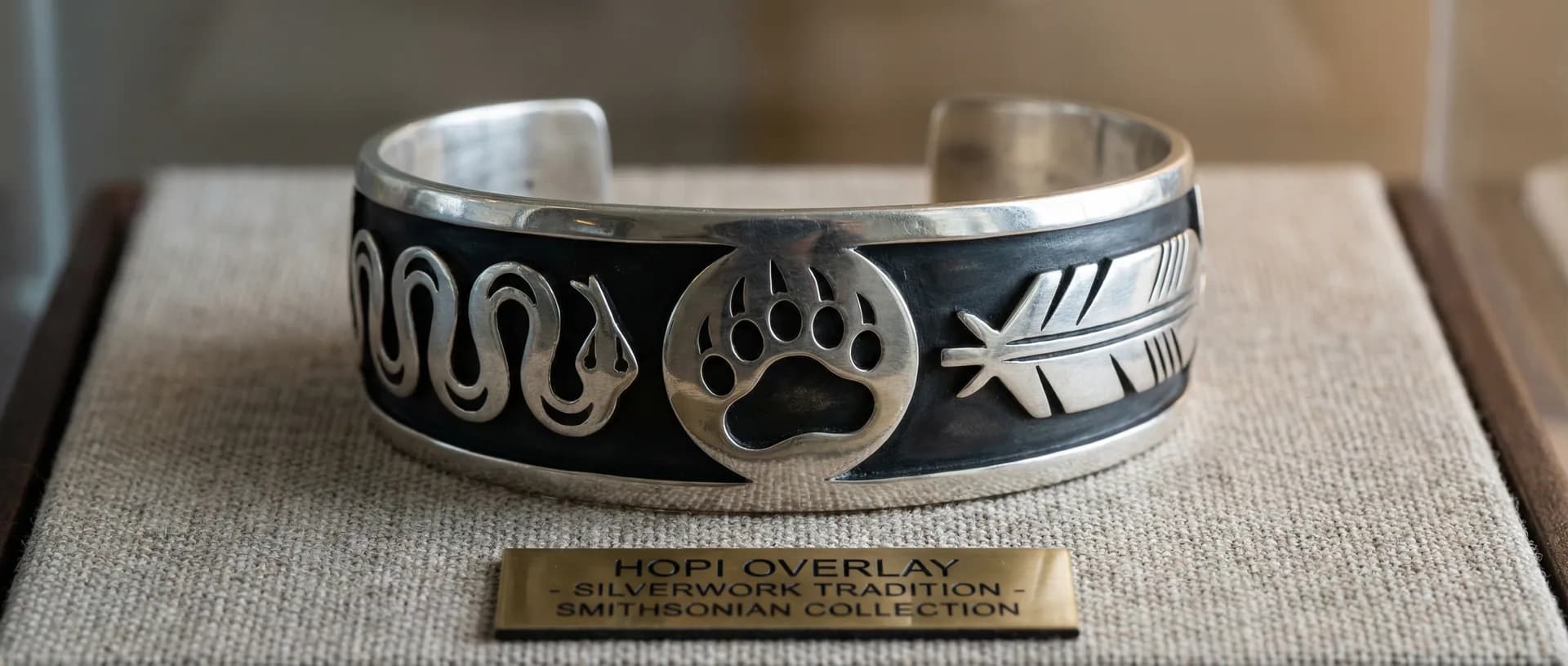
Hopi overlay — the technique of cutting designs from one silver sheet and soldering it atop a second, oxidized sheet — emerged in the 1940s through the Hopi Silvercraft Cooperative Guild as a deliberate effort to create a Hopi-specific jewelry identity distinct from Navajo silversmithing. Clan symbols including bear paw, rain cloud, and migration spiral encode cultural narratives in silver, with stylistic distinctions between Second Mesa and Third Mesa workshops reflecting the artistic diversity within Hopi culture.
Read Article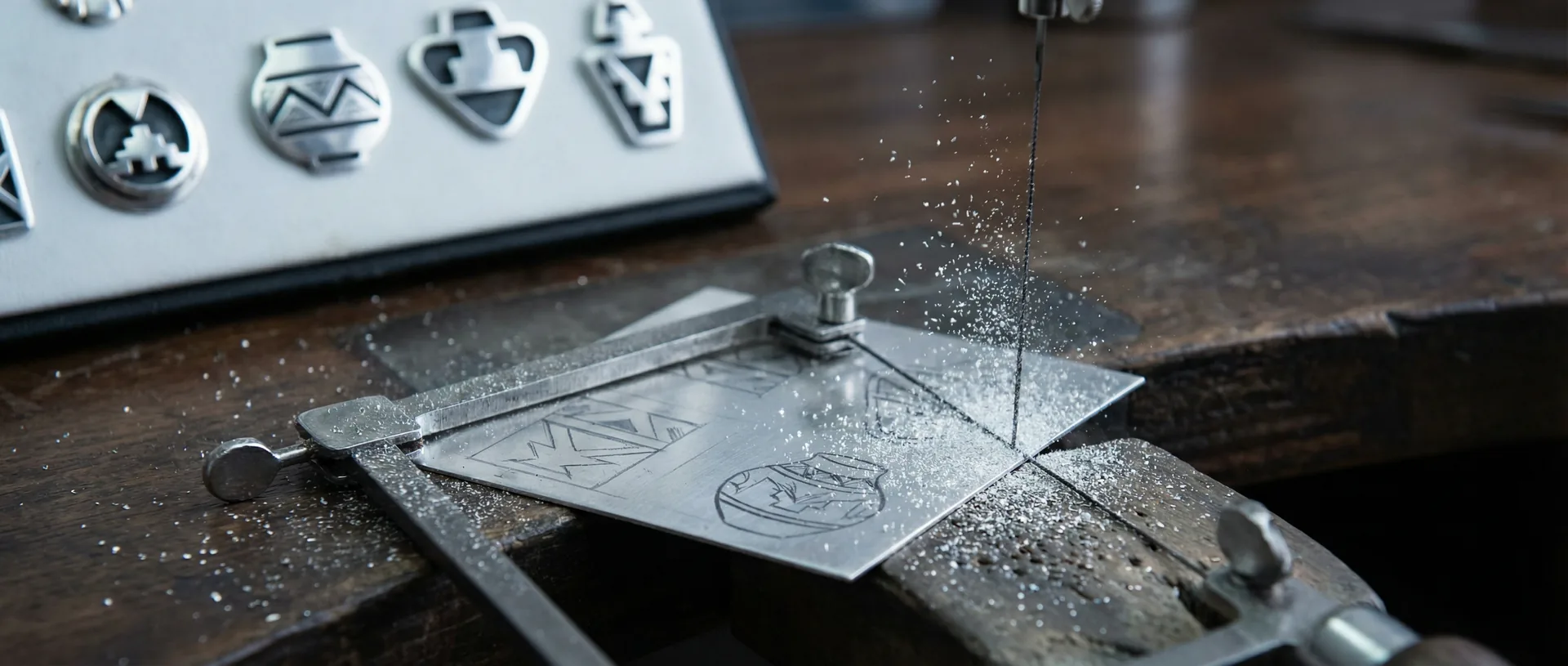
Working from his studio on Second Mesa, Duane Tawahongva practices the distinctive Hopi overlay technique — a method in which two layers of sterling silver are fused together, with designs cut from the top layer to reveal the oxidized surface beneath. Clan symbols, water motifs, and migration patterns translate centuries of Hopituh Shi-nu-mu spiritual knowledge into wearable silver narratives that carry prayers across the secular world.
Read Article
$165.00

$275.00

$215.00

$255.00

$245.00

$230.00

$165.00

$179.00