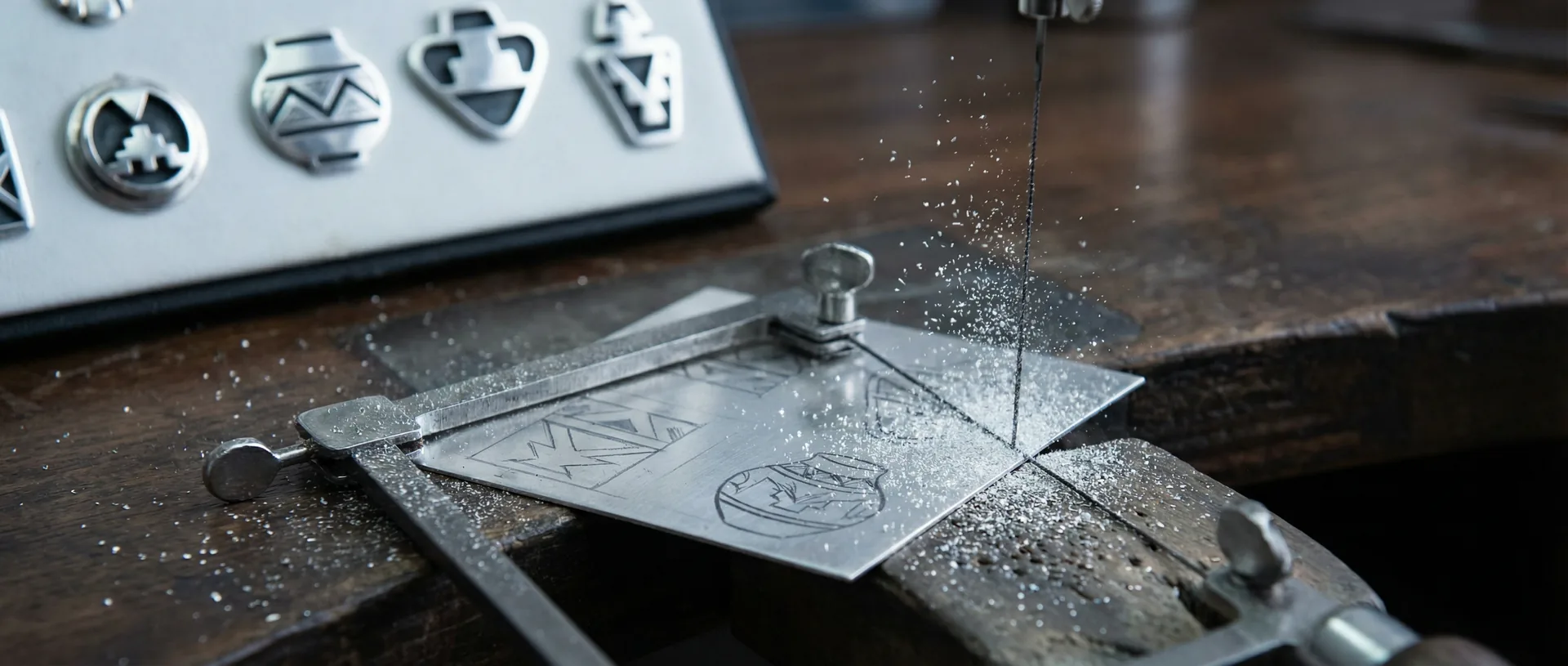
The Hopi overlay tradition as a language of prayer and cultural memory
By The Humiovi Editorial Desk — Sedona, Arizona · est. 1972
·
Hopi overlay began on Second Mesa in northeastern Arizona, its origins precisely documented: the Museum of Northern Arizona invited painter Fred Kabotie to design motifs from traditional Hopi imagery, and silversmith Paul Saufkie developed the method of cutting designs from one silver sheet soldered to an oxidized second sheet.
The Hopi Mesas rise from the painted desert of northeastern Arizona like stone ships on a dry sea — three narrow, flat-topped peninsulas extending south from the larger Black Mesa formation. Second Mesa, the central promontory, is home to the villages of Shungopavi, Mishongnovi, and Sipaulovi, communities that have been continuously inhabited for centuries and that gave birth to the silver overlay technique that would become the defining artistic expression of Hopi metalwork.
The overlay technique’s origins are precisely documented, a rarity in the history of Native American craft traditions. The Museum of Northern Arizona in Flagstaff, seeking to help Hopi silversmiths develop a distinctive style that would differentiate their work from the Navajo and Zuni jewelry dominating the market, invited artist Fred Kabotie to design motifs based on traditional Hopi pottery, textile, and kachina imagery. Kabotie, already recognized as one of the most important Native American painters of his generation, created a vocabulary of designs drawn from ancient Sikyatki pottery, clan symbols, and ceremonial iconography. Silversmith Paul Saufkie then developed the technical method of cutting these designs from one sheet of silver and soldering it to a second sheet, with the recessed areas oxidized to create contrast.
The resulting technique — Hopi overlay — was a genuine innovation that married traditional visual culture with a new metalworking method. A formal silversmithing program was subsequently established on Second Mesa under the guidance of the Museum of Northern Arizona and the Hopi Silvercraft Cooperative Guild, training a generation of artisans in the overlay technique and establishing quality standards that persist to this day.
The revolutionary figure who expanded Hopi jewelry beyond the overlay tradition’s original parameters was Charles Loloma, whose workshop on Third Mesa became the epicenter of Native American jewelry innovation across several decades. Loloma incorporated turquoise, coral, lapis lazuli, and other stones into his silver work — a departure from the stone-free purity of classical overlay — and developed forms that drew as much from modernist sculpture as from Hopi tradition. Loloma demonstrated that tradition could be extended without being betrayed, that innovation conducted with cultural knowledge and artistic integrity was itself a form of cultural continuity.
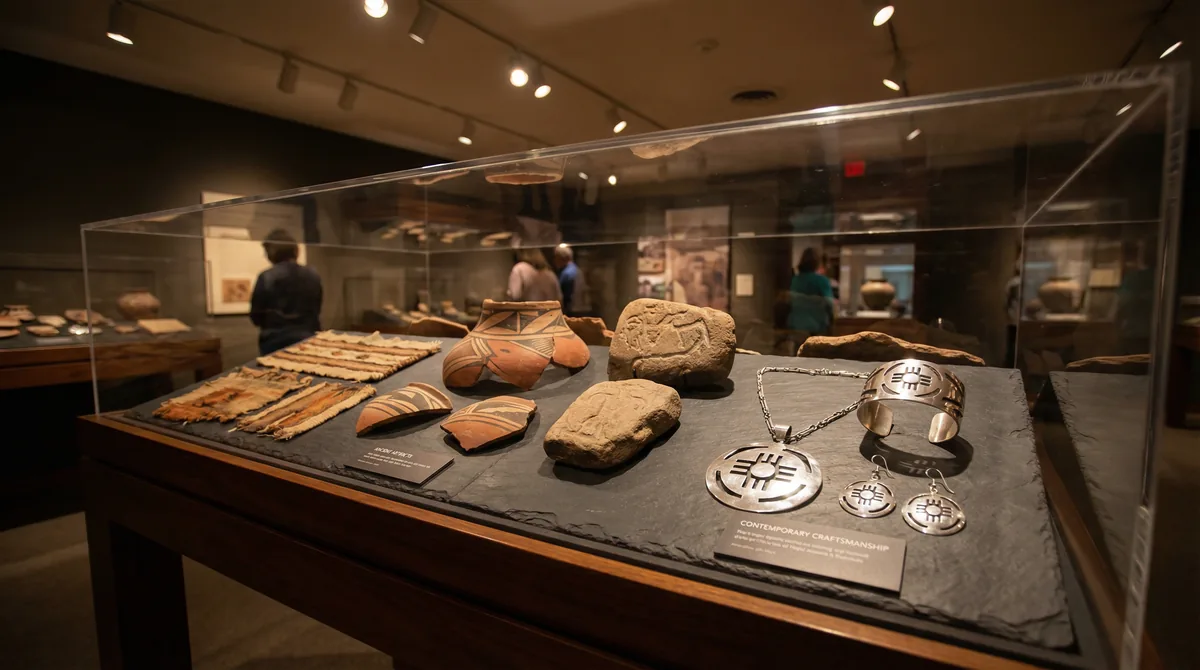
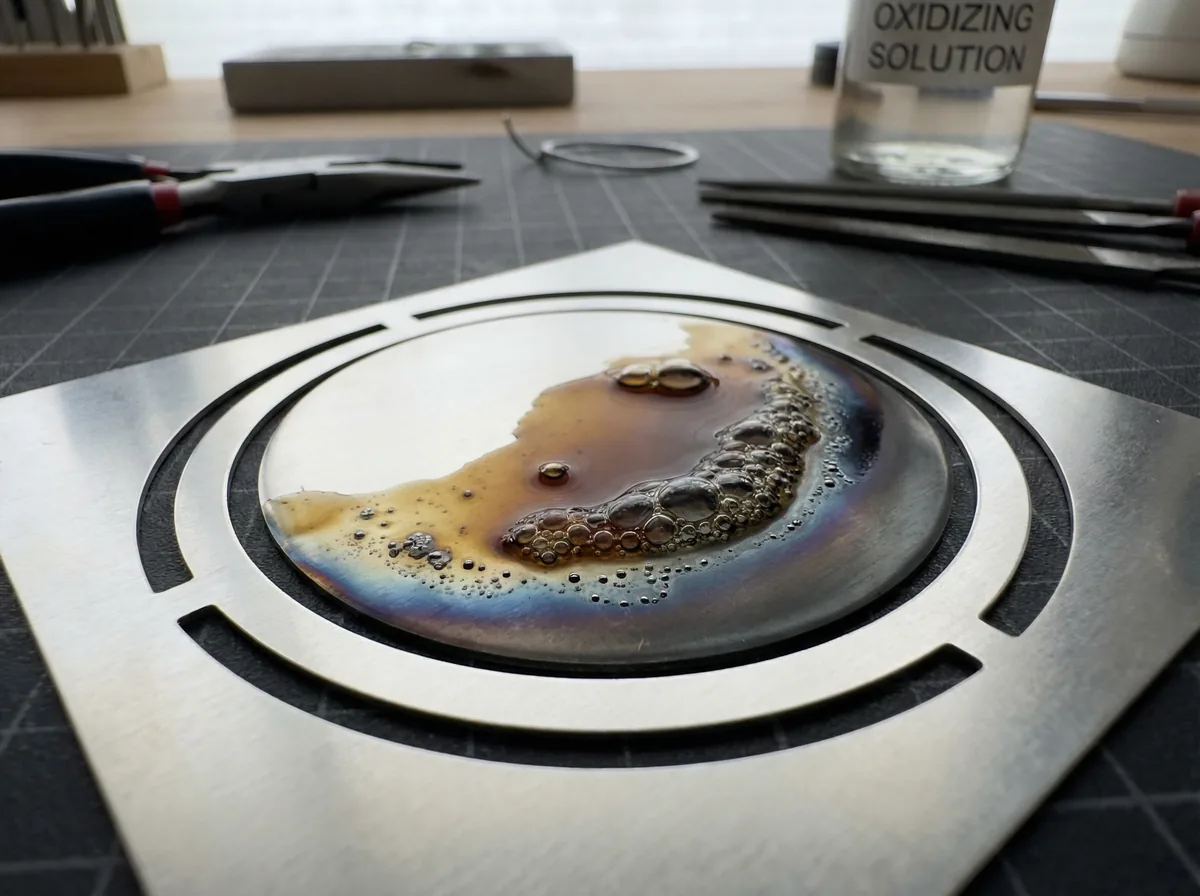
Hopi overlay is a subtractive technique: silver is removed from a top layer to reveal a contrasting surface beneath. Duane Tawahongva transfers a design onto 20-gauge silver, saws away the negative spaces, textures and oxidizes the bottom layer, solders the two sheets together, then polishes only the bright top layer for maximum contrast.
Hopi overlay is a subtractive metalworking technique — the design emerges not through addition of material (as in Navajo stampwork) or insertion of material (as in Zuni inlay) but through the removal of silver from the top layer to reveal the contrasting surface beneath. The process demands a specific sequence of operations, each requiring precision and patience, that Duane Tawahongva has refined across three decades of daily practice.
The process begins with design transfer. Duane draws his designs on paper first, working with pencil and eraser until the composition achieves the balance he seeks. The finished drawing is transferred to a sheet of 20-gauge sterling silver using carbon paper, creating a guide for the cutting stage. The choice of 20-gauge silver for the top layer is deliberate — thinner gauges lack the visual weight that gives overlay its distinctive raised-line quality, while thicker gauges make the sawing process unnecessarily laborious.
Cutting is the most time-intensive phase of overlay production. Using a jeweler’s saw with a fine blade (typically 4/0 or 6/0 gauge), Duane follows the transferred design lines, cutting away the negative spaces that will reveal the bottom layer. The saw blade moves only on the pull stroke, a technique that provides maximum control and minimizes the risk of blade breakage. Sawing a complex bracelet design with intricate water symbols or migration patterns demands steady hands, even breathing, and meditative focus.
The bottom layer is prepared with a contrasting texture. Duane applies a consistent crosshatch pattern using a hand-held graver or texturing stamp, creating a surface that will appear dark and matte against the bright, polished top layer. This textured surface is then oxidized using liver of sulfur solution, which darkens the silver to a deep charcoal gray or black. The contrast between the bright, polished cutout areas of the top layer and the dark, textured bottom layer is what gives Hopi overlay its visual power — the design reads as positive silver forms floating above a dark ground, creating an effect that is simultaneously bold and refined.
Soldering the two layers together requires uniform heat distribution across the entire piece to ensure complete bonding. Duane uses a combination of hard silver solder and flux, heating the assembled piece with a large torch until the solder flows throughout the joint. Any cold spots result in incomplete bonding that will eventually cause the layers to separate under stress. After soldering, the piece is cleaned in pickle solution, shaped to its final form (curved over a mandrel for bracelets, formed on a ring mandrel for rings), and polished. The polishing process is selective: Duane polishes only the top layer to a bright finish, leaving the oxidized bottom layer undisturbed to maintain maximum contrast.
Unlike techniques that can be partially mechanized, overlay’s every step requires hand guidance, making it resistant to mass production and ensuring that each piece carries the distinctive character of its maker’s hand.
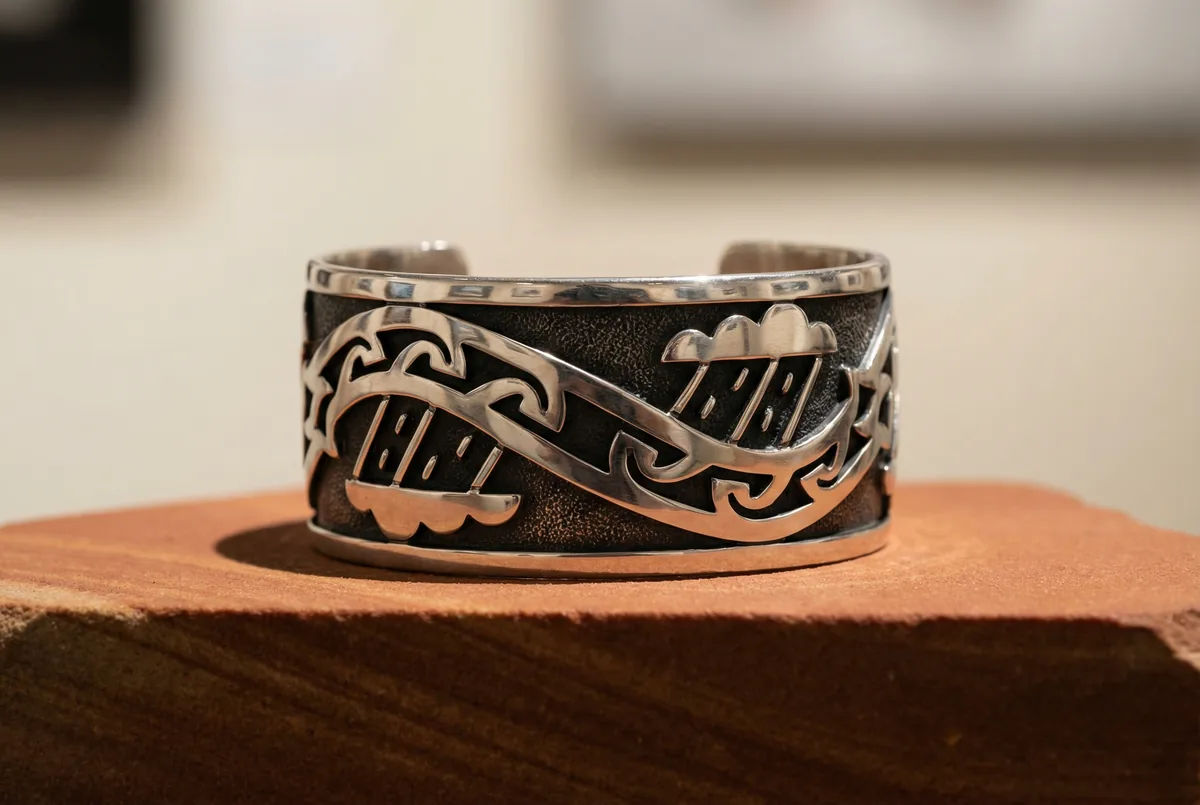
Every element in Duane Tawahongva's overlay carries cultural meaning rooted in Hopi cosmology. Water symbols, clouds, rain lines, and waves dominate, reflecting water's spiritual importance; migration spirals record clan journeys; and kachina forms appear in respectful abstraction.
Every element in Duane Tawahongva’s overlay designs carries specific cultural meaning rooted in Hopi cosmology, ceremony, and clan history. Unlike purely decorative patterns, Hopi overlay motifs function as a visual language — a system of symbols whose meanings are known to community members and whose presence on a piece of jewelry transforms it from ornament into prayer object. Duane navigates this symbolic territory with the responsibility of someone who understands that his artistic choices carry spiritual weight.
Water symbols dominate Duane’s design vocabulary, reflecting the central importance of water in Hopi life and ceremony. The Hopi homeland receives an average of seven inches of rainfall annually, making water the most precious and spiritually charged element in the landscape. Cloud symbols — stepped forms representing cumulus formations — appear frequently in Duane’s work, often combined with rain lines (parallel diagonal strokes) and water wave motifs (undulating horizontal lines). These elements reference specific prayers for moisture that are integral to Hopi ceremonial cycles, and their presence on a bracelet or pendant extends those prayers into the wearer’s daily life.
Migration patterns constitute another major design category. Hopi oral history describes a series of great migrations undertaken by different clans before their arrival at the current mesa-top villages, journeys that are recorded in spiral and labyrinth motifs found on ancient pottery and rock art. Duane incorporates these migration symbols into his overlay designs, connecting the wearer to the deep temporal narrative of Hopi movement across the landscape. The spiral, in particular, holds multiple layers of meaning — representing the migration journey, the cycle of seasons, the passage from one world to the next in Hopi cosmological narrative, and the inward journey of prayer and contemplation.
Kachina imagery, while culturally sensitive, appears in appropriately abstracted forms in Duane’s work. Kachinas — spiritual beings who serve as intermediaries between the human and spirit worlds — are central to Hopi ceremonial life. Duane represents kachina forms through geometric abstraction rather than figurative depiction, respecting the community’s norms about the appropriate contexts for detailed kachina representation. A stepped cloud form might suggest a specific kachina’s headdress without explicitly depicting the figure; a series of parallel lines might reference a kachina’s characteristic body markings without creating a recognizable portrait. This approach allows Duane to work within the visual vocabulary of his cultural inheritance while maintaining the boundaries that Hopi tradition establishes around sacred imagery.
Duane Tawahongva keeps the overlay method rigorously traditional while pushing his compositions beyond early symmetrical formats into asymmetry and varying scale. He occasionally adds a single turquoise accent, an echo of Charles Loloma's legacy.
Duane Tawahongva positions his work at the intersection of strict traditional technique and contemporary design sensibility — a territory that Charles Loloma first mapped and that subsequent generations of Hopi artists have continued to explore. While Duane’s overlay method is rigorously traditional, his compositions frequently push beyond the symmetrical, border-pattern formats that characterized early Guild-era overlay work. He experiments with asymmetrical placement, varying scale within a single piece, and compositional strategies borrowed from contemporary graphic design and architecture.
Duane’s relationship with color in silver work is nuanced. Classical Hopi overlay is a monochromatic medium — bright silver against dark silver, with no color from stones or other materials. Duane respects this tradition in the majority of his work but has, on occasion, introduced a single turquoise accent into an overlay design — a small cabochon set at a compositionally strategic point that introduces a flash of color into the silver-and-shadow dialogue. These pieces acknowledge Charles Loloma’s legacy while maintaining the restraint of classical overlay. The turquoise, when present, is never the focal point but rather a quiet punctuation mark within the silver narrative.
Hopi agriculture offers a metaphor for innovation within tradition. Hopi farmers have cultivated corn on these dry mesas for centuries using dry-farming techniques that require deep understanding of soil, weather, and seed behavior. Each generation of farmers inherits the core knowledge and techniques but must adapt to specific conditions — a particular drought year, a change in rainfall patterns, the availability of new seed varieties. The adaptation does not violate the tradition; it extends it. Overlay can be seen in the same terms: the overlay technique and the symbolic vocabulary are inherited, but each piece must respond to the specific conditions of its making — the commissioning context, the available materials, the artist’s accumulated experience, and the cultural moment in which the piece enters the world.
His pieces function in multiple registers: as beautiful objects, as cultural documents, as prayer carriers, and as evidence that living traditions evolve through the creative engagement of each successive generation of practitioners.
Duane Tawahongva has taken an apprentice into his own studio, a young man from the village of Shungopavi, as fewer young Hopi enter silversmithing. He teaches in the traditional Hopi sequence — observation, then simple tasks, then complex ones.
Duane’s current concern is the declining number of young Hopi men and women entering the silversmithing profession. The economics of overlay silversmithing — which rewards patience and skill but produces modest hourly returns compared to wage employment — present a genuine challenge to cultural transmission. Duane has responded by accepting apprentices in his own studio, currently working with a young man from the village of Shungopavi who shows the combination of manual dexterity, cultural knowledge, and temperamental patience that the craft demands.
The apprenticeship follows the traditional Hopi model: the student observes before participating, participates in simple tasks before attempting complex ones, and demonstrates proficiency at each stage before advancing. A complete overlay education takes years of sustained practice, and that length is itself a form of quality control — it ensures that only individuals with genuine commitment and aptitude complete the training, maintaining the standard of excellence that the Hopi silversmithing community has upheld since the technique’s inception.
Overlay invites the viewer to see beyond the silver’s surface. Each design is a text written in a visual language developed over centuries, each symbol a compressed narrative of prayer, history, and identity. The overlay technique itself — with its interplay of light and shadow, revelation and concealment, surface and depth — serves as a metaphor for the relationship between the visible and spiritual worlds that Hopi philosophy understands as the fundamental structure of reality. To wear one of Duane’s pieces is to carry that understanding, quietly and beautifully, through the ordinary world.
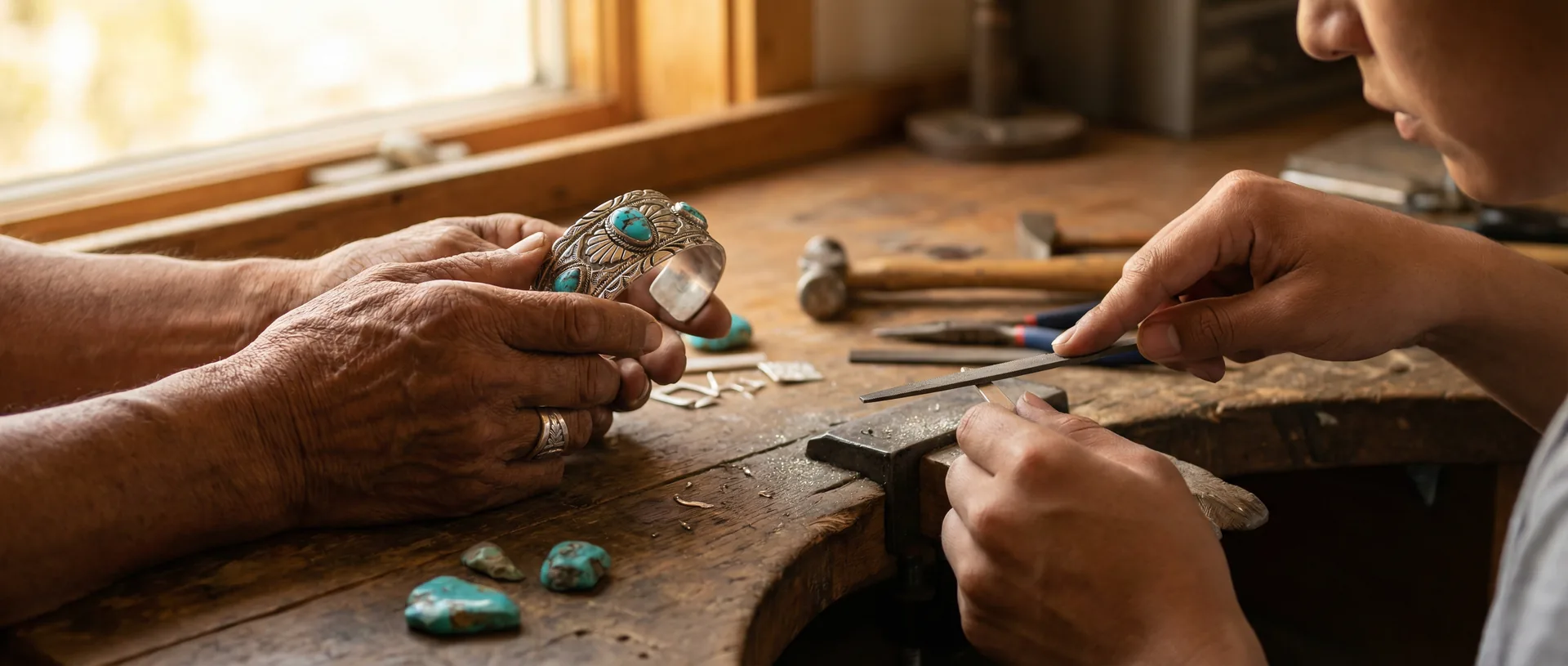
Generational Knowledge in Every Piece
Understanding the apprenticeship model and family lineages that produce the finest Native American jewelry.
Read Article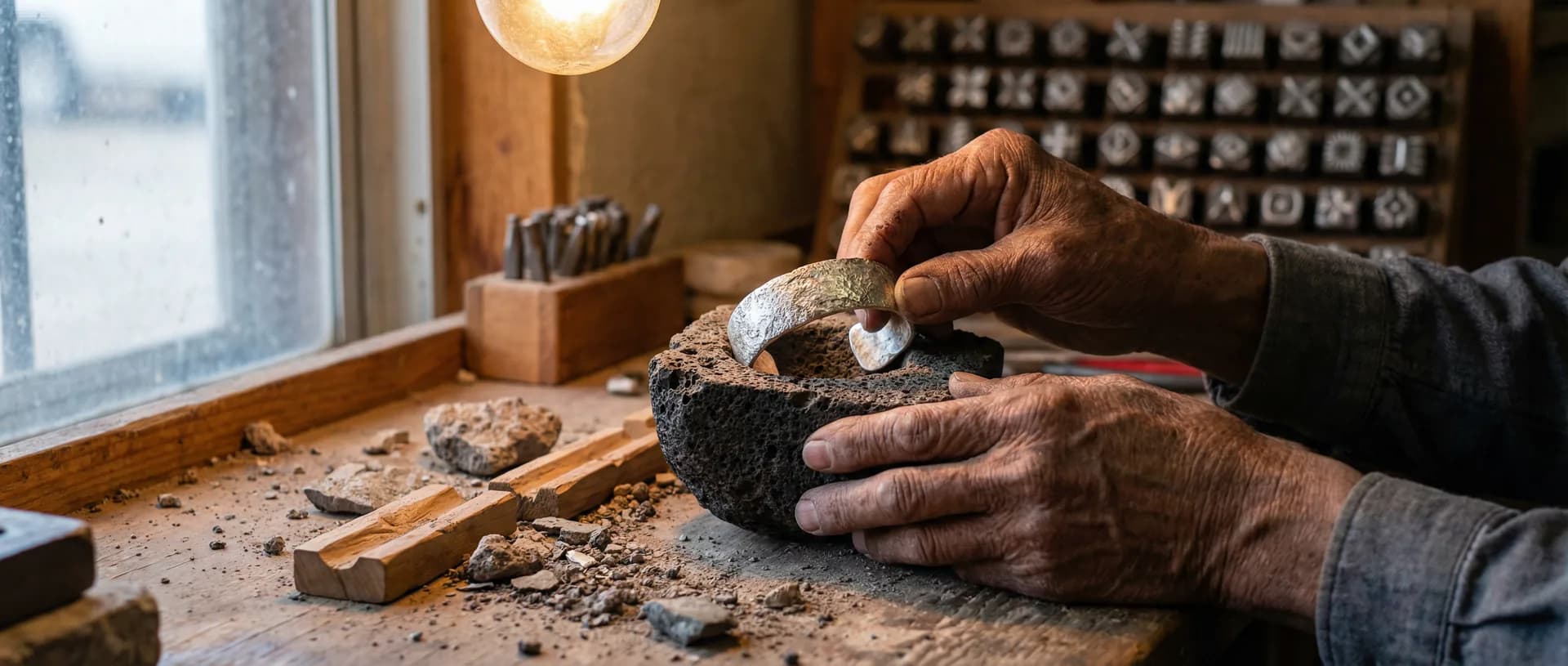
A lifetime devoted to the ancient art of Diné silverwork
Thomas Begay has spent five decades refining the techniques first brought to the Diné by Atsidi Sani generations ago. His sand-cast and tufa-cast creations represent a living bridge between ancestral metalworking traditions and contemporary artistic expression, each piece carrying the weight of cultural memory forged in sterling silver.
Read Article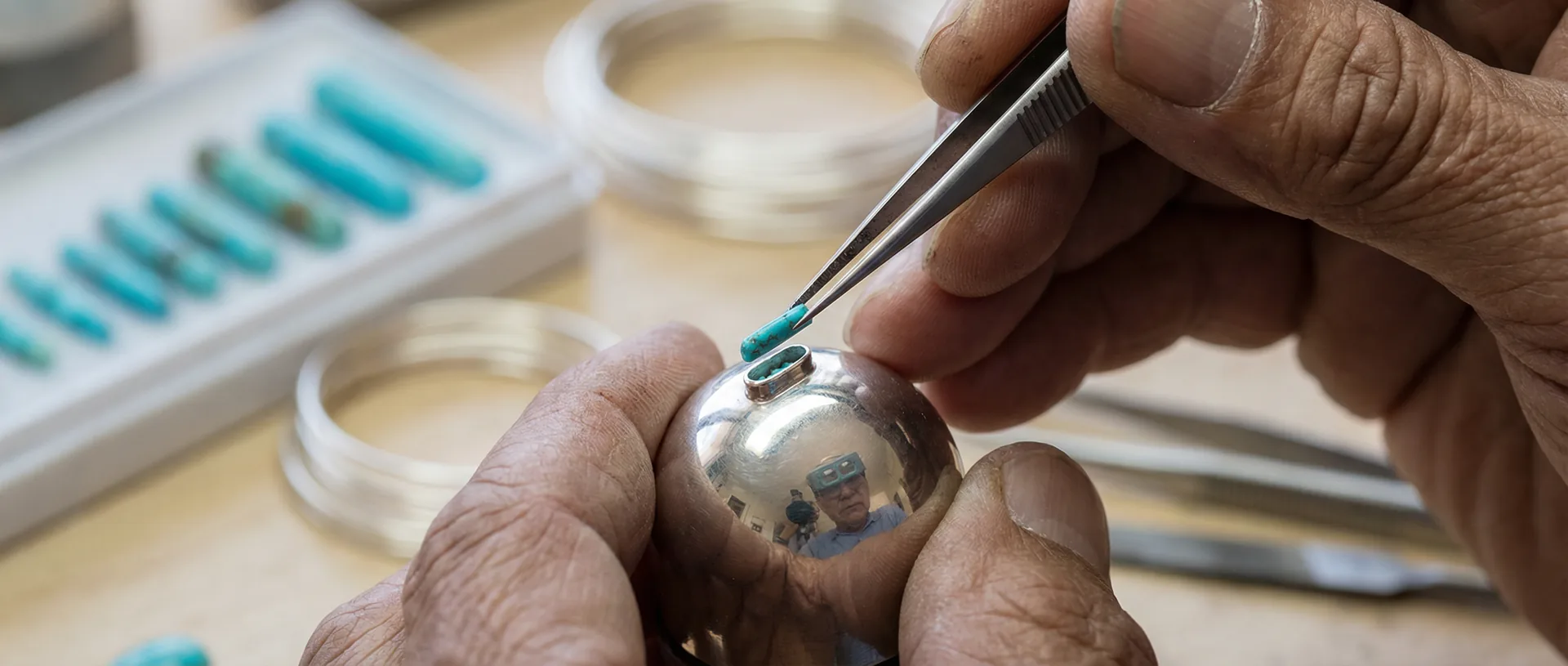
Where patience becomes beauty in the A:shiwi tradition of stone cutting
In the quiet precision of her Zuni Pueblo workshop, Lorraine Waatsa transforms raw turquoise, coral, and shell into the intricate needlepoint, petit point, and mosaic inlay patterns that have defined Zuni lapidary artistry for over a century. Her work carries forward the Zuni lapidary tradition while pushing the boundaries of what stone-on-silver composition can achieve.
Read Article