Where patience becomes beauty in the A:shiwi tradition of stone cutting
By The Humiovi Editorial Desk — Sedona, Arizona · est. 1972
·
Zuni Pueblo, known to its people as Halona:wa in western New Mexico, has stone cutting and inlay traditions reaching back centuries before European contact. Lorraine Waatsa was born into this tradition, which emphasizes stone over metal, unlike Navajo silversmithing.
Zuni Pueblo — known to its inhabitants as Halona:wa, the Middle Place — sits along the banks of the Zuni River in western New Mexico, approximately thirty-five miles south of Gallup. The A:shiwi people’s relationship with stone cutting and inlay work extends back centuries before European contact, when Zuni artisans created elaborate mosaic designs on shell, bone, and wood using carefully shaped pieces of turquoise, jet, and red shale.
Lorraine Waatsa was born into this tradition, whose modern history includes Leekya Deyuse, the legendary Zuni carver and lapidary artist whose fetish carvings and stone-set jewelry established international recognition for Zuni artistry in the modern era. While Leekya is most celebrated for his animal fetish carvings — small, meticulously detailed figures of bears, birds, and frogs carved from turquoise, shell, and other stones — his broader influence on Zuni lapidary technique cannot be overstated. He demonstrated that stone could be worked with the same precision and expressive range as silver, elevating the lapidary arts to equal standing with metalwork in the hierarchy of Southwestern jewelry traditions.
Lorraine learned through the traditional Zuni teaching method: sustained proximity. There were no formal lessons. She simply grew up surrounded by the work — the sound of grinding wheels, the smell of stone dust mixed with water, the sight of tiny cabochons accumulating in shallow dishes like geological confetti. By the time she was old enough to articulate her desire to become a lapidary artist, she had already absorbed years of foundational knowledge through osmosis.
The Zuni lapidary tradition differs fundamentally from Navajo silversmithing in its emphasis on stone rather than metal. Where a Navajo piece is typically conceived as a silver design that incorporates stone, a Zuni piece is often conceived as a stone composition that requires silver only as structural support. The silver serves as the armature — the framework that holds the stone arrangement in place and provides the piece’s wearable form — but the artistic statement resides in the stone cutting, shaping, and arrangement. This distinction shapes every aspect of a Zuni lapidary artist’s training, from the initial emphasis on stone selection and cutting technique to the advanced skills of color matching, pattern composition, and inlay precision.
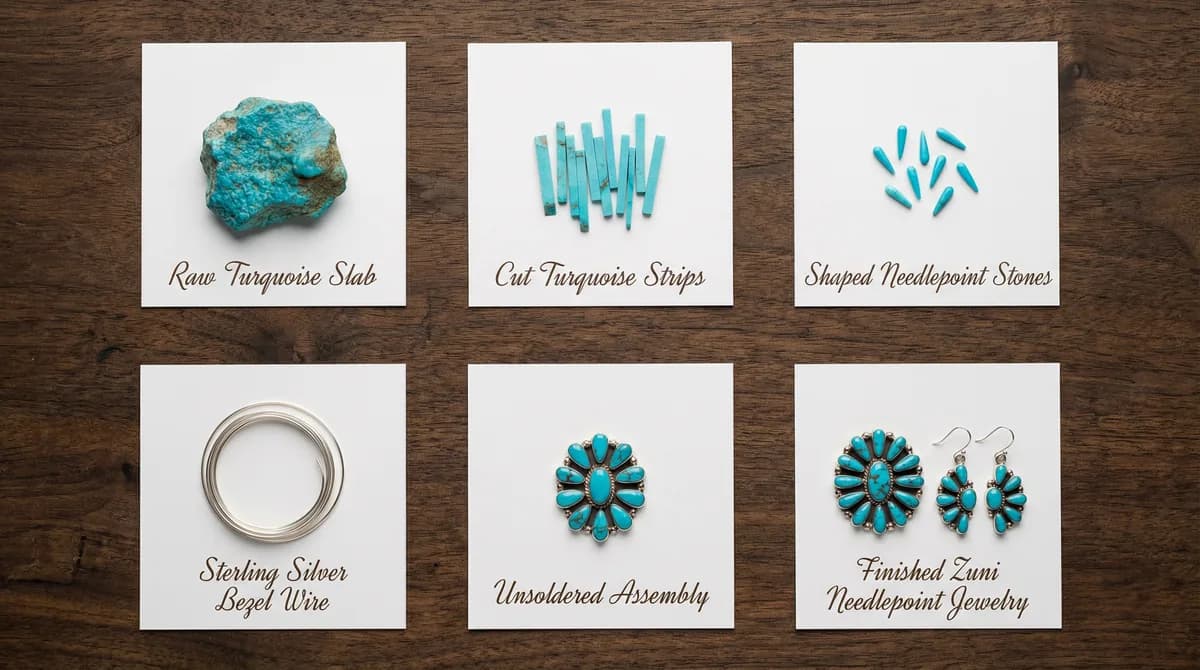
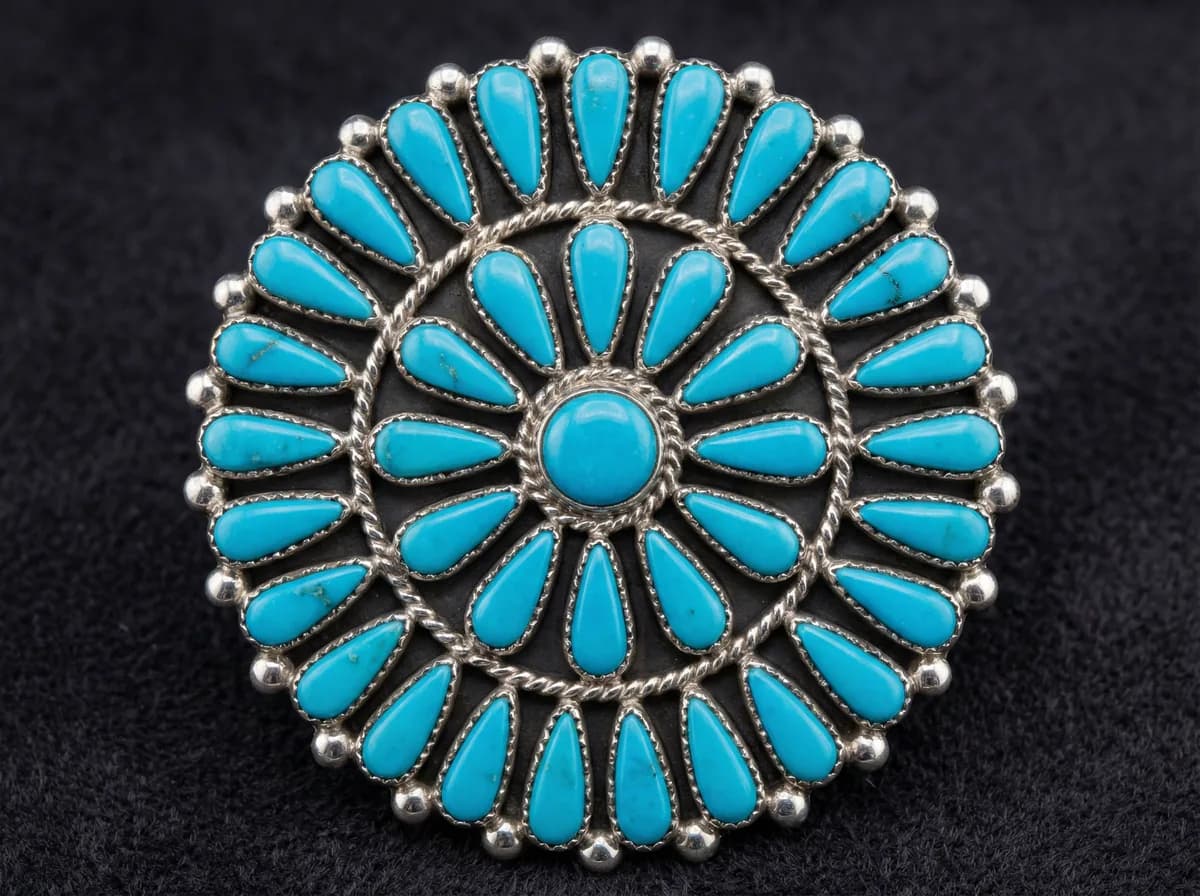
Needlepoint and petit point, Lorraine Waatsa's primary specialization, cut turquoise into very small, precisely shaped cabochons set in individual silver bezels arranged in geometric patterns. Needlepoint stones are elongated, pointed ovals; petit point stones are small rounded ovals or teardrops. Both demand tolerances measured in fractions of a millimeter.
Needlepoint and petit point represent the most technically demanding forms of Zuni stonework, and they are Lorraine Waatsa’s primary specialization. Both techniques involve cutting turquoise into extremely small, precisely shaped cabochons that are set in individual silver bezels arranged in geometric patterns. The distinction between them lies in the cabochon shape: needlepoint stones are elongated, pointed ovals resembling the eye of a needle, while petit point stones are small, rounded ovals or teardrops. Both require cutting and shaping stones to tolerances measured in fractions of a millimeter.
Lorraine’s needlepoint work begins with stone selection. She favors Sleeping Beauty turquoise for its color consistency — when a piece requires forty or sixty individually set stones, even subtle color variation between cabochons disrupts the visual coherence that defines successful needlepoint. Cutting begins by slicing rough turquoise into thin slabs using a diamond-blade trim saw. Each slab is then marked with a fine-point pen to indicate the individual cabochon shapes, oriented to maximize yield while ensuring consistent color across every stone that will appear in the finished piece.
The grinding and shaping process is where Lorraine’s decades of experience become most evident. Each stone is shaped on a series of progressively finer silicon carbide grinding wheels, beginning with a coarse 100-grit wheel for rough shaping and moving through 220, 400, and 600 grit for refinement. The final polish uses a leather wheel charged with cerium oxide compound. A single needlepoint cabochon is typically six to ten millimeters in length and two to three millimeters in width.
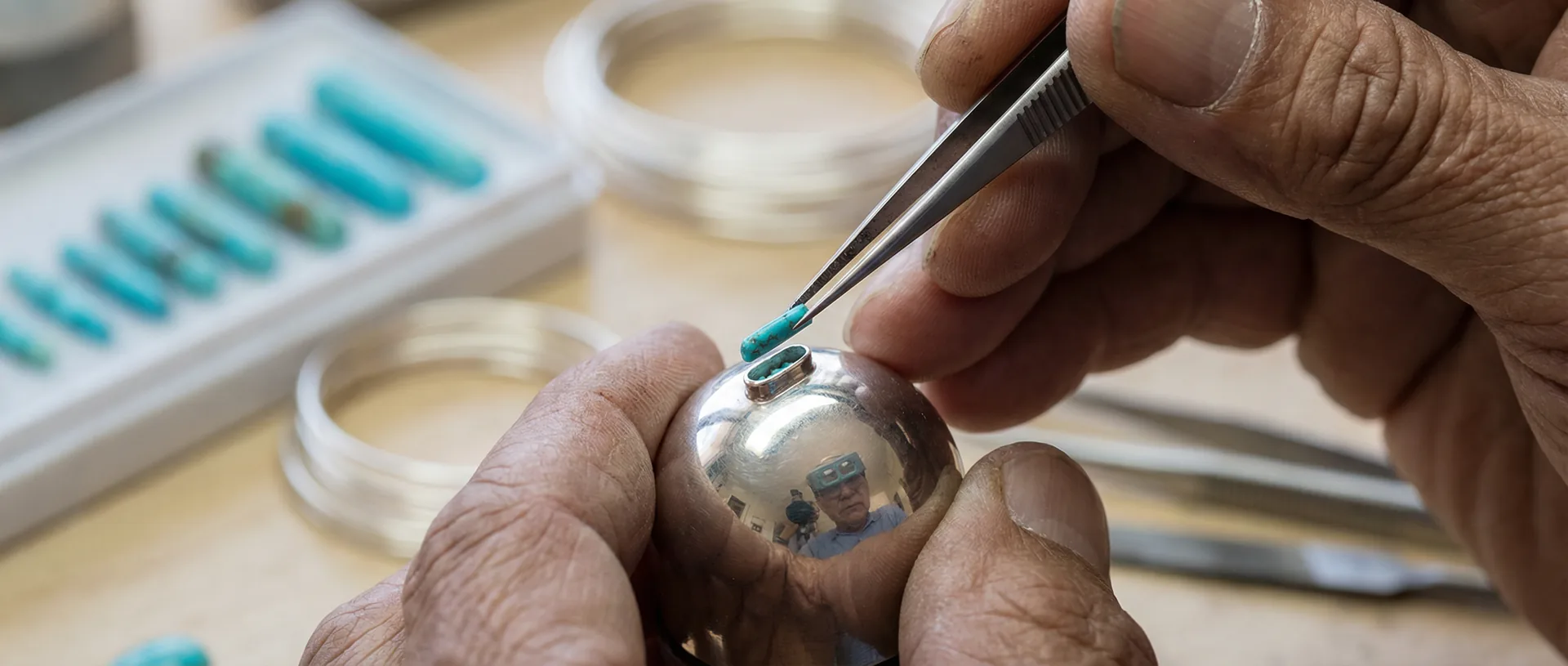
The bezel fabrication for needlepoint work demands equally exacting precision. Each stone requires a custom bezel cut from thin-gauge silver sheet, formed to match the stone’s exact profile, and soldered to the silver base plate at the correct position and angle within the overall pattern. Lorraine fabricates these bezels using techniques that have remained essentially unchanged for a century: hand-cutting with jeweler’s shears, forming over a steel mandrel, and fitting each stone individually to ensure the bezel height is uniform and the stone sits level with its neighbors. The final assembly of a needlepoint piece involves setting each stone into its bezel, pressing the silver snugly against the stone’s perimeter, and checking the alignment under magnification to confirm that the geometric pattern reads cleanly.
Petit point work follows a similar process but with rounded rather than pointed cabochon shapes, creating a visual effect that is softer and more organic than needlepoint’s angular geometry. Lorraine often combines both techniques in a single piece, using needlepoint rays radiating from a central cluster of petit point cabochons to create sunburst or floral compositions that showcase the tonal unity of matched Sleeping Beauty turquoise across two complementary cutting styles.
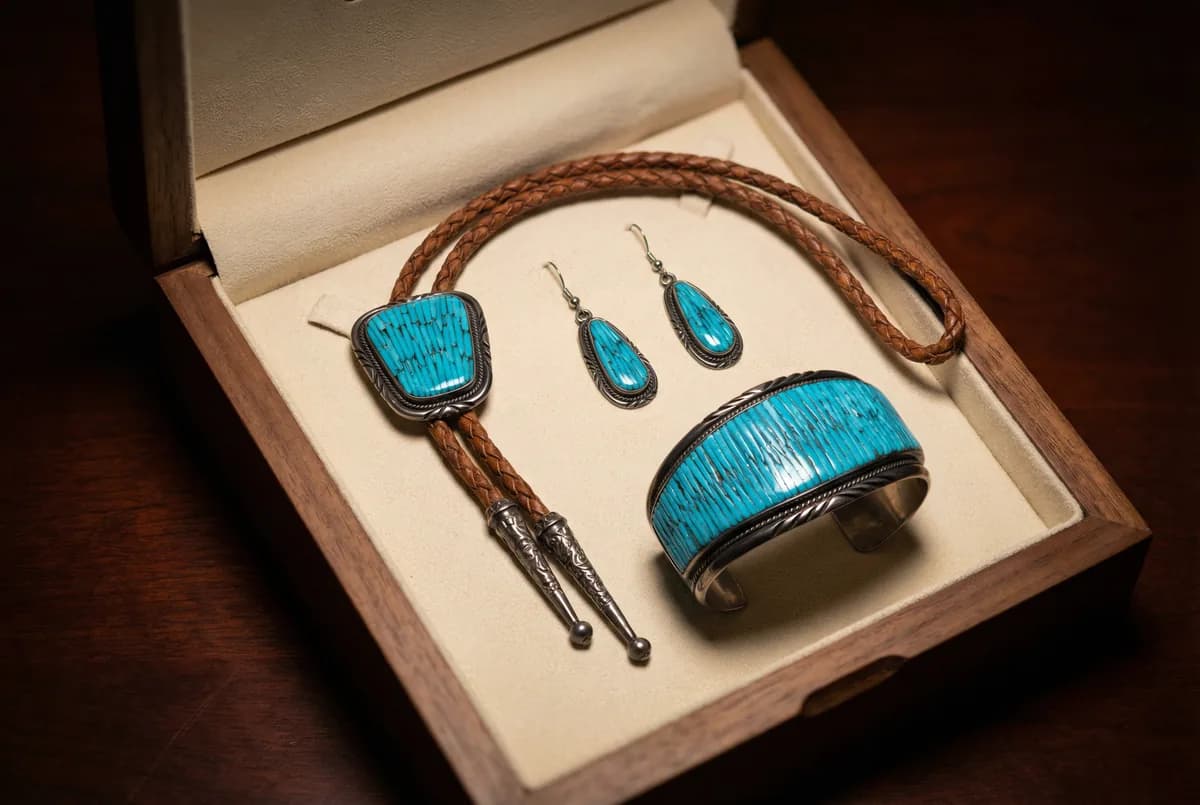
Lorraine Waatsa fits precisely cut stones into channels in the silver surface, creating flush compositions where stone and metal share one plane, separated by thin silver walls. Her palette spans turquoise, Mediterranean coral, mother-of-pearl, jet, and spiny oyster shell, and her mosaic pieces assemble hundreds of hand-shaped stones into free-form pictorial designs.
Beyond needlepoint and petit point, Lorraine Waatsa practices the demanding art of channel inlay — a technique in which precisely cut stone pieces are fitted into channels carved or fabricated in the silver surface, creating flush, seamless compositions where stone and metal exist on the same plane. Channel inlay eliminates the raised bezel structure visible in needlepoint work; instead, the cut stones fit together like tiles in a mosaic, separated by thin silver walls that serve as both structural dividers and design elements.
The material palette for Lorraine’s inlay work extends beyond turquoise to encompass the full range of traditional Zuni stones. Mediterranean coral — prized for its deep, saturated red — provides warm contrast to turquoise’s cool blue. Mother-of-pearl contributes luminous white and iridescent tones. Jet, the polished form of fossilized wood, offers deep black that defines edges and creates visual anchors within complex compositions. Spiny Oyster shell, harvested from the Pacific coast, ranges from vivid orange through deep purple and has become increasingly prominent in Zuni work as coral regulations have limited traditional Mediterranean coral supply.
Lorraine’s mosaic inlay pieces represent her most ambitious compositions. Unlike channel inlay, which typically follows geometric patterns defined by the silver channel structure, mosaic inlay allows free-form pictorial designs — depictions of birds, butterflies, dancers, and ceremonial figures rendered entirely in shaped stone pieces fitted together without gaps. The technical challenge is formidable: each stone piece must be cut to an exact, irregular shape that interlocks with its neighbors while maintaining the correct surface height for a flush finish. A mosaic depicting a Zuni Shalako figure might contain over two hundred individually shaped stone pieces, each cut and fitted by hand.
The adhesive question is one that separates traditional from contemporary inlay practice. Historic Zuni inlay used no adhesive at all, relying entirely on the mechanical friction of precisely fitted stones held in place by their silver channel walls. Modern practice, including Lorraine’s, typically employs a minimal amount of two-part epoxy to secure stones — a practical concession that ensures the durability collectors expect while preserving the visual integrity of the traditional technique. Lorraine applies epoxy in quantities small enough to be invisible, never allowing adhesive to substitute for precision in the stone fitting process.
The finishing process for inlay work involves grinding the assembled surface to achieve perfect planarity — a condition where every stone surface and silver divider exists at precisely the same height, creating an unbroken visual plane. Lorraine accomplishes this using progressively finer abrasive papers, working the entire surface simultaneously to prevent any stone from being ground below its neighbors. The final polish with cerium oxide produces a surface that reflects light uniformly across both stone and silver, creating the illusion that the composition was carved from a single multicolored material rather than assembled from discrete components.
Lorraine Waatsa regards stones as living entities with spiritual properties, turquoise tied to sky and breath, coral to water, jet to the night sky, in keeping with A:shiwi tradition.
Lorraine Waatsa’s relationship with her materials reflects the broader A:shiwi understanding of stones as living entities with inherent spiritual properties. In Zuni cosmology, turquoise is associated with the sky and with the breath of life; coral connects to the ocean and to the creative power of water; jet is linked to the night sky and to protective forces. These associations are not merely symbolic — they inform the way Lorraine handles, selects, and positions stones within her compositions, treating each material as a participant in the work rather than a passive medium.
Some Kingman turquoise approximates Sleeping Beauty’s color consistency, though the Kingman material occasionally shows subtle matrix inclusions that require more careful sorting for needlepoint work. Chinese Hubei turquoise, when carefully selected and properly stabilized, offers another viable option for cluster work where absolute color matching across dozens of stones is essential.
In Zuni inlay, Spiny Oyster shell’s vivid orange and purple tones offer dramatic contrast possibilities when combined with turquoise in inlay designs, and its relative availability provides a sustainable alternative to Mediterranean coral, whose harvest is now regulated by international conservation agreements. Its layered structure requires a different cutting approach than mineral stones — the lapidary must orient the shell to avoid delamination along its natural growth planes, a skill that transfers from experience rather than instruction.
The economics of Zuni lapidary work operate differently from those of Navajo silversmithing. Because the artistic value of a Zuni piece resides primarily in its stonework rather than its silver content, the calculation of fair market value centers on the hours of lapidary labor invested, the quality and rarity of the stones used, and the complexity of the design.
Lorraine’s current focus includes training her daughter in the needlepoint tradition. She approaches this transmission with the same precision she brings to her stonework: each skill is taught in sequence, each milestone verified before the next is introduced, each standard enforced without exception. The tradition continues, one carefully cut stone at a time.
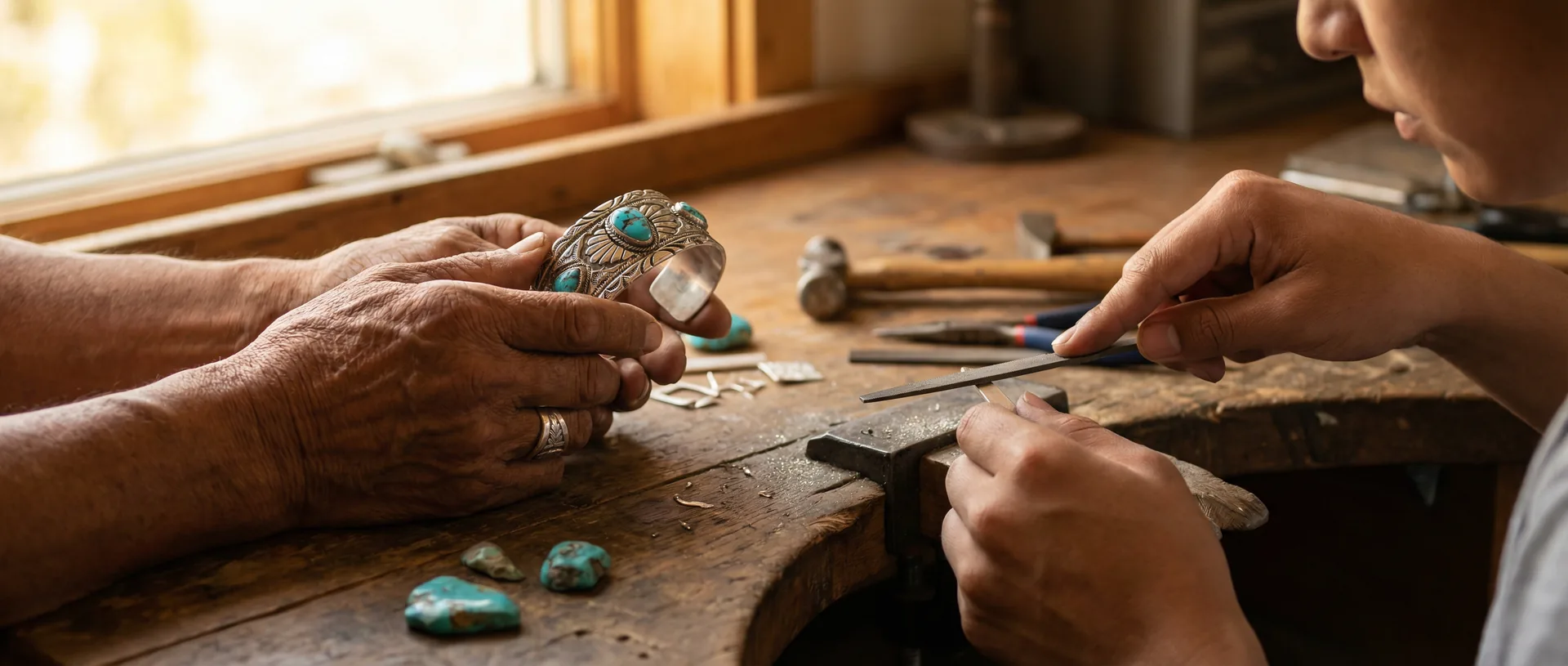
Generational Knowledge in Every Piece
Understanding the apprenticeship model and family lineages that produce the finest Native American jewelry.
Read Article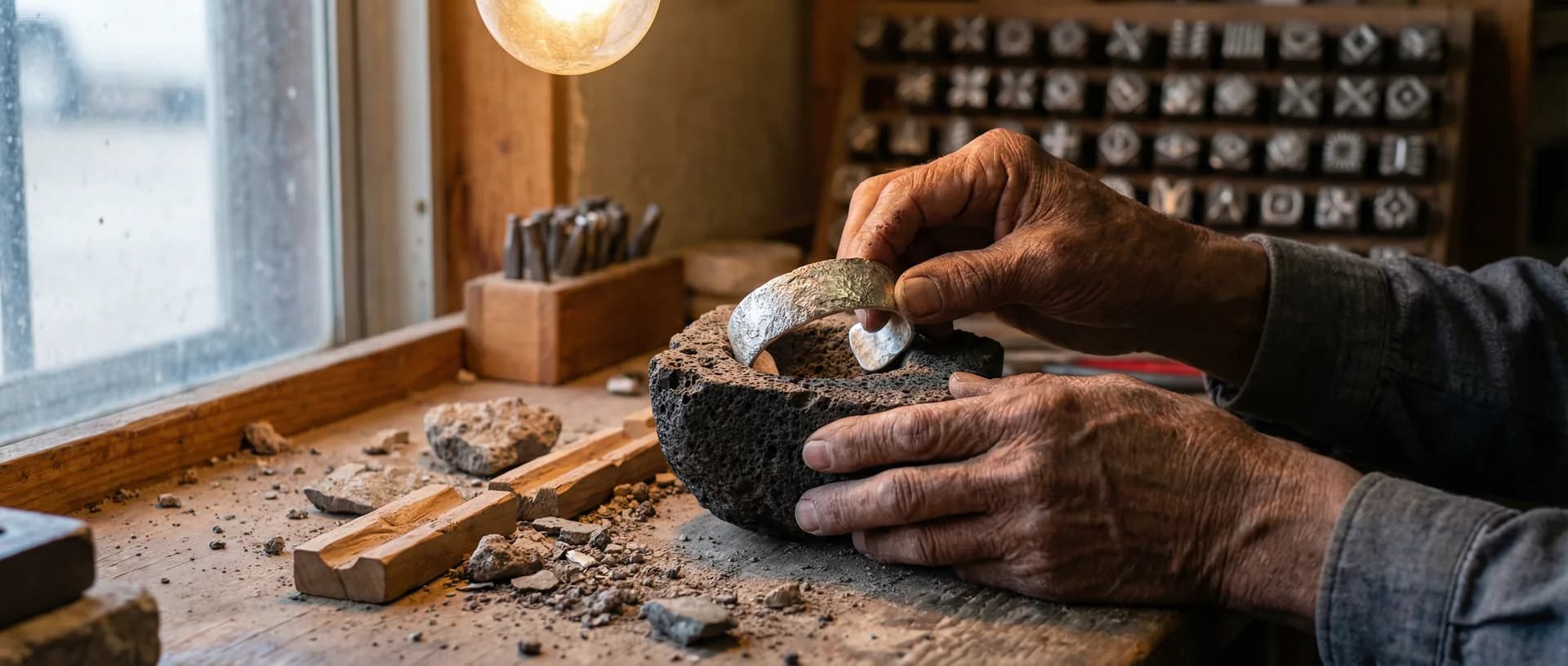
A lifetime devoted to the ancient art of Diné silverwork
Thomas Begay has spent five decades refining the techniques first brought to the Diné by Atsidi Sani generations ago. His sand-cast and tufa-cast creations represent a living bridge between ancestral metalworking traditions and contemporary artistic expression, each piece carrying the weight of cultural memory forged in sterling silver.
Read Article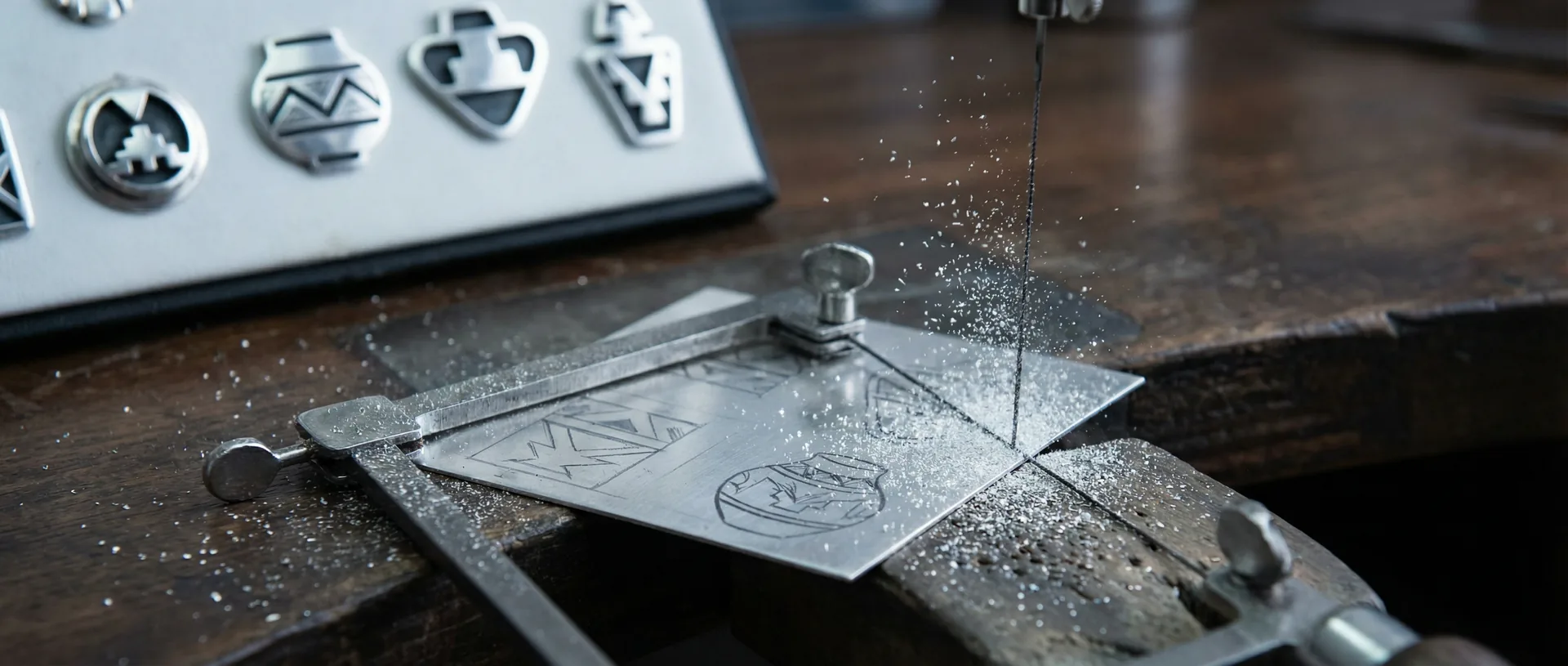
The Hopi overlay tradition as a language of prayer and cultural memory
Working from his studio on Second Mesa, Duane Tawahongva practices the distinctive Hopi overlay technique — a method in which two layers of sterling silver are fused together, with designs cut from the top layer to reveal the oxidized surface beneath. Clan symbols, water motifs, and migration patterns translate centuries of Hopituh Shi-nu-mu spiritual knowledge into wearable silver narratives that carry prayers across the secular world.
Read Article