A lifetime devoted to the ancient art of Diné silverwork
By The Humiovi Editorial Desk — Sedona, Arizona · est. 1972
·
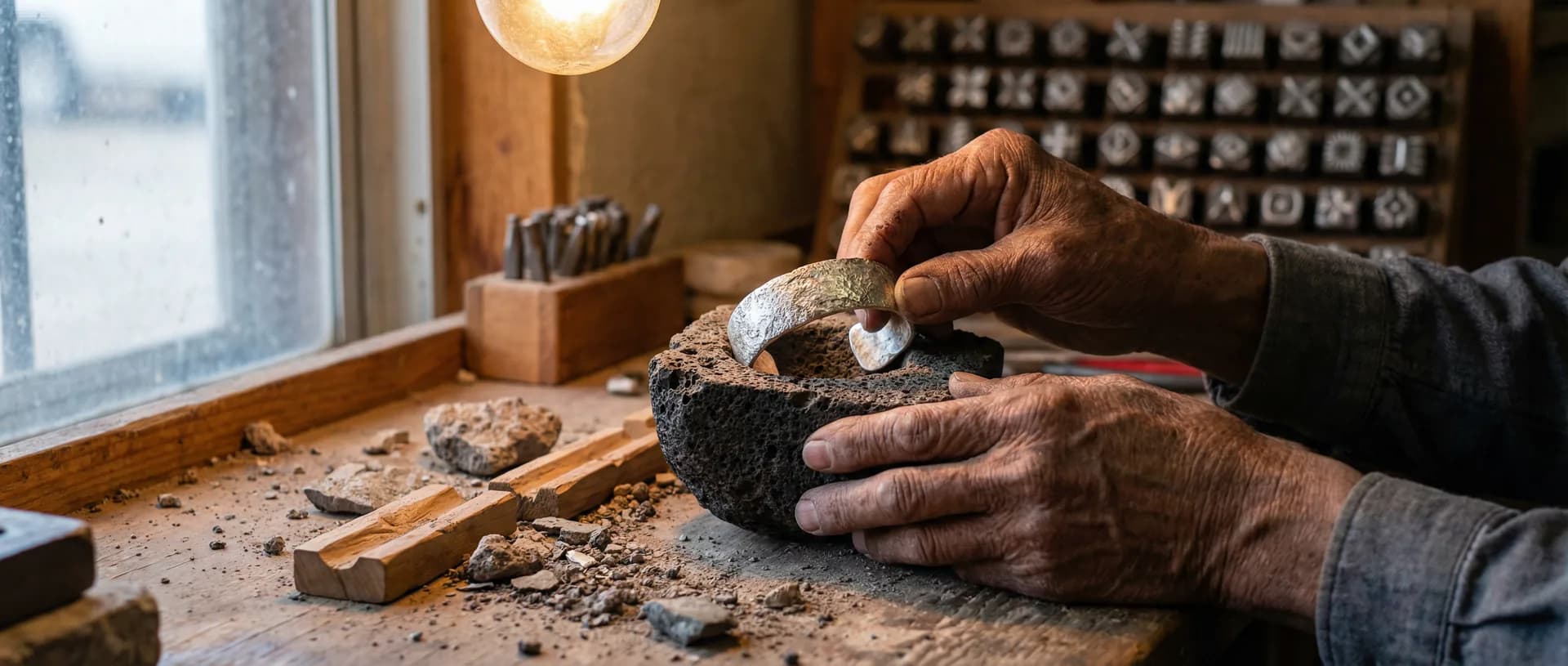
Thomas Begay learned Navajo silversmithing from his maternal grandfather. Watching in the family hogan from age seven, Thomas worked the forge bellows by nine and produced his first bezel-set turquoise ring by twelve, grounded in material mastery before any creative departure.
The story of Navajo silversmithing is bound up with the Long Walk — the forced march that relocated thousands of Diné people to Bosque Redondo in eastern New Mexico. Atsidi Sani, widely recognized as the first Navajo silversmith, had learned metalworking from a Mexican platero named Nakai Tsosi in the early 1860s. When the Diné returned to their homeland under the Treaty of Bosque Redondo, Atsidi Sani carried with him a knowledge that would transform his people’s artistic heritage forever.
Thomas Begay grew up hearing these origin stories from his maternal grandfather, himself a silversmith. The family’s compound sat at the base of a sandstone bluff in the Chinle Valley, where the light shifts from rose to amber across the afternoon hours and the silence is broken only by the rhythmic tap of hammer on silver. Thomas’s grandfather maintained a traditional hogan as his primary workspace, believing that the circular form concentrated creative energy in ways that rectangular buildings could not.
By age seven, Thomas was permitted to sit in the hogan and watch. By nine, he was trusted to operate the bellows for the charcoal forge. By twelve, he had produced his first complete piece — a simple band ring with a single bezel-set turquoise cabochon. His grandfather examined the ring under a kerosene lamp, turning it slowly, testing the bezel tension with a thumbnail. He handed it back without a word, which Thomas understood as the highest available compliment. The ring was technically sound. It would take another forty years for Thomas to understand that technical soundness was merely the foundation upon which artistry could be built.
The apprenticeship model that shaped Thomas Begay is characteristic of Diné metalworking traditions. Unlike Western art education, which emphasizes individual expression and theoretical knowledge, the Navajo approach grounds the student in material mastery before permitting creative departure. A silversmith must first understand silver — its melting point at 1,763 degrees Fahrenheit, the way it flows into a tufa stone mold with the viscosity of heavy cream, how it work-hardens under repeated hammer blows and must be annealed by heating to cherry red and quenching in water. Only after these physical properties become intuitive — known in the hands rather than merely in the mind — does the apprentice begin to design original work.
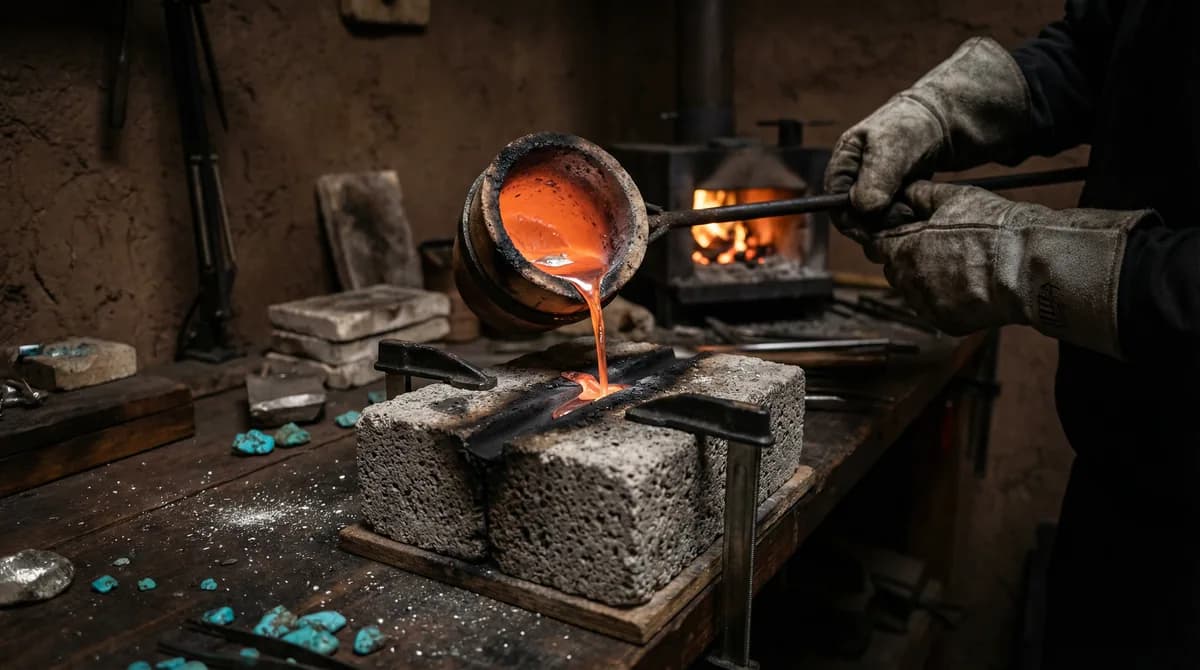
Tufa casting, Thomas Begay's signature method, carves a design in reverse into volcanic tufa stone, binds it to a matching block, and pours molten sterling silver into the cavity. Each mold serves only once or twice, making every casting effectively unique, and the stone's granular texture transfers to the silver as a signature of the process.
Tufa casting is among the oldest metalworking techniques practiced by Navajo silversmiths, and it remains Thomas Begay’s signature method. The process begins not with silver but with stone — specifically, tufa, a soft porous stone carved into molds. The finest tufa stone for casting comes from deposits near the San Juan River in northwestern New Mexico, where Thomas has collected raw material for decades, selecting pieces with the ideal combination of density and porosity that allows clean casting without excessive gas entrapment.
The silversmith carves the desired design in reverse into the flat face of a tufa block, working with small chisels, files, and dental tools to create the negative impression of the finished piece. A second tufa block is prepared as a matching lid, and channels are carved to allow molten silver to flow into the cavity and displaced air to escape. The two halves are bound together with wire, and molten sterling silver — heated in a crucible over a charcoal forge until it reaches a fluid state — is poured into the mold through the sprue channel.
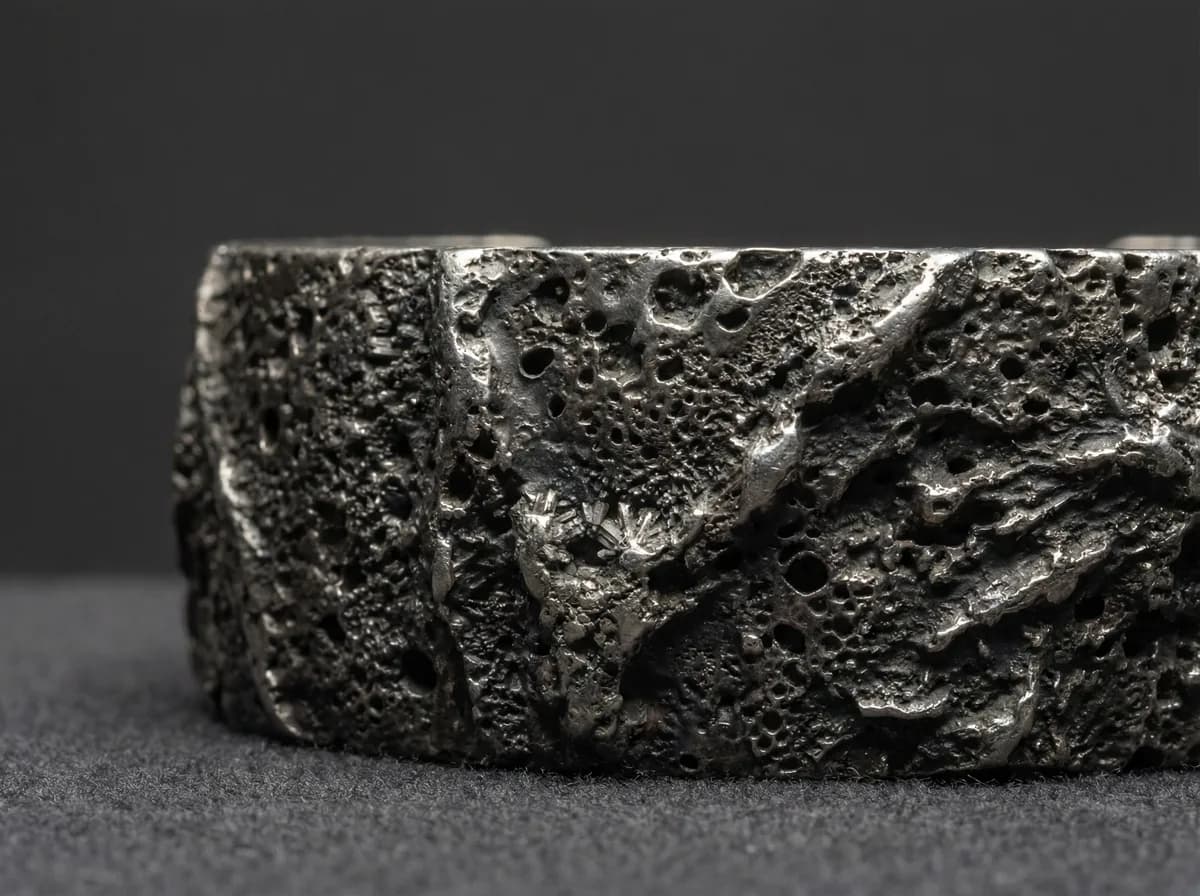
What distinguishes tufa casting from commercial casting methods is its inherent individuality. Each tufa mold can be used only once or twice before the stone’s surface begins to degrade, meaning every casting is effectively unique. The tufa’s natural texture transfers to the silver surface, creating a distinctive granular finish that collectors describe as resembling weathered sandstone. Thomas deliberately preserves this texture on the backs and edges of his pieces, considering it a signature of the process’s authenticity. The front surfaces are selectively polished to create contrast between rough-textured and mirror-finished areas, a technique that gives his work its characteristic interplay of refined and elemental surfaces.
Sand casting, the other traditional Navajo technique in Thomas’s repertoire, uses a similar principle but substitutes wet sand packed into a wooden frame for the tufa stone mold. Sand casting produces a smoother surface texture and is better suited to larger pieces — belt buckles, concha elements, and large cuff bracelets — where the tufa’s delicate surface detail would be lost at scale. Thomas employs both methods according to the demands of each design, sometimes combining tufa-cast elements with sand-cast components in a single piece to exploit the textural contrasts between the two techniques.
The economics of tufa casting impose a natural constraint on production volume. Where a commercial jeweler using lost-wax casting can produce dozens of identical pieces from a single rubber mold, a tufa caster invests hours in mold preparation for each individual piece.
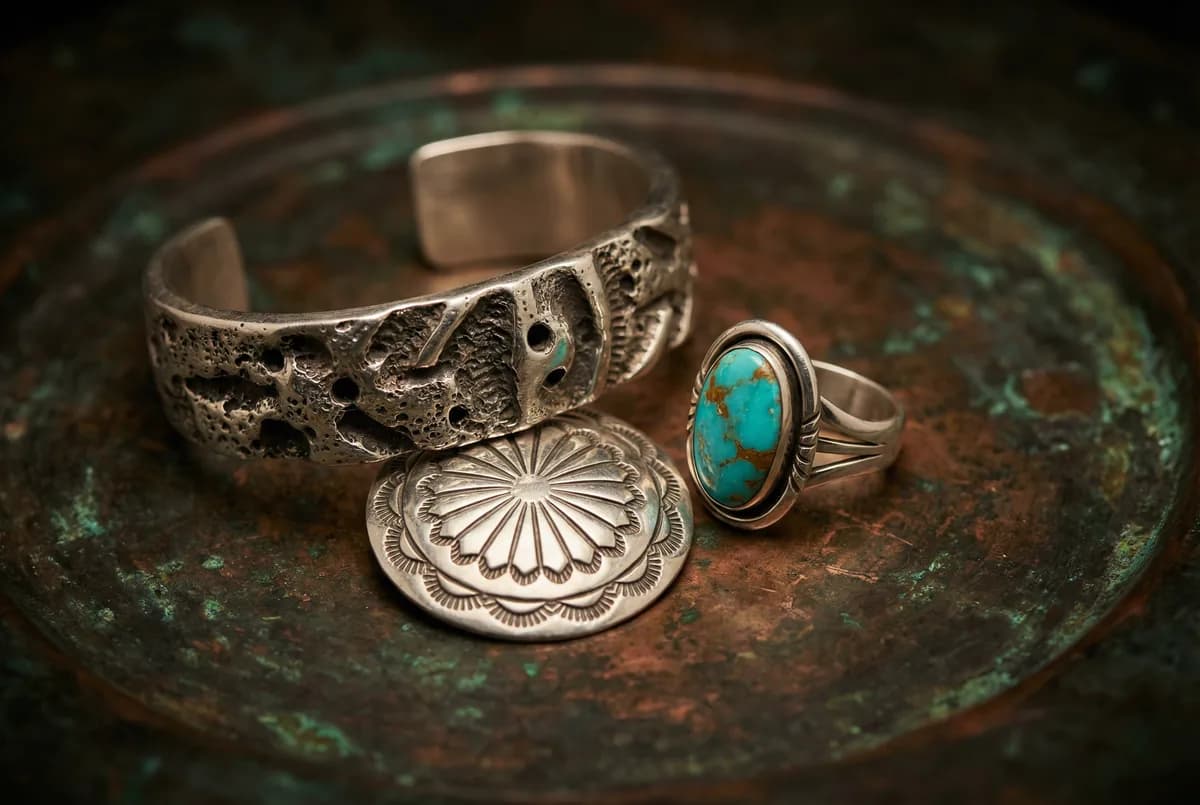
Thomas Begay treats his work as a conversation between silver and stone in which neither dominates: silver provides structure and reflective luminosity while turquoise contributes color and geological depth. He chooses each stone to suit its design, and hand-cuts bezels that hold cabochons through mechanical tension alone, without adhesive.
Thomas Begay’s material philosophy centers on a conversation between silver and stone. In this view, the silversmith’s role is not to dominate or subordinate either material but to create conditions in which both can express their essential character. The silver provides structure, weight, and reflective luminosity; the turquoise contributes color, geological depth, and spiritual resonance. A successful piece achieves equilibrium between these voices — neither the metalwork nor the stonework overwhelms the other.
This philosophy manifests in Thomas’s stone selection process. The traditional palette includes Sleeping Beauty, spider-web Kingman from the Ithaca Peak zone, Bisbee with the distinctive chocolate-brown matrix that identifies material from the Lavender Pit, and Number Eight turquoise from Nevada with its characteristic golden-brown spider-web pattern. Each stone is evaluated not merely for its individual quality but for its compatibility with the silver design it will inhabit.
Thomas selects stones the way a portraitist selects a background — considering how the color, texture, and visual weight of the turquoise will interact with the surrounding metalwork. A bold, deep blue Sleeping Beauty cabochon demands a restrained silver setting that frames without competing. A complex spider-web Kingman stone, with its own internal visual activity, pairs best with smooth, undecorated bezels and simple silver surfaces that allow the stone’s pattern to command attention. Thomas applies this principle with unwavering discipline, occasionally rejecting stones that another silversmith would consider exceptional because their character conflicts with the specific design in progress.
The bezel work — the thin strip of silver that wraps around and secures the turquoise cabochon — receives particular attention in Thomas’s practice. He hand-cuts bezel wire from sheet silver rather than using commercial pre-fabricated bezel strip, allowing him to precisely control the height, thickness, and profile of each bezel to suit the specific stone it will hold. The bezel is fitted so precisely that it holds the stone through mechanical tension alone, without adhesive. When Thomas presses the bezel against the stone using his burnisher — a polished steel tool that smooths and tightens the silver against the cabochon’s edge — the silver conforms to every subtle irregularity in the stone’s profile, creating a joint that appears seamless.
The dead pawn tradition holds a particular place in Thomas’s understanding of the silversmith’s cultural role. Historically, Navajo families would pawn their finest jewelry at trading posts during lean seasons, redeeming the pieces when circumstances improved. Jewelry that remained unredeemed after an extended period was classified as ‘dead pawn’ and could be sold by the trading post. Thomas’s grandfather would occasionally acquire dead pawn pieces to study their construction, reverse-engineering the techniques of earlier silversmiths whose names had been lost. Thomas continues this practice, maintaining a small study collection of anonymous historic pieces that inform his own work and connect him to the broader continuum of Diné metalworking.
Thomas Begay has begun teaching advanced tufa-casting techniques to two apprentices — a nephew and a young woman from the Tuba City area whose family has no prior silversmithing tradition — so that the techniques he learned from his grandfather, who learned them from his own teacher, find their way into new hands.
Looking toward the future, Thomas has begun teaching advanced tufa-casting techniques to two apprentices — a nephew and a young woman from the Tuba City area whose family has no prior silversmithing tradition. This mentorship represents Thomas’s most deliberate engagement with the question of cultural transmission that has defined his career. The techniques he learned from his grandfather, which his grandfather learned from his own teacher, must find their way into new hands if they are to survive. Thomas approaches this responsibility with the same patience and rigor he brings to his metalwork, understanding that the apprenticeship is itself a form of craftsmanship — the shaping of a silversmith is no less demanding than the shaping of silver.
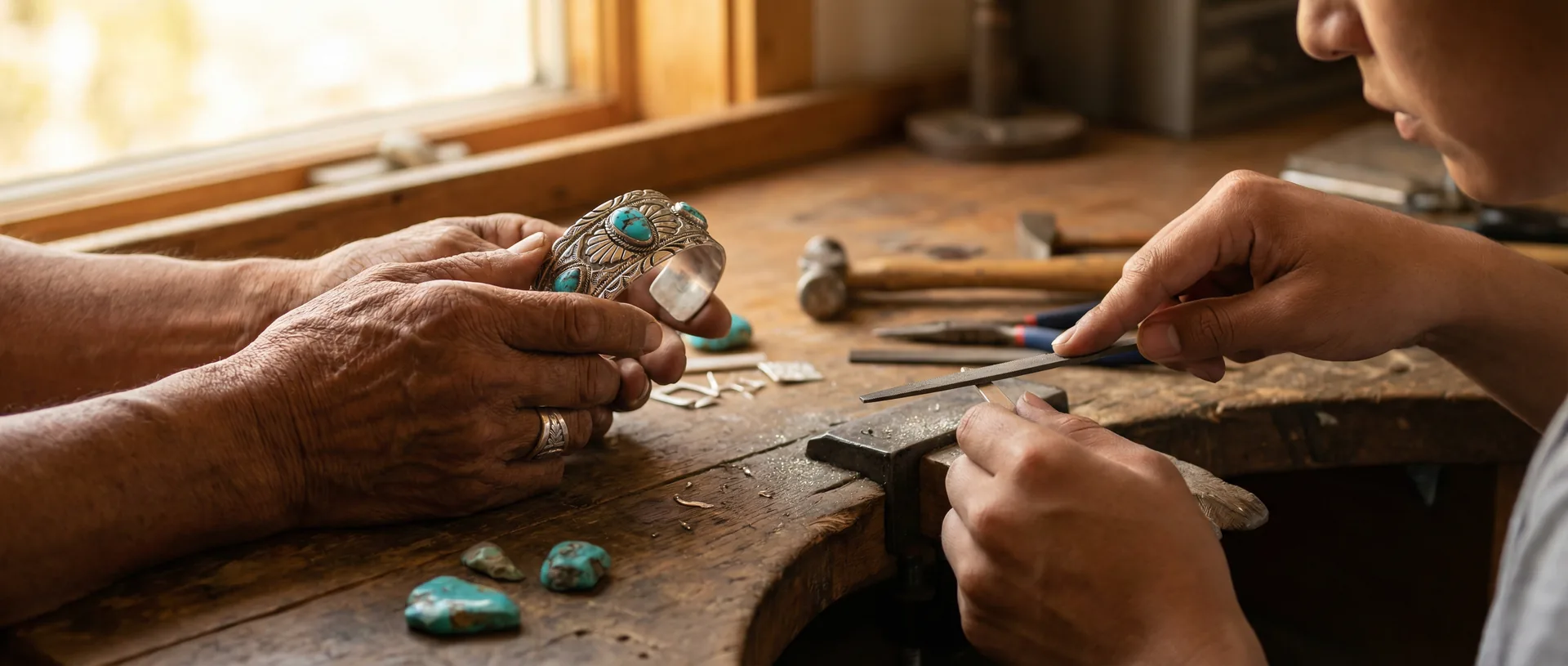
Generational Knowledge in Every Piece
Understanding the apprenticeship model and family lineages that produce the finest Native American jewelry.
Read Article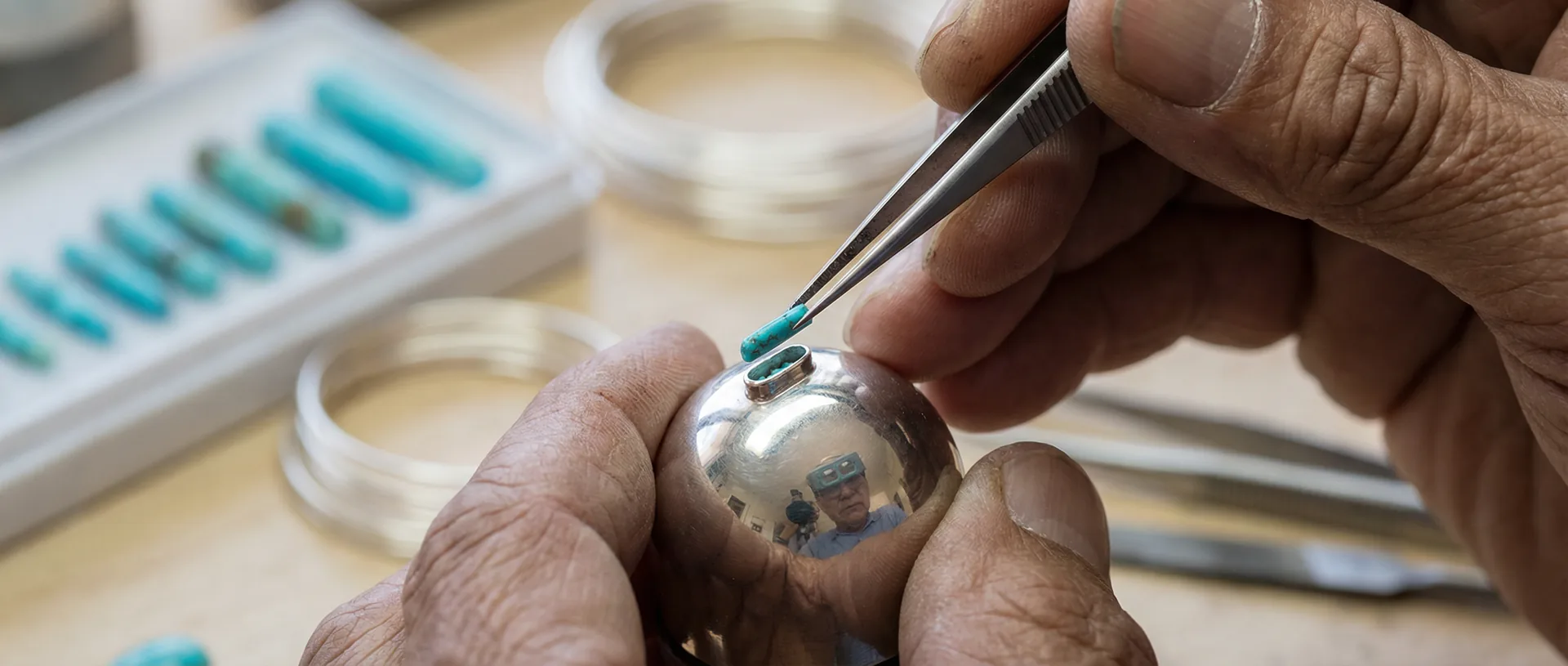
Where patience becomes beauty in the A:shiwi tradition of stone cutting
In the quiet precision of her Zuni Pueblo workshop, Lorraine Waatsa transforms raw turquoise, coral, and shell into the intricate needlepoint, petit point, and mosaic inlay patterns that have defined Zuni lapidary artistry for over a century. Her work carries forward the Zuni lapidary tradition while pushing the boundaries of what stone-on-silver composition can achieve.
Read Article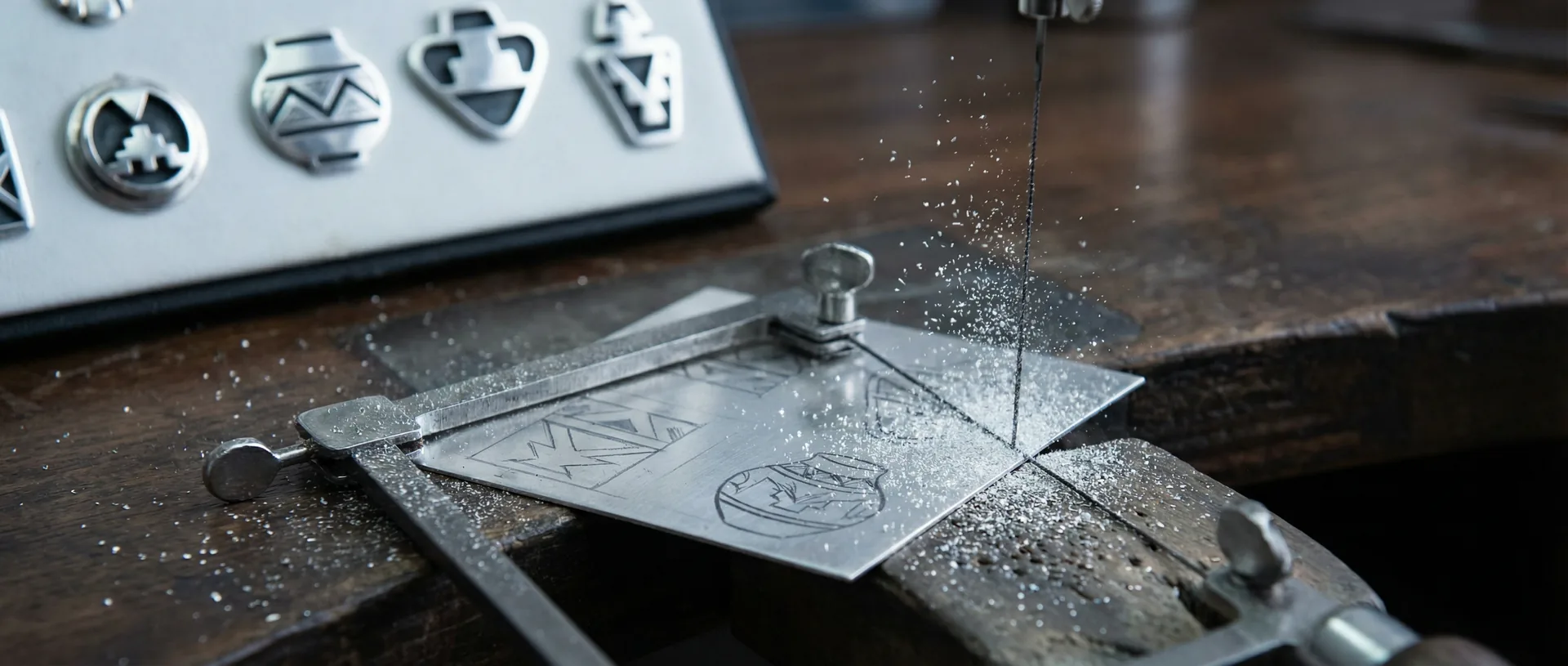
The Hopi overlay tradition as a language of prayer and cultural memory
Working from his studio on Second Mesa, Duane Tawahongva practices the distinctive Hopi overlay technique — a method in which two layers of sterling silver are fused together, with designs cut from the top layer to reveal the oxidized surface beneath. Clan symbols, water motifs, and migration patterns translate centuries of Hopituh Shi-nu-mu spiritual knowledge into wearable silver narratives that carry prayers across the secular world.
Read Article