Learn about Charoite in Native American–made and Southwestern-style jewelry: its history, geology, and care.
This collection includes Native American–made and Southwestern-style pieces; each piece's own page states its origin where it is known.
HistoryCharoite comes from a single locality: the Murun massif in the Sakha Republic of Siberia, near the Chara River that gives the stone its name. It was not described as a distinct mineral until the 1970s, making it one of the newest gemstones to enter the lapidary world.
That singular origin gives charoite a built-in scarcity. Southwestern silversmiths adopted it as part of the same modern, color-driven inlay tradition that brought in sugilite and gaspeite — a way to introduce true purple into a palette long defined by blue, red, white, and black.
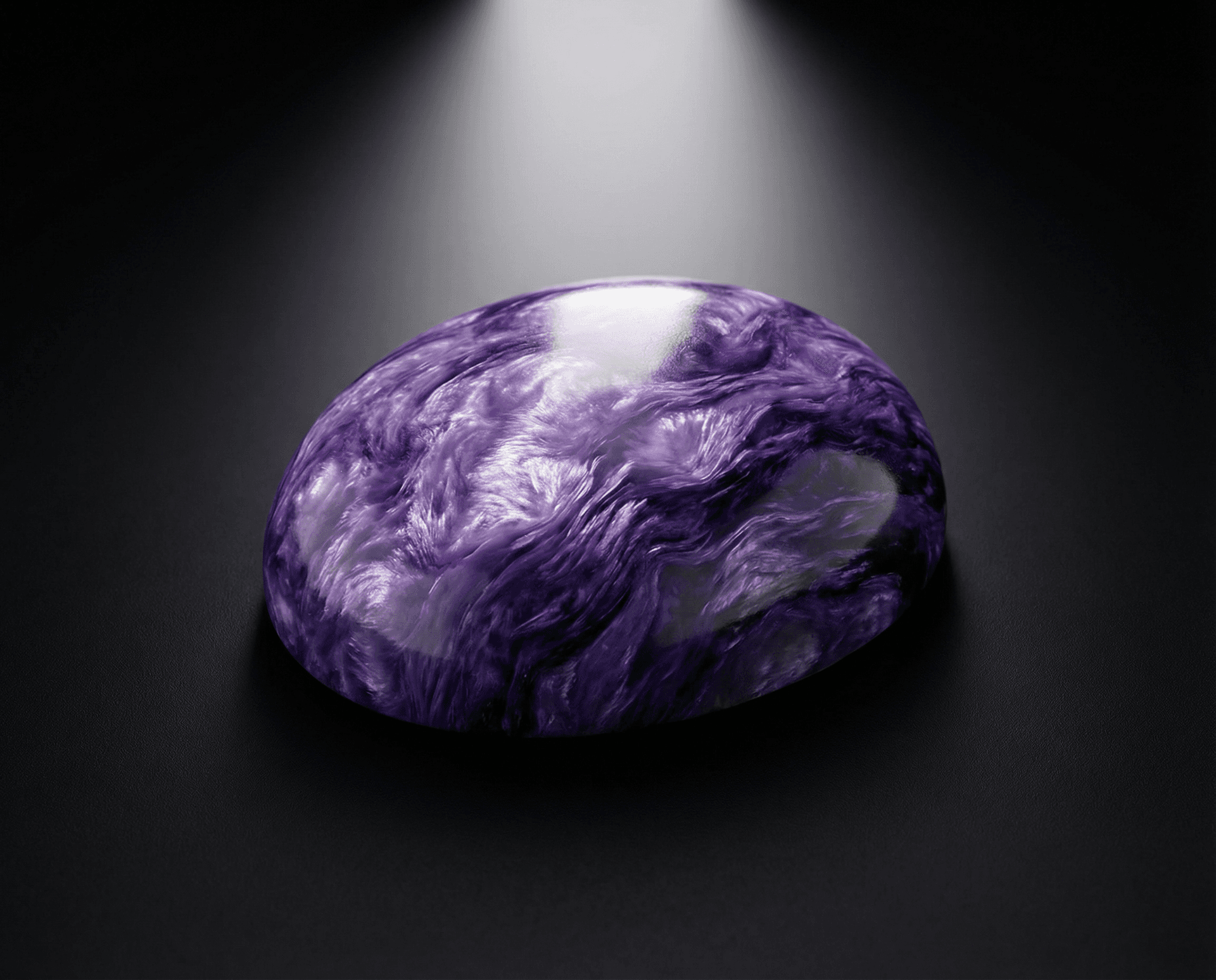
In contemporary Native silverwork, charoite is used as a feature stone or in inlay, where its marbled lilac-to-deep-purple stands apart from every traditional material. Lapidaries cut it to display the swirling pattern and the silky chatoyant sheen, often pairing it with turquoise or shell for contrast. Because the supply is limited to one mine, it reads as a deliberate, luxurious choice in a finished piece.
Charoite is a complex silicate of potassium, sodium, and calcium that formed where a mass of alkaline igneous rock altered the surrounding limestone — an unusual set of conditions that has never been duplicated at any other deposit. Its interlocking fibrous crystals are what produce the swirling, feathery pattern and the soft, silky luster across the polished surface.
At Mohs 5 to 6 it is durable enough for rings and pendants. Quality is judged by the intensity of the violet and the beauty of the swirl; the single-locality origin keeps fine material genuinely scarce.
Charoite is reasonably durable but still benefits from care. Keep it from harsh chemicals, prolonged sun, and abrasion, clean it with a soft, dry cloth, and store it separately so harder stones cannot scratch its polished surface.
This collection includes Native American–made and Southwestern-style pieces; each piece's own page states its origin where it is known.
$245.00
$2,700.00

from$95.00

$235.00

$219.00

$255.00

$255.00

from$235.00