Learn about Bumblebee Jasper in Native American–made and Southwestern-style jewelry: its history, geology, and care.
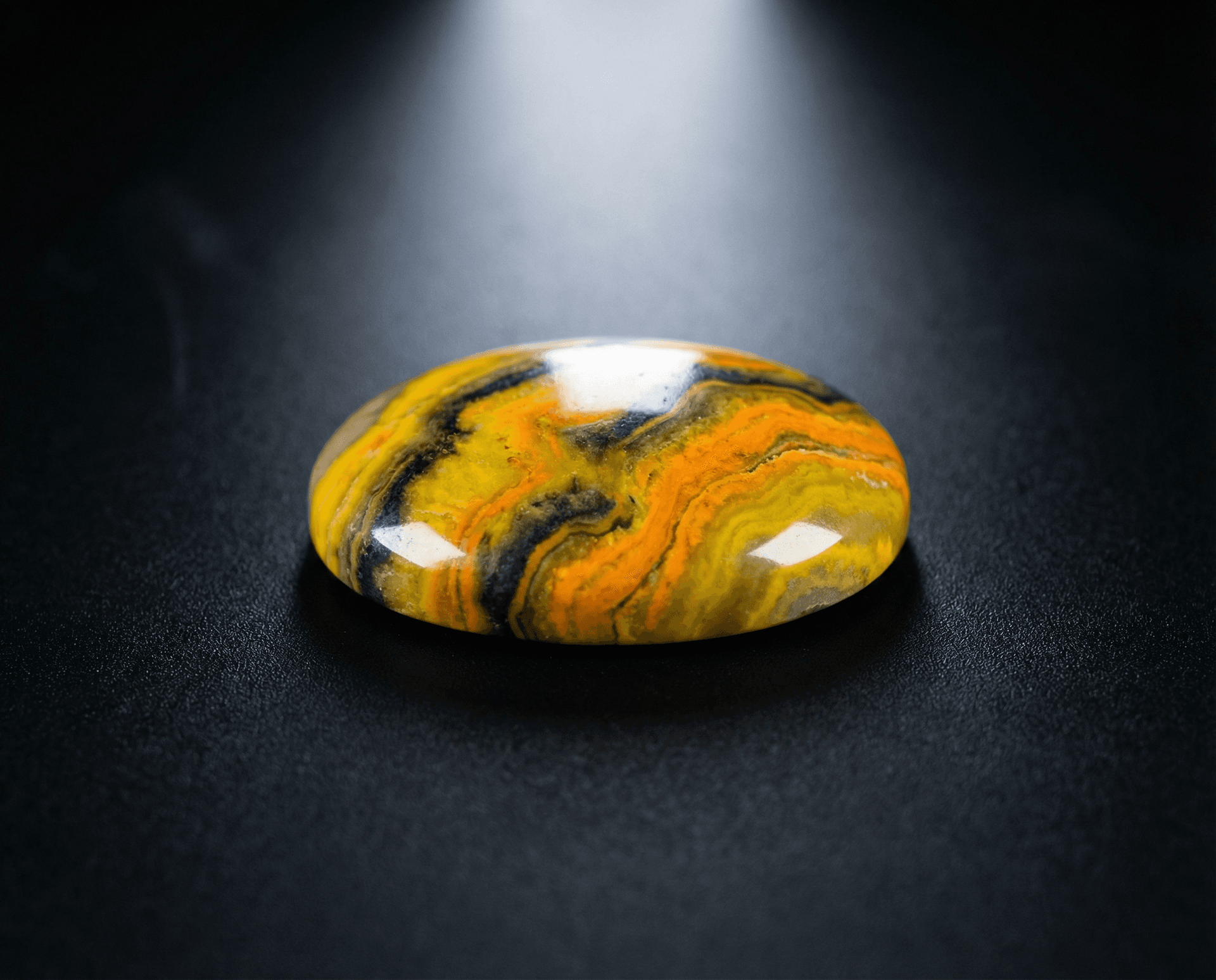
This collection includes Native American–made and Southwestern-style pieces; each piece's own page states its origin where it is known.
HistoryBumblebee jasper is a recent material, mined from the volcanic country of West Java, Indonesia, and introduced to the lapidary world only in the last few decades. Native artisans adopted it for its bold, sunny color, which stands out sharply in inlay and statement settings.
Its arrival is a clear example of how Southwestern silversmiths continually fold new materials into established techniques — taking a stone unknown to earlier generations and setting it with the same overlay and inlay skills used for turquoise and coral.
Bumblebee jasper's striking yellow-and-black bands make it a contemporary feature stone, set to catch the eye in rings, pendants, bolos, and inlay where a jolt of strong color is wanted. Because its pattern is so assertive, artists generally let a single well-cut piece carry the design rather than crowding it, often grounding the bright bands against black onyx or sterling.
Despite its name, bumblebee jasper is not a true jasper but a soft, banded sedimentary stone formed around volcanic vents, where mineral-laden gases and waters deposited successive layers. Its yellow and orange bands come from minerals including sulfur and arsenic-bearing compounds, with calcite and other material making up the matrix.
At Mohs 4 to 5 it is relatively soft, and because of its mineral makeup it is typically sealed or stabilized for use in finished jewelry; the cut, sealed stone is stable to wear, and only raw, dust-producing material calls for caution in the workshop.
Keep finished bumblebee jasper away from harsh chemicals, acids, and abrasion, clean it with a soft, dry cloth, and store it separately. As with any cut stone, handle the finished, sealed jewelry rather than raw or dust-producing material.
This collection includes Native American–made and Southwestern-style pieces; each piece's own page states its origin where it is known.

$699.00

$815.00

$235.00

$195.00

$209.00

$660.00

$470.00

$780.00