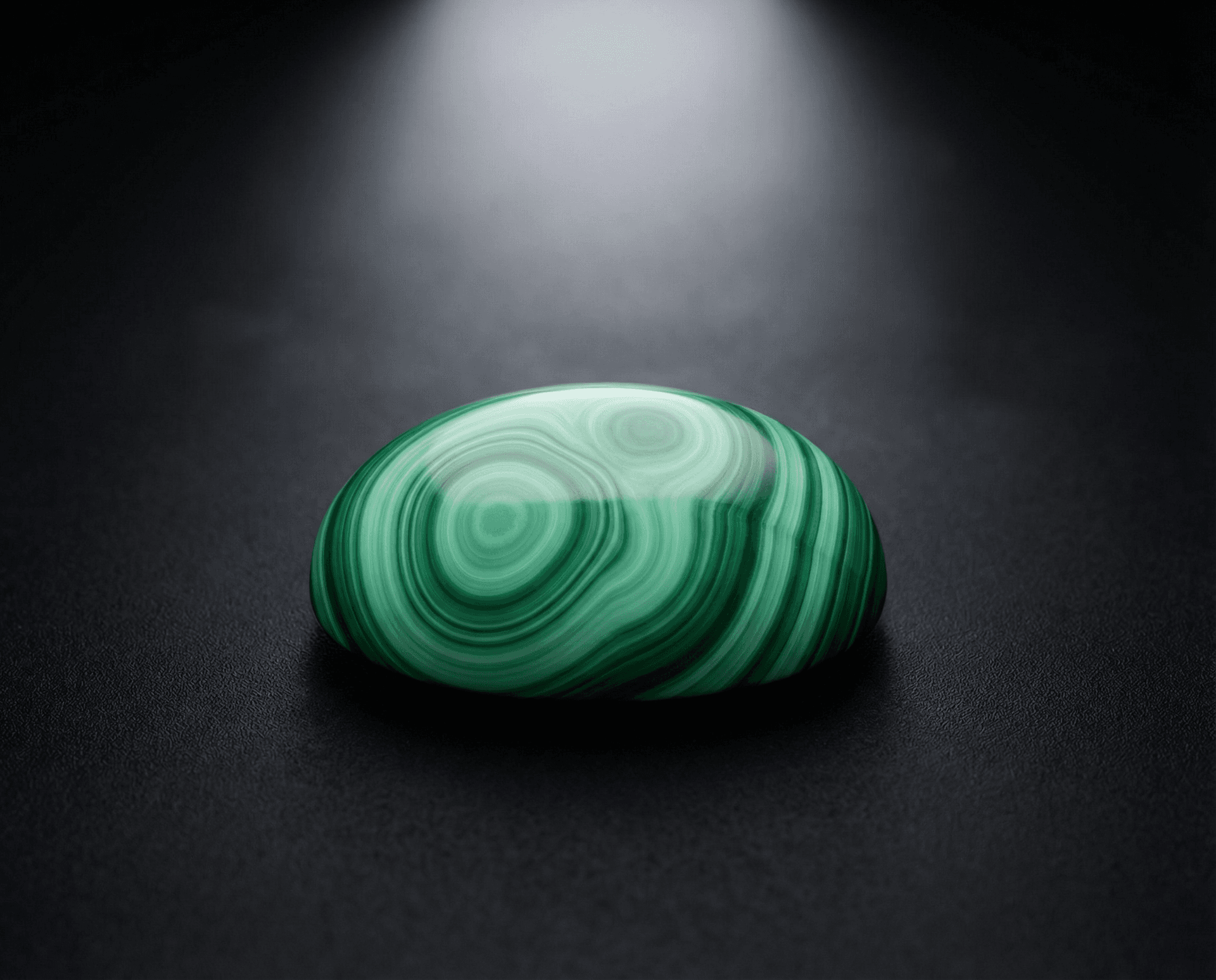
Malachite is the most vivid green in the lapidary's tray — an opaque copper mineral banded in light and dark green, each layer a record of the way it grew. Cut across its concentric rings, no two cabochons repeat, and in Southwestern silverwork that bold, organic pattern reads as a deliberate counterpoint to the blue of turquoise.
This collection includes Native American–made and Southwestern-style pieces; each piece's own page states its origin where it is known.
HistoryMalachite has been prized for nearly six thousand years, ground for the green eye-paint and pigments of ancient Egypt and carved for ornament long before it reached the modern bench. It is a stone of the great copper districts, and the Southwest sits in copper country: the same Arizona deposits that yield turquoise — Bisbee above all — have produced fine malachite as a companion mineral.
Native silversmiths fold it into contemporary inlay and feature settings for exactly the reason older cultures valued it — a saturated, patterned green that no dye can imitate. It is a comparatively recent addition to Southwestern jewelry, belonging to the era of refined channel and mosaic inlay rather than the older squash-blossom tradition.
In Zuni and Navajo inlay, malachite supplies a deep, restless green that sets off turquoise, coral, and shell, its bands giving a mosaic movement and depth. Lapidaries orient each piece to show the banding to best effect, and a single well-chosen cabochon can carry a ring or pendant on its own.
Because its pattern is so distinctive, malachite is often used where the stone itself is meant to be the subject rather than a quiet field of color.
Malachite is a copper carbonate hydroxide that forms in the oxidized upper zones of copper ore bodies, where copper-bearing water reacts with carbonate rock. It crystallizes in successive layers, and those layers — alternating in shade as conditions shifted — are what give the polished stone its signature concentric bands, bull's-eyes, and ribbons.
At Mohs 3.5 to 4 it is soft and chemically reactive: it will scratch against harder stones and etch on contact with acid, so it is cut, set, and worn with more care than quartz-family material. Its copper content is also why the dust must be handled responsibly during cutting; the finished, sealed stone is stable to wear.
Malachite is soft and reactive — treat it gently. Keep it well away from acids, household cleaners, cosmetics, perfume, and heat, none of which it tolerates, and never use a chemical jewelry dip. Wipe only with a soft, dry cloth, take the piece off before washing or swimming, and store it on its own so harder stones and silver edges cannot scratch the polish.
This collection includes Native American–made and Southwestern-style pieces; each piece's own page states its origin where it is known.

$88.00

$179.00

$149.00

$350.00