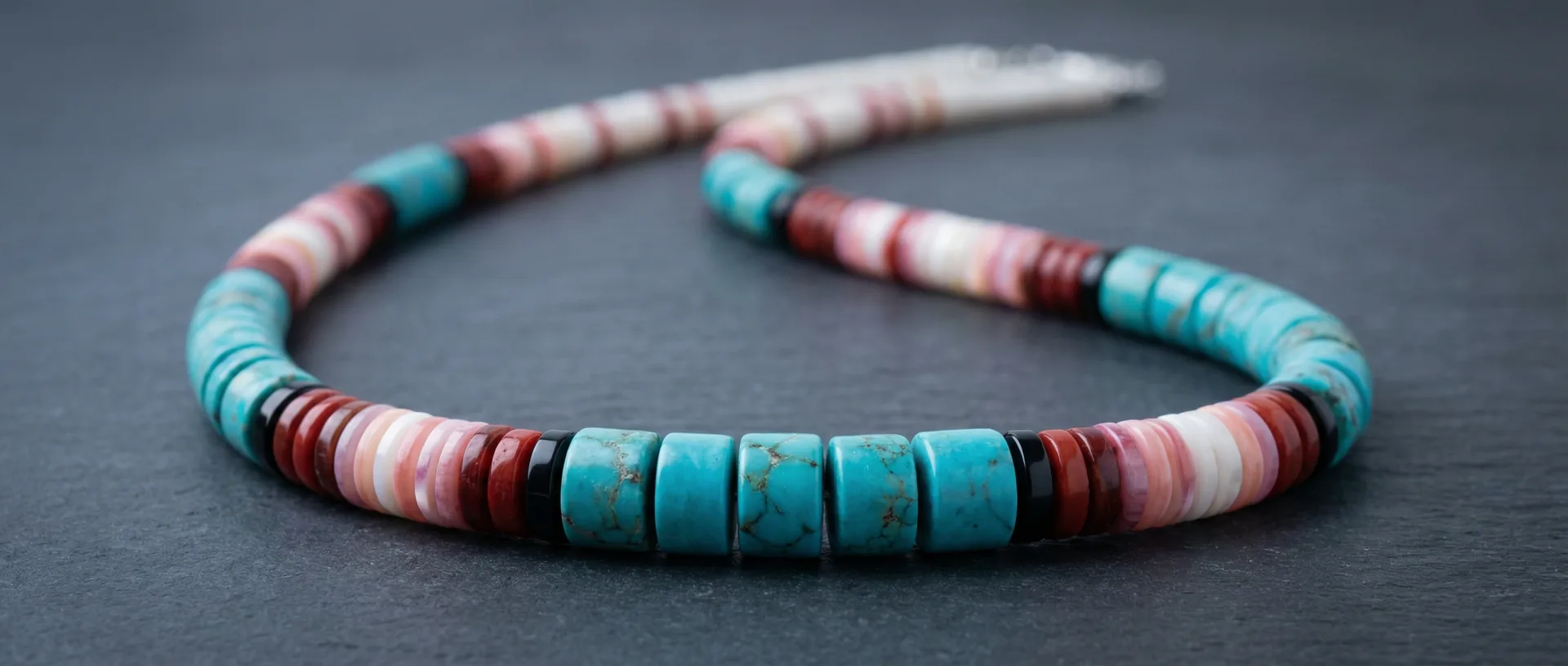
The Rio Grande's bead and mosaic masters — Kewa heishi and inlay traditions older than silver itself, hand-rolled from turquoise, shell, and jet.
Kewa Pueblo · the Rio Grande, north-central New MexicoSanto Domingo Pueblo, known by its traditional name Kewa, sits along the Rio Grande between Albuquerque and Santa Fe. One of the most traditional of the Rio Grande communities, the Kewa have kept ancient customs intact while becoming the Southwest's preeminent makers of beads and mosaic jewelry — a reputation earned over centuries and renewed at every Indian Market.
Kewa jewelry predates the arrival of silver by a very long time. Long before metalworking reached the Southwest, the ancestral Puebloan peoples of this region were drilling and shaping shell and turquoise into beads, and at Kewa that lapidary inheritance never faded. The pueblo's defining art forms — heishi and mosaic inlay — descend directly from this deep tradition, making Kewa work some of the most ancient continuously practiced jewelry-making in North America.
The early twentieth century brought both hardship and ingenuity. During the Great Depression, when fine turquoise was scarce and cash scarcer, Kewa artisans created the celebrated "thunderbird" or Depression-era necklaces, ingeniously composing mosaic figures from whatever was at hand — fragments of black phonograph records and battery casings for the dark ground, gypsum and bone for white, and bits of turquoise, jet, and red plastic for color, all mounted on backings cut from old 78-rpm discs. These resourceful pieces are now collected as folk-art treasures.
Today Kewa remains synonymous with the finest hand-rolled heishi and bold mosaic and multi-strand necklaces, its families among the most respected bead-makers and lapidaries in Native art.
That standing was hard-won and is jealously guarded. Kewa families have specialized in beadwork and mosaic across many generations, and the pueblo's reputation rests on a collective insistence on quality that has held for well over a century. Even as tastes and tools have changed, the core of the tradition — true hand-rolled heishi and finely fitted mosaic — has remained the benchmark against which bead-work across the Southwest is measured.
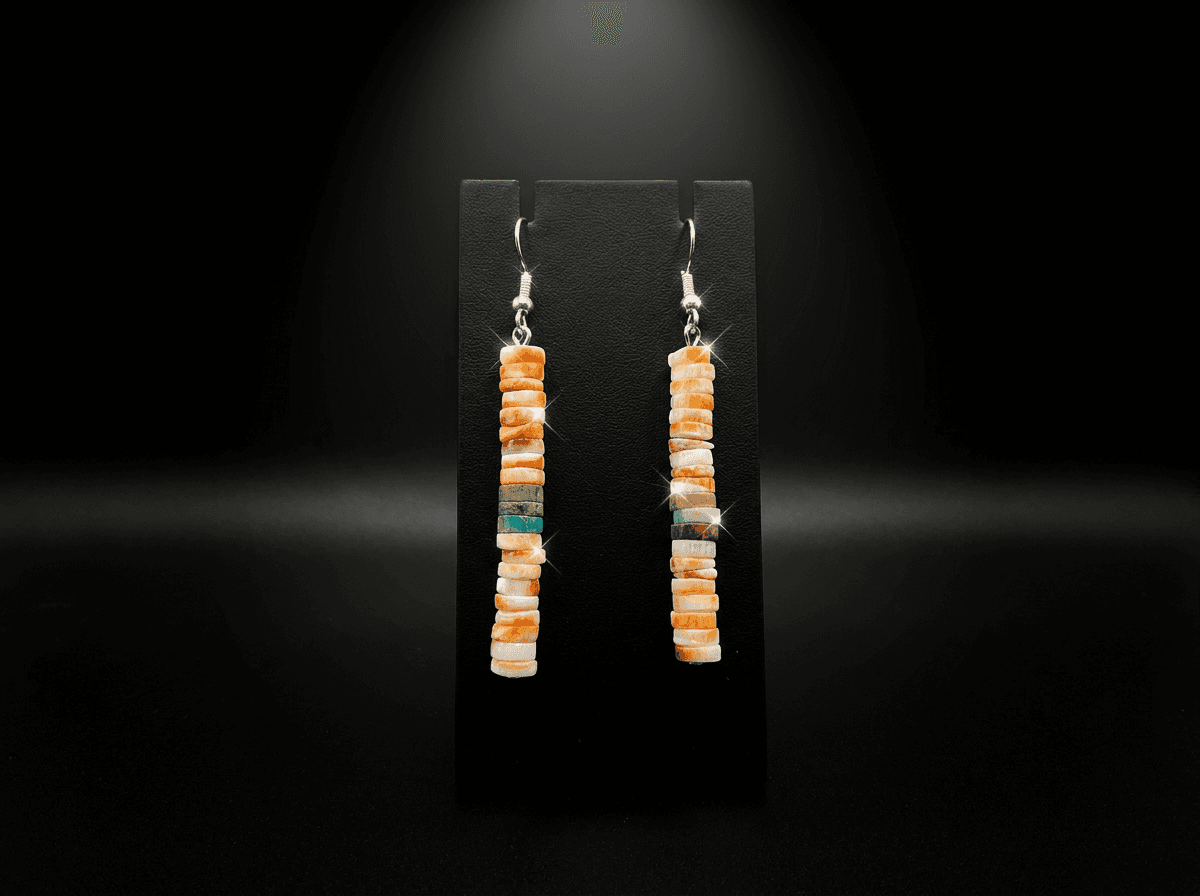
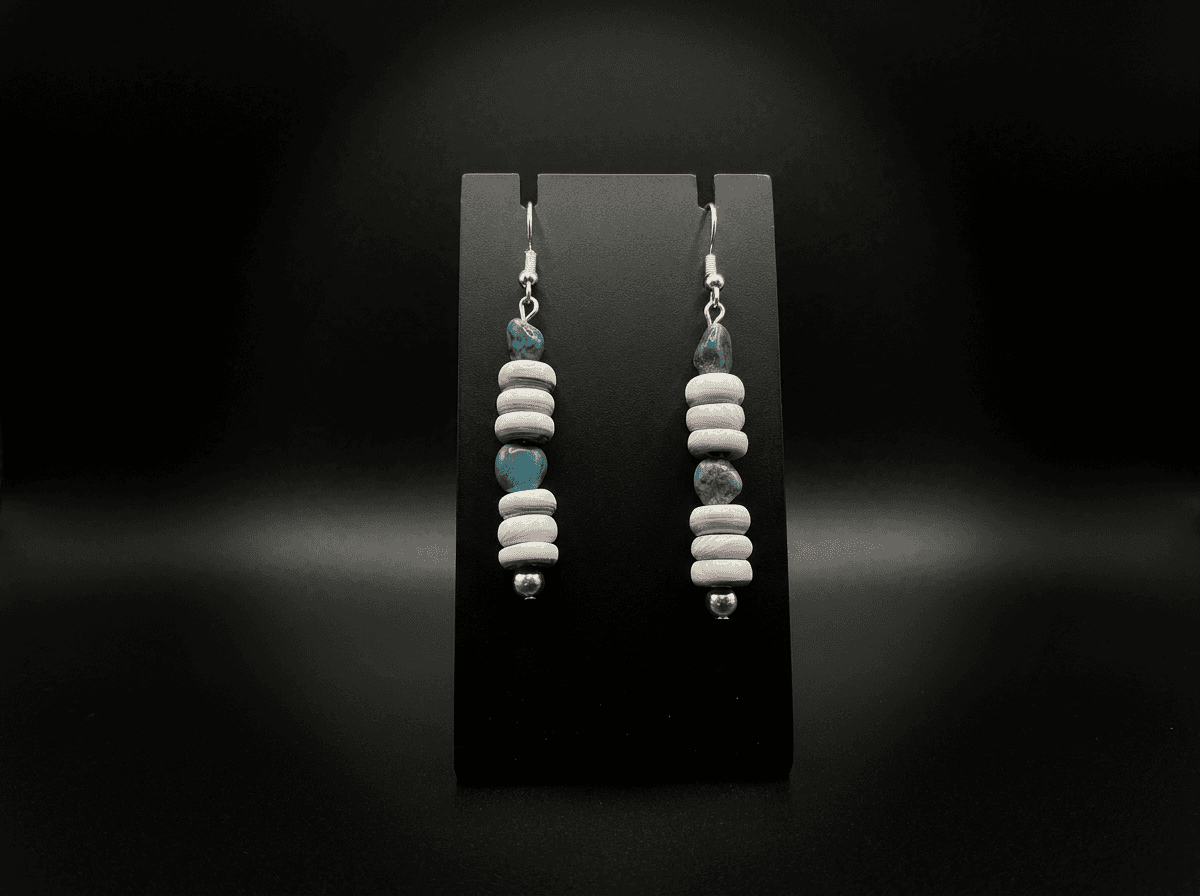
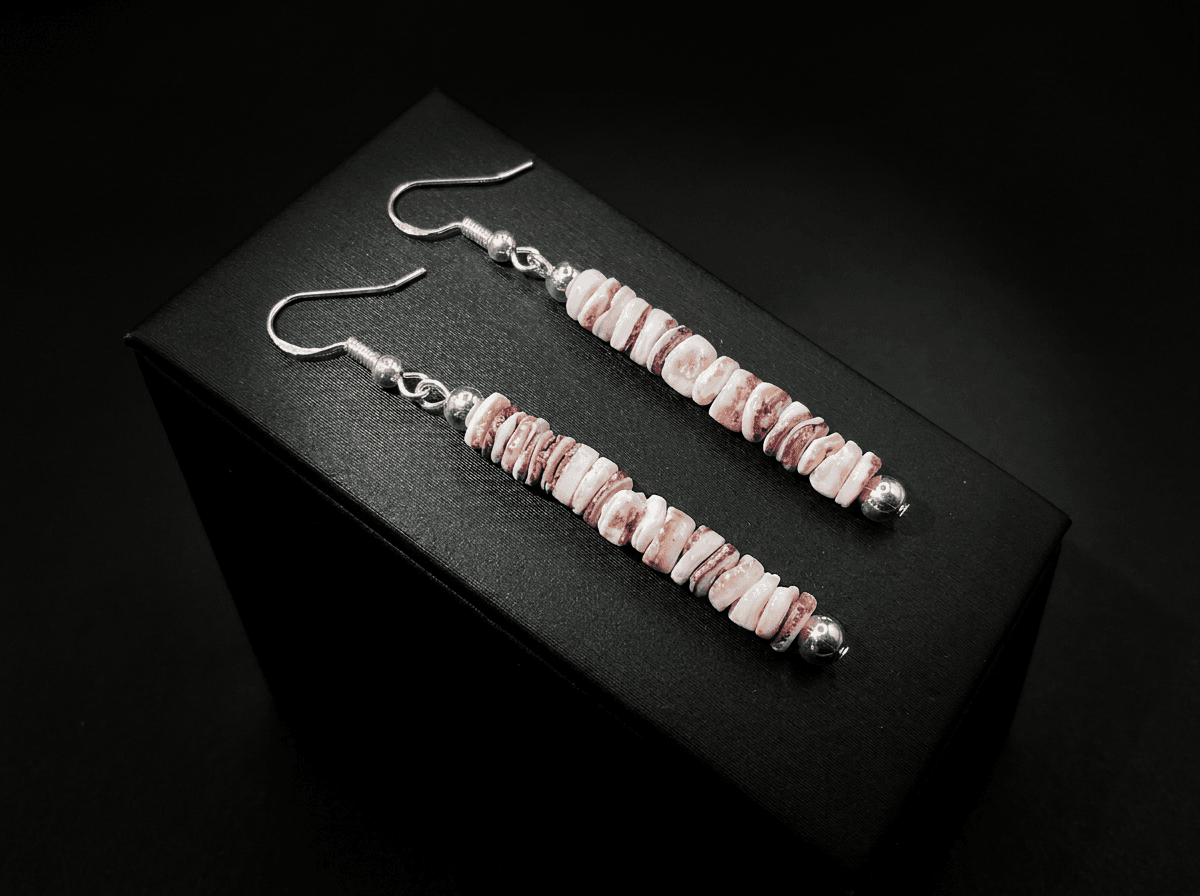
Kewa jewelry is built bead by bead. Heishi — from the Keres word for shell — are tiny, hand-rolled disc beads ground from shell, turquoise, coral, jet, and other natural materials, strung into strands of remarkable smoothness and uniformity. Fine heishi flows like liquid against the skin, the mark of hundreds or thousands of individually shaped beads; the finest strands taper and graduate so subtly that the eye reads them as a single supple line.
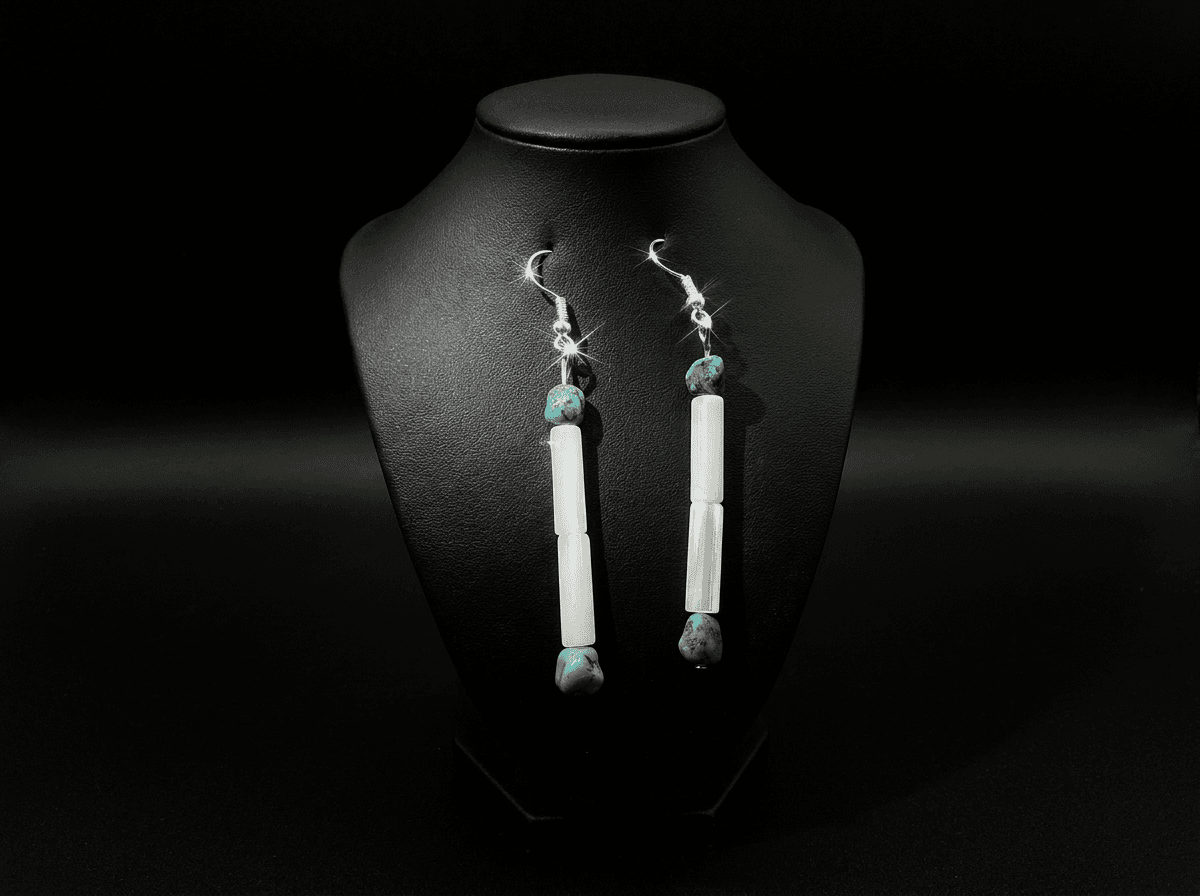
Alongside heishi, Kewa artisans are renowned for mosaic and "depression" inlay, fitting cut stones and shell onto backings of shell, jet, or silver to build geometric and figurative designs — the thunderbird being the most famous. Tab necklaces and jaclas (the small turquoise loop earrings often tied into a necklace) carry older forms forward, while bold multi-strand necklaces combine large turquoise nuggets and branch coral with heishi for dramatic, sculptural statements.
This is jewelry of profound patience — quiet in technique, striking in effect, and rooted in one of the oldest unbroken craft traditions on the continent. Even the simplest Kewa strand represents an extraordinary investment of skilled handwork.
The forms reward knowing. A graduated heishi necklace tapers from larger beads at the center to the finest near the clasp; a jacla preserves the old turquoise loop-earring shape as a pendant; a tab necklace hangs flat-cut slabs of turquoise and shell; and a mosaic or thunderbird piece composes color into figure. Across all of them, the Kewa aesthetic prizes the natural beauty of the material and the fluid, living drape of a strand over any excess of ornament — restraint and richness held in balance.
For the Kewa, jewelry-making is both a livelihood and an inheritance carried within families across many generations. Children learn to drill, roll, grade, and string beside their elders, and the pueblo's reputation rests on a communal standard of excellence sustained over centuries. Kewa is also one of the most private and traditional of the pueblos, and its people guard their ceremonial life closely even as their jewelry travels the world.
Kewa artisans are celebrated, too, for resourcefulness and adaptation — the Depression-era thunderbird necklaces stand as a testament to creativity under hardship, transforming whatever was available into objects of lasting beauty. That ingenuity, married to deep traditional skill, remains a point of pride and a hallmark of the pueblo's art.
Kewa makers are a constant, respected presence at the Santa Fe Indian Market and other juried shows, where their strands are sought by collectors worldwide. Humiovi presents Kewa work as the product of this living, family-rooted tradition, honoring the makers and the centuries of skill behind every strand.
Because Kewa is among the most private and traditional of the pueblos, much of its inner life is closed to outsiders, but its jewelry has long been the pueblo's open hand to the world — a way of sustaining families and carrying Kewa skill far beyond the Rio Grande. Every strand bought honors both the maker and the community that produced the maker.
Heishi-making is exacting handwork. The maker breaks shell or stone into small fragments, drills each through the center — historically with a hand-spun pump drill — then strings the rough pieces tightly onto a cord or wire and grinds the entire strand against a stone or wheel until the beads become uniform discs. A final polish brings the strand to its smooth, fluid finish. A single fine necklace can represent days or weeks of labor, and the smoothness and consistency of the beads are the measure of the maker's skill.
Mosaic and depression inlay call for precise cutting and fitting. Stones and shell are shaped and set tightly against one another on a prepared base, the seams kept fine so the surface reads as a continuous design. Color is composed deliberately — turquoise against spiny oyster, jet against white shell — for contrast and rhythm, with the thunderbird and other figures built up piece by piece.
Even contemporary Kewa makers who adopt modern rotary tools preserve the hand judgment that distinguishes the tradition: the eye for proportion, color, and the satisfying drape of a well-made strand, and the patience to roll true heishi by hand when machine-cut beads would be faster.
The smoothness and consistency of the beads are the truest measure of a strand. Run fine heishi through the fingers and it should feel almost liquid, with no rough edges and only the faint, organic irregularity that proves a human hand shaped each disc. That tactile quality — the result of patient grinding and grading — is precisely what distinguishes genuine Kewa heishi from the uniform, glassy beads of machine manufacture, and it is why collectors will pay far more for a hand-rolled strand than for its mass-produced imitation.
Authenticating Kewa jewelry rewards a close look at the beads. Genuine hand-rolled heishi shows the subtle, organic uniformity of handwork — smooth to the touch, gently graduated, with a faint irregularity that machine-cut beads never have. Perfectly identical, glassy beads, or "heishi" of dyed reconstituted block, indicate mass production rather than Kewa handwork. True mosaic and thunderbird work shows fine seams and natural stone and shell with real depth.
Materials should be natural: turquoise, spiny oyster, coral, jet, and genuine shell. Ask whether turquoise is natural or stabilized, and whether shell and coral are real. Older thunderbird necklaces, with their characteristic record-and-battery materials, are collected as historic folk art and should be represented honestly as such.
Kewa work is most often sold by the artisans and their families, and the pueblo's makers are well known at Santa Fe Indian Market and other juried shows. The Indian Arts and Crafts Act of 1990 protects work marketed as Santo Domingo or Kewa-made. Each Kewa piece at Humiovi is genuine, artist-made work and arrives with a Certificate of Authenticity for you to keep. We are happy to share what we know about the maker and the materials in any strand.
$295.00
$165.00
$300.00
$185.00
$185.00
$185.00
$185.00
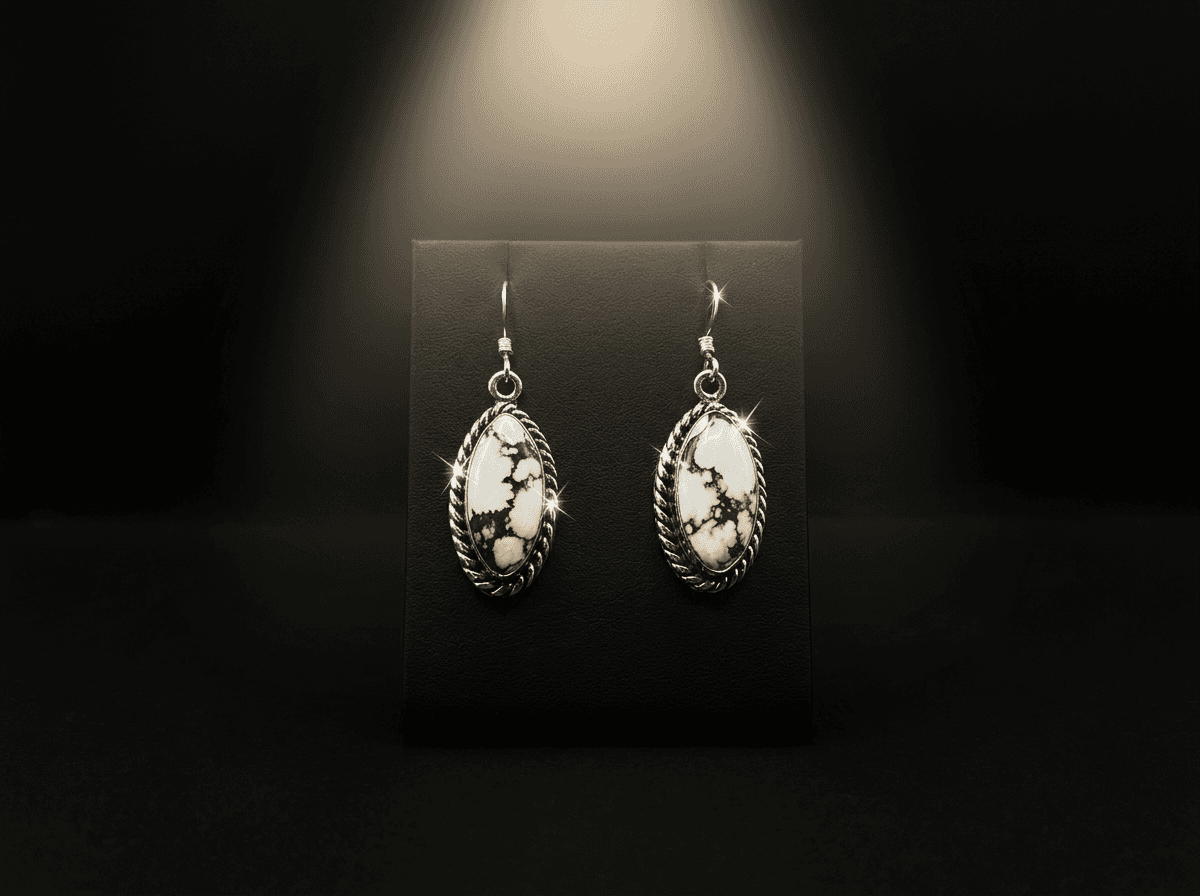
$255.00